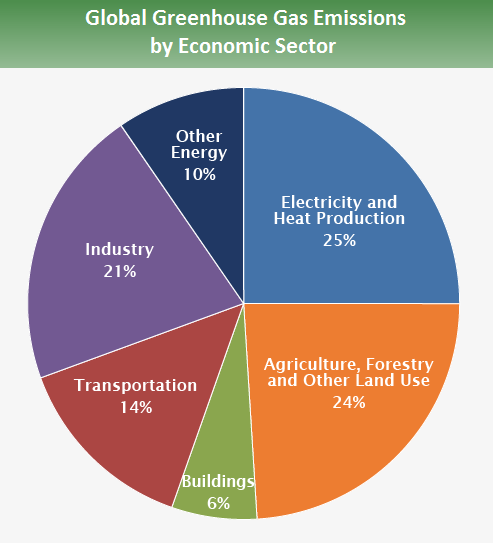
For those who didn't read the article: the chemistry of Portland cement works against it. Production requires heating the calcium carbonate to a high temperature to extract carbon dioxide from it. Which obviously produces large amounts of CO2 proportional to concrete production. However, concrete also absorbs carbon dioxide from the air over its lifetime. So the measured emissions aren't the entire story.
Perhaps in future we will consider this an excellent source of carbon dioxide for the production of various hydrocarbons. I've heard of several efforts to create octane using carbon dioxide from the air, but you need a large amount of energy to extract a useful amount of CO2. Well this would be a good source of high concentration CO2. Perhaps not for octane ( we should really be moving away from combustion engines ) but perhaps plastics and other products that are currently derived from crude oil.
I don't know which country you have in mind but in Europe the construction industry by law is obligated to design concrete structures for residential buildings that ensures a useful life of at least 50 years, and by definition that means that the building structure shall not require maintenance for at least 50 years.
Moreover, concrete as a widespread structural material is relatively new, and city centers are still packed with contrete buildings that were built when the technology started popping up.
In fact, in general a building with concrete structure is only demolished when it's not possible to retrofit or renovate it effectively, due to unrelated reasons such as increasing occupation density that would not be cost-effective by reinforcing the concrete structure.
My point is that concrete structures are not demolished with enough frequency to be of any concern. The main reason is that concrete structures are simply too expensive to be demolished, moreso in urban centers. Thus your concern simply isn't relevant in the real world because economics already impose the same restrictions that are expressed in your environmental concerns.
Turning the cons of concrete into pros (carbon-cured concrete) https://www.vttresearch.com/en/news-and-ideas/turning-cons-c...
>carbon-cured concrete: in carbon curing, concrete is cured with gaseous carbon dioxide, from the plastic phase forward. The curing of concrete with pressurized carbon dioxide generates not only the ordinary reaction products of cement but also carbonate-based reaction products. Consequently, the process binds carbon dioxide, and it is even possible to make the final product carbon negative if ordinary cement is replaced with alternative binders with a low carbon footprint.
The Carbon Reuse Economy: Transforming CO2 from a pollutant into a resource https://cris.vtt.fi/en/publications/the-carbon-reuse-economy...
The alternative is to build from wood whenever possible, and capture extra cabon in building material. This increases market need for wood and therefore forestation.
My parents live in a house that was originally built in the 1890s. It first had a fire place and wood stove for eating/cooking (surmised via chimneys), then it had gas lighting (some pipe are still in the walls), then it knob-and-tube lighting, then modern electrical lighting and cooking.
Walls were replaced, insulation added, etc. Lots of internal changes.
But the foundations and external brick is original (AFAICT).
Buildings are just boxes for people which keep the cold/heat/moisture at a comfortable level. As long as the "bones" of the buildings are good seismically, the "skin" has proper environmental control, then you can shuffle the inside around without too many issues.
Design/build things with minimal internal load-bearing walls and things can be shuffled fairly easily. Perhaps also use trusses instead of rafters as well for easier running of piping/wire.
At least a fifth of the UKs housing stock is over a century old, so the answer to that question is yes, if they're built properly...
The house where I grew up was made before Portland came to our zone, so it was made of lime mortar and rocks, some of them as big as a mellon, I found out when I tried to drill the walls to put a basketball basket.
It was demolished in the eighties, but not because it was in bad shape. I met the bulldozer operator years later and he recalled how he had a hard time with it.
I'm sure it would have been fine today, when it would be 100 y.o. or close. And I'm sure there's no other place where I'd rather live. It was cool in the summer, easy to warm in the winter, no mold, little noise from the outside.
Obviously, we do.
To put it in terms that may be easier to understand, we do not want to demolish a building when it serves all functional requirements.
Double so if they have urban and cultural value.
I suggest you visit places such as Amsterdam, where most of the city center was built in the 17th century and it's glorious.
I don't want a new house. Why? Because I refuse to live in a house with no natural ventilation. Most modern houses need air condition or at least ventilation systems, because they need to be so energy efficient, that there is no other way to get fresh air in. The fact that a house needs to be pressure tested seems insane.
Sure you can leave the windows open, but that defeats the purpose. Modern home needs to be ventilated three times a day, that means opening all the windows in the morning, when you get home in the afternoon and before going to bed. How many people will remember to do that?
The air in a modern home is often so dry that my nose start running the minute I enter. I don't want to live in that sort of climate.
Depending on the country, I think people should aim for home built from the late 1940 to mid 1970. Most likely additional isolation and new windows have been added over the years, making them reasonably energy efficient.
Now the thing is that I like old houses.
So, just pay a nice marketing team to make sure people love old houses (after all, we have marketing team that can sell poison such as cigarettes or carbon dioxide).
Or, as you said, just build with something easier to handle such as wood (provided you recycle it, else it'll go back to biomass, releasing its CO2 again)
It’s something of a design failure of modern buildings where walking outside when it’s 80f is pleasant but inside you need AC at those temperatures.
The citation for this claim doesn't seem very robust. It links to the Ellen MacArthur foundation website, but just to the front page. After some of my own Googling it looks like it's coming from this publication [1]. This study drew up some estimates on the amount of textiles produced and discarded as well as a simple conversion of 4.7 Kg of CO2 for every Kg of textiles produced. The source for this ratio of CO2 to kilogram of textiles simply says "McKinsey Analysis"/
1. https://www.ellenmacarthurfoundation.org/assets/downloads/pu...
Say Australia digs up some coal, ships it to China, it’s used to power factories and smelters to produce goods, then those goods are shipped to and used by Americans. Is there consensus on who the pollution from burning coal gets tied to? Or does it vary per report and article?
- Scope 1 emissions are direct emissions from owned or controlled sources. - Scope 2 emissions are indirect emissions from the generation of purchased energy. - Scope 3 emissions are all indirect emissions (not included in scope 2) that occur in the value chain of the reporting company, including both upstream and downstream emissions.
So grain purchased and shipped to the animals is measured under Scope 3. Powering the lights and machinery on the farm is Scope 2.
It's tricky and inexact to do GHG accounting, but the same methodology and emissions factors are used everywhere so at least it's comparable between companies and products.
Cattle produces a lot of methane, which has a very powerful greenhouse effect, a lot more powerful than CO2. So while it does not contribute to CO2 emissions that much, it contributes to the greenhouse effect proportionally a lot more.
We'll clearly have to use something else for building moon bases.
Co2 is released in the production of cement (in cement factories). Once it’s used in the buildings it actually sucks back some of that co2 back during the first years.
In biosphere cement was actually a carbon sink, but it threw the system off balance, because it caused bacteria to eat more oxygen than expected.
Also, as pointed out below, the "fashion industry" includes all clothing. Beyond food and water, I'm not sure what would be more necessary than clothing.
I suspect cheap, disposable clothing is driving much more emissions.
Using CLT (and passive house principles) can reduce the total CO2 emmissions of a house by 90% in its total life span. The wood in CLT stores carbon and the passive house principles reduces energy needs.
For those unfamiliar with CLT, this is a high tech building material suitable for making e.g. sky scrapers or other types of buildings. It's much lighter and stronger than concrete. Because it is lighter, you save a lot of fuel transporting it. It's fire resistant and rot resistant because it is chemically treated. It's also much easier to work with as you can drill, glue, saw, etc. it. Additionally, you can do this off site meaning actual onsite construction activities are a lot more straight forward, less noisy, and much less wasteful. Think Ikea for buildings.
To sketch you a picture of how awesome this stuff is, the Japanese are planning to build a 1100 feet skyscraper made of wood, steel, and clt in Tokyo, which is of course a city that regularly sees earthquakes and tropical storms. https://www.archdaily.com/889142/japan-plans-for-supertall-w....
The biggest challenge is going to be simply scaling the production of this material and transitioning the construction industry to mostly using this instead of concrete. Right now it's kind of a novelty / niche thing and it is going to take a while to reach efficiencies and economies of scale we have with concrete today. It's not exactly cheap (yet) but it could become cheaper long term; especially if you consider all the benefits (technical and environmental).
There's also a report[3] about a glulam burn test, something I was quite curious about.
[1]: https://www.moelven.com/mjostarnet/
[2]: https://en.wikipedia.org/wiki/Mj%C3%B8st%C3%A5rnet
[3]: https://www.moelven.com/mjostarnet/glulam-can-withstand-a-bu...
With rigorous humidity and temperature regulation, some adhesives have an as-yet undetermined lifespan. I'm still looking for transportable passive designs without active mechanical assistance that keep humidity at or below 40% and temperature variation to within ±10° C in temperate zones.
[1] https://www.bhhomeinspections.com/building-materials-life-ex...
[2] http://www.woodcentral.com/woodworking/forum/archives.pl/bid...
"passive designs without active mechanical assistance" - do you mean passive (highly insulated, air tight) designs without mechanical ventilation?
Cement ball mills are less than 1% efficiency.
https://en.wikipedia.org/wiki/Cement_mill
Having done two postdocs in the field i can tell its not progressing very fast...
If it's cement, you presumably can't count 'construction' as it would be double-counted. Do you count an iPhone just during production? Or do you include shipping? If you include shipping, you can't have 'cargo ships' as it's own category.
Concrete might look very different in 25-50 years.
True more like it looked in 150 BC:
Let’s say we take cement out or drastically reduce it. Where does co2 sit in increased consumption of viable alternatives.
Does this not cancel out the effect of making the cement in the first place? And if not, why not?
Would love to know if anyone has a good understanding.
A largely overlooked issue with the idea of concrete absorbing CO2 is exposed surface area. Imagine a hydro dam, one side is saturated with water, the other side is air. The dam is also usually quite thick, several meters to hundreds of meters. That really limits the available absorption surface especially considering the ratio of surface area to volume. Concrete foundations, epoxy coated parkades, even painted surfaces start to drastically reduce the possibility of CO2 being absorbed.
Think of concrete like a membrane or a sponge. The thicker the membrane you want to pass a fluid through, the higher the pressure you would require. So using our pressure as atmospheric, getting a high depth of CO2 absorption requires a well connected pore structure, and a long time frame.
Add to this membrane metaphor the issue of size. We design concrete structures to prevent fluid transfer, especially hydro dams! H2O is a smaller molecule than CO2, and the static pressure on the ‘wet’ side of a hydro dam increases 1 atmosphere every 10m.
As concrete sets and gains strength, its porosity decreases. This process happens rapidly in the first few days, and only ever stops when the cement runs out of free water to absorb. CO2 absorption depth is a pretty common test when evaluating a structure for rehabilitation purposes (carbonation dept testing) as CO2 will mess with the concrete PH and corrode reinforcing steel which (depending on many factors) can be as shallow as 5cm from the concrete surface. I’ve seen structures with up to 5cm of depth, but that is outside of the norm. 1-2cm of CO2 absorption depth for a structure from the 50’s is pretty common in my area.
Modern concrete, through many different means, has a highly disconnected pore structure (compared to the concrete of the 50’s). New concrete, is designed to reduce any type of fluid transfer especially after the first few days of curing. This will reduce the depth of CO2 absorption further.
So bringing this all back together, consider the absorption depth of 2cm, a structure with minimal exposed surface area, and some sort of coating or cladding… and you very quickly realize that you are not going to be off setting CO2 production outputs by any significant margin, and its not in your best interests either.
And agreed that surface area would effect the rate of absorption. I understand it can take hundreds of years for concrete to fully harden, which I could see being effected surface area and ability of the material to breath.
http://www.constructionphotography.com/Details.aspx?ID=14133...
Opentopomap: https://opentopomap.org/#map=13/46.93620/11.45582
I have to wonder why we are still looking for new ways to employ Portland cement at this point, over alternatives. You can, I’m told, reduce the footprint of clinker a bit with fly ash, but you get that mostly from coal, so it’s splitting the “savings” with an equally problematic cousin, and at any rate that supply should be in steady decline now, although I guess we discovered the Tennessee Valley Authority has stockpiles of the stuff when they lost one of them a decade or two ago.
I am not an American but I am not sure I have even seen a paver made from brick now that I think about it. I suspect the larger a brick is, the more chance of cracking.
So if it makes you feel any better, you probably would not find one in New Zealand either.
https://www.horizoninternational.co.nz/domestic-pavers/nubri...
But I don't think any national chains carry them anymore.
https://www.epa.gov/international-cooperation/mercury-emissi...
https://www.cement.org/cement-concrete-applications/cement-a...
https://constructionclimatechallenge.com/2016/11/18/co2-abso...
90% of landfill debris is from demolition.
We need more renovation instead of new construction.
From page 128 of https://dnr.mo.gov/env/swmp/docs/wcs98constructionwaste.pdf
There’s a Wikipedia page on the subject but little of it sounds familiar, and those bits have no citations.
https://www.epa.gov/smm/sustainable-management-construction-...
The long term geobiological trend is for C02 to decrease through absorption by weathering rocks and burial of biogenic limestone in subduction zones. C02 was thought to be as much 50% early Earth. Then a percent or two in early Phanerozoic 400 million years ago. And natural about .025% in the current ice age.