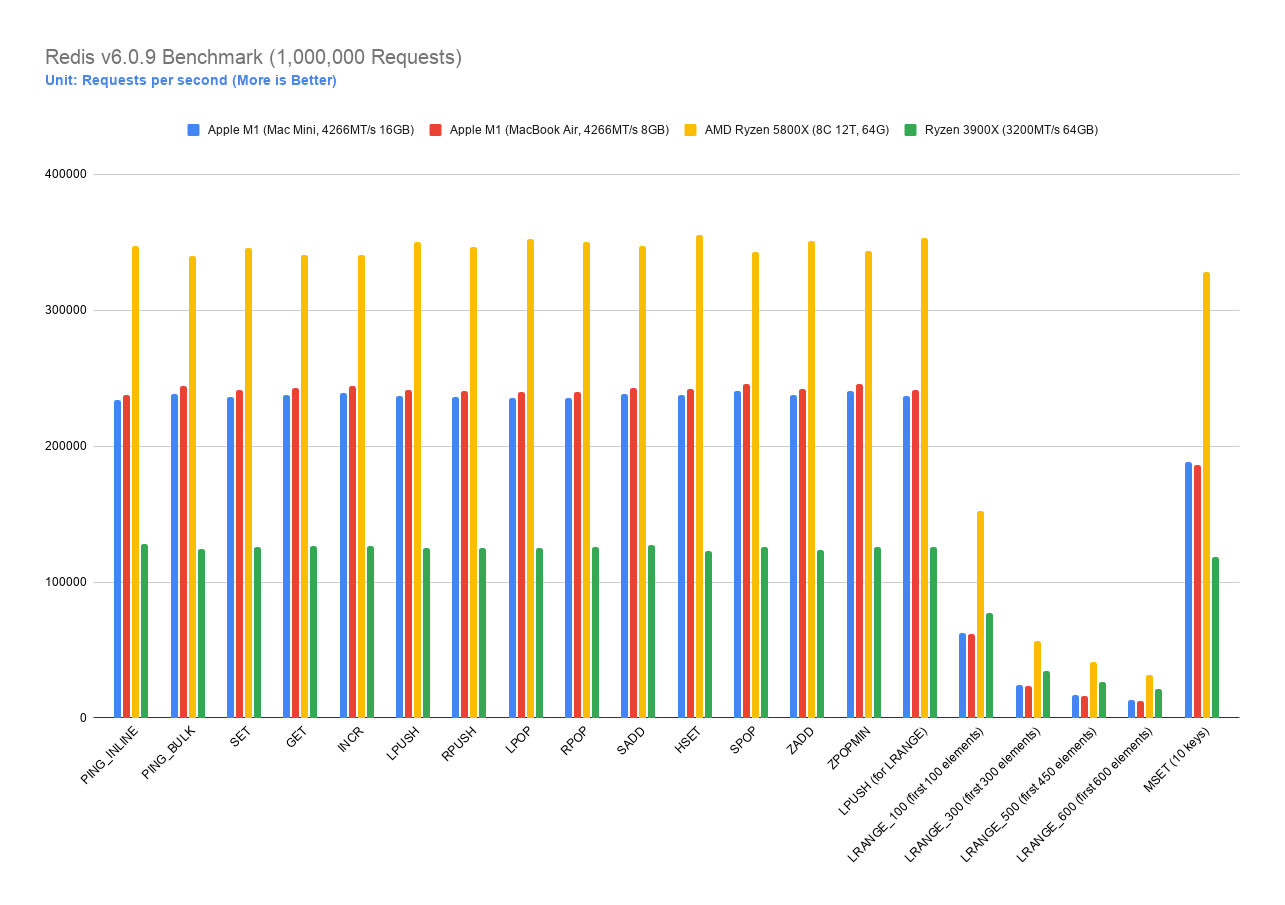
The M1 processor is extremely impressive for the price and power envelope. However, I'm noticing a lot of people have taken Apple's marketing material a bit too literally and assumed that it somehow beats any and every desktop CPU out there, which is clearly not the case.
Moreover, as the author mentions: A significant portion of Apple's lead came from buying exclusivity on TSMC's 5nm process through the end of the year. It will be interesting to see how AMD stacks up as they roll out 5nm parts in the future, compared to Apple's scaled up M1 successors.
Exciting times. It's good to have some progress in CPU technologies again after years of Intel stagnation.
> Geekbench 5 measures the performance of your device by performing tests that are representative of real-world tasks and applications.
http://support.primatelabs.com/kb/geekbench/interpreting-gee...
I'd rather rely on Geekbench score than some programmer's compilation pipeline. Not saying programming benchmarks aren't important. Just that you cannot blame the reviewers testing comprehensively because your use case is specific.
[1] https://techreport.com/review/3089/how-atis-drivers-optimize...
Consumer grade CPUs are driven by a variety of things - marketing, brand loyalty, gaming benchmarks, reviewers such as Anantech and Extremetech, and yes, Geekbench scores. Datacenter processors are a whole another beast and driven by proprietary benchmarks by vendors.
Geekbench runs so many different tests, atleast a couple of dozens of tests. So, if CPU manufacturers are optimizing to those tests, its hard to believe that that's not a good thing and would apply to pretty much what an average user does in the first place.
I find this disparity perplexing and the OP all the more refreshing for it.
It's hard to estimate how much of Apple's advantage came from the 5nm process, but we can get a guess by comparing the A13 and A14. One of the biggest differences between last year's A13 and this year's A14 is the 5nm process (vs 7nm+). The performance increase seems to be on the order of 15% [1], and Apple was able to fit in a lot more transistors- 11.8B vs. 8.5B, though we don't know how many of those transistors were spent on the CPU, and how many were spent in other areas like the GPU or ISP.
Seems like the additional transistors and lower power consuption were used to increase performance in a bunch of ways- higher clock speeds, more cache, and a bigger reorder buffer being the obvious improvements. Perhaps AMD can pull off a similar improvement when they switch processes.
[1] Spec2006 numbers from https://www.anandtech.com/show/16192/the-iphone-12-review/2
So you'll probably see some variation but each time a process is scaled down to 0.7x of the previous size, you'll get smaller transistors that use less power individually and you could expect a "40% performance boost for the same amount of power and a 50% reduction in area" (according to https://semiengineering.com/5nm-vs-3nm/)
90 nm (2003) * 0.7 = 63 nm
65 nm (2005) * 0.7 = 45.5 nm
45 nm (2007) * 0.7 = 31.5 nm
32 nm (2009) * 0.7 = 22.4 nm
22 nm (2012) * 0.7 = 15.4 nm
14 nm (2014) * 0.7 = 9.8 nm
10 nm (2016) * 0.7 = 7 nm
7 nm (2018) * 0.7 = 4.9 nm
5 nm (2020) * 0.7 = 3.5 nm
To me, it's a bit of a miracle that Intel is still able to sort of compete on mostly 14 nm nodes, but maybe that's because "node size" basically just means "smallest feature size", and their 14 nm or new 10 nm process is a little better than e.g. competing 14/10 nm processes, or maybe their chip designs just prioritize different things that have a decent real world effect (e.g. Intel CPUs have AVX-512, but AMD CPUs don't).
1. The 0.7x comes with 50% reduction in area. Where if you times 0.7 by 0.7 you get 0.49.
2. The original naming of Intel 14nm was actually 15nm. But Intel changed it which was part of the reason why it caused delays.
3. And Intel original 10nm naming was 11nm.
4. The node naming now mostly follows TSMC, the node after 3nm is 2nm, then 1.4nm, then 1nm, then 0.8nm.
The geekbench numbers comparing the iphone 12 pro to iphone 11 pro average to around 19% difference: https://browser.geekbench.com/ios-benchmarks/.
A few caveats: A compiler change made made the libquantum uplift (a part of the spec benchmark) huge, and non-representative of hardware changes. Conversely, the geekbench 5 multicore results are actually worse for the iphone 12 pro vs. 12; hinting that they're over-boosting the iphone 12 pro, so peak perf is likely actually a little better (from the hardware's perspective, not that an app can do much about it).
In any case, let's call it a 20% uplift with the same amount of threads, very respectable.
Another caveat: AMD may not be able to get the same 20% uplift from 5nm that apple does. Without any expertise in this matter I can only repeat what others claim, but I've heard people say that it's hard to make x86 wider (i.e extract more ILP) because the instructions are variable length, making lookahead more difficult. I guess we'll see next year with zen4 if that's true!
So what's clear is that a lot of people are acting irrationally especially since the M1 is their low-end laptop CPU. At least wait for their mid-range laptop/desktop CPU scheduled for next year to make proper judgements.
Also the MSRP is $450. It may be a bit more expensive now, but in a month or two the price will drop.
https://www.phoronix.com/scan.php?page=article&item=ryzen-59...
"For the code compilation speed tests were compiking Apache, PHP, the Linux kernel, ImageMagick, GDB, LLVM, FFmpeg, and MPlayer."
I got my m1 MacBook Pro 16GB yesterday and was pretty confused to find that Rust compilation felt faster than the desktop. To go from recent Intel laptops taking two to three times longer to compile Rust than my budget desktop despite the laptops' whiny fans and extreme heat, to having my desktop be sightly outclassed by an ice cold laptop on battery (which got at least 15 hours of use, including said compiling, with no need to charge) is a world changer. I can’t remember the last time a laptop was this close to desktop performance for my everyday workflow.
Now that I think about it, I haven’t even tried optimising compile times on the MacBook like I usually do with Rust projects. My desktop would have been running lld at least to make its compilation significantly faster, and the MacBook more than kept up in spite of the handicap.
My 7 year old desktop goes toe-to-toe with my top of the line MacBook Pro from 2020 and in almost all benchmarks crushes it.
https://cpu.userbenchmark.com/Compare/Intel-Core-i7-4930K-vs...
on the other hand, your mentioned 1065G7 is a 15w processor that doesn't really represent what a laptop processor can do in 2019/2020. laptop processors like i7-10875H would be a far better apple-to-apple comparison in case you still want to make your claims above. the reality here is that at much lower power draw and thermal envelope (45w vs 130w), laptop processor like 10875H would crush 4930k in both single core and multi core settings.
The much older CPU in the MBP has a much faster base clock of 2.4GHz vs 1.3GHz in the XPS. What I find frustrating is that the XPS will throttle down to base clocks for any workload sustaining about 10 seconds, even if the temperature is reasonable, e.g. 50C.
In Windows I can work around this a little using ThrottleStop but I'm primarily a Linux user and haven't found a reliable way to bypass Intel's turbo limits with my Ice Lake CPU. Linux also has annoying bugs where the CPU will limit itself to base clock when connected to AC but then turbo up to 4.1GHz when the AC is unplugged, baffling.
Glad to hear about your positive results with m1, it's for sure a purchase I'll be making in 2021.
I had got same issue with my dell before, it caused by trouble with charger(I have replaced it 3 times). I actually get a lot of power issue with dell laptop, my an other dell can't fall to deep sleep. I won't pick a dell anymore >:< .
The M1 generally keeps up quite well, which blows my mind. The power use difference Is pretty big as well.
Yeah, it would be great if Apple was totally open source.
But this is going to push the entire industry to do way better.
GPU: $150 (1650 super)
Storage: $60 (samsung 970 evo 250gb)
PSU: $90 (silverstone sfx 500w 80 plus gold - there's probably cheaper options but most PSUs seem sold out on amazon)
RAM: $70 (16gb 3200mhz CL16, gskill or team group)
Case: $70 (Silverstone tek)
Motherboard: $120 (asrock b550-m itx)
There's your $1000 mac killer. I wouldn't call it a sensible build, but it should outperform the mac across the board. Notably the GPU is significantly better but the closest gpu the m1 is to trading blows with is the Radeon 560 which is only $30 cheaper. Also the mac comes with 8gb ram in the base model, and 16gb is a $200 upgrade but I could not find a decent speed 2x4gb ddr4 kit as nobody wants that little ram anymore in a custom build. I could save $40 by going with a 1x8gb kit for $30, but single channel will hurt performance.
I'd also consider $30 to go from the 250gb ssd to a 1tb variant, something apple charges $400 for.
The reason I wouldn't call it sensible is that the 1650 super is a budget gaming card while the 5800x a higher tier cpu. If you were actually planning to build this for gaming I'd suggest dropping down to the 5600x and putting the extra $100. actually for gaming I'd even suggest squeezing the budget for a 2060 (or even better wait for the standard 3060) by dropping to basic ddr4-2133, and going for standard sized case/psu rather than the small form factor to chase the mac.
On the other hand, if you're not gaming and just need a video output, save like 120 bucks and just get a gt 1030. Use that to buy some nicer RAM or more cores via a 5900x depending on what suits your workload better. Sadly you have to get _a gpu_ as Intel is falling behind and AMD won't give us high end APUs in the individual market.
Not scientific at all, but one of my large java app test suites takes ~7 minutes to run on my 2017 MPB and ~3 minutes to run on the M1 MBA using the Azul ARM build.
I can't wait for the 16" MBP with Apple Silicon.
Charging more in the premium segment is normal in any industry because you a smaller volume to spread fixed costs over.
The idea that the laptop-grade M1 is keeping pace in these tests with the processor in my desktop is mind blowing. Sure the 5800x was tuned for these tests. Sure the M1 is on 5nm. All of this is missing the point: Intel created a huge market opportunity and 2 of the best poised companies to take advantage of it have.
Computer consumers are winning big thanks to TSMC in 2020. Let's all hope intel can turn things around and keep the space competitive.
So I can sit and wait for the 5000x series to be available at which point the 2700X/2080 goes to the boy and the 5950X/3080 goes in my work machine.
Hopefully sometime in the first half of next year when stock levels stabilise.
I'm excited to try out the similar VM workloads (and gaming) that I currently run.
Although they have a lot of work to do, I can't help but think people writing off Intel are way too keen. Intel's annual dividend is still bigger than AMD's revenue IIRC, so at worst they should be able to buy themselves out of the hole they're in.
Most comparisons have been M1 vs the frankly dated Intel offerings with the previous Mac product line.
So things to remember would be that power/performance is not linear and so 5800 like CPU could be scaled back in power consumption without sacrificing the same proportion of it's performance. Also, 5800X is on TSMC 7nm process where as M1 is on the 5nm; this difference will have a measurable impact on performance and power consumption.
The 5800X is a beast of a CPU. The IPC improvements over the previous generation really are incredible. It's not surprising to me at all that it beats the M1 in several benchmarks. However, it's not the same class of device at all.
The leaked Geekbench results of AMD's upcoming 5800H laptop parts are about 85% of the M1's single core score and matching the M1's multi-core score. TDP is still higher than the M1, obviously, but AMD is also using a 7nm process while Apple got the jump on 5nm by buying exclusivity on TMSC's 5nm process through the end of the year.
I'm extremely impressed with the M1 and I'll be buying an Apple Silicon device as soon as they have something with 32GB or more of RAM. However, the sentiment that the M1 chip obliterates any and every desktop part on the market is getting kind of silly at this point.
1. Nobody ever stated that. If anything, it was all of the Intel and AMD users who created that straw man. "See, it's slower than a 64-core Threadripper at 280 watts". No kidding.
2. The M1 is clearly not a desktop-class SoC nor was it intended to be. However, it's more than competitive with many desktop x86 processors that run faster and hotter while consuming much more power.
3. As a first attempt, the M1’s performance per watt is very impressive. Obviously the 5nm process helps but it's never one thing with Apple: it's the unified memory, the 8 instruction decoders (AMD and Intel max out at 4), and the integration of the 16-core Neural Engine, among other features.
Oh hell no. If you read through 10K comments sine M1 launch on HN alone, majority of them are stating exactly that. ( Which is rather annoying )
That why you see quite a few of these new benchmarks blog post trying to provide a balanced view.
Castrated by a paltry 8GB of RAM in stock configuration!
You will need to wait for the M3 in 2022 for the true desktop HEDT/Threadripper competitor.
I have a 15 inch 2018 i9 MBP that's objectively a terrible device (throttling/keyboard).
With corona and WFH I'm weighing my options - right now everything is out of stock but early next year I'd be interested in building a desktop. My problem is the M1 is so good that if they do a 8 performance cores version for 16 inch MBP in spring there would literally be no point in having a desktop - I could have a single device that outperforms the desktop machine. Frankly I don't see why they couldn't offer a 13 inch varian with more cores - thermals are not a constraint.
> please keep in mind that for single-threaded tasks, a single core doesn’t consume all 95W TDP headroom of the CPU. Based on Anandtech’s analysis, a single 5800X core only consumes 17.3W at 4850 MHz
Remember these are single-threaded benchmarks.
Look at the chart again. One Ryzen core active, 37 watts total package power. It doesn't matter what the per core wattage is, because you can't get that one core without the package.
This is the desktop Zen 3 which is still using the 12nm I/O die. It uses more power as a result, which nobody really cares about on the desktop. The Ryzen laptops use a single die which is entirely 7nm and thereby less power with no corresponding reduction in performance.
Also, if you want to do an apples-to-apples comparison, the 5800X package handles vastly more I/O.
> While M1 is indeed very powerful for its size, when comparing it to the high-end x86 desktop, it is still slower.
Okay, great. I'm not sure what to expect when you compare the lowest end first generation processor from Apple to one of the more high-end of the spectrum x86.
Edit: Forgot to mention how the power draw on the M1 is still significantly less; m1 with all cores @ 100% is ~20W whereas the x86 ryzen was at 17.3W for 1 one core
> To conclude that it performs better than the existing x86 CPUs, is a mistake.
True, no denying that. Exciting times in this market; I wonder how much better gen 2 of Apple's chips will be if the lowest end can do this.
That's an interesting way of describing Apple's highest performing, late model CPU.
Edit: In fact I just ran Cinebench R23 single thread test and package power barely crossed 5W.
https://www.anandtech.com/show/16252/mac-mini-apple-m1-teste...
So do Ryzen CPUs. The 16 core Ryzen only needs 5W per core. It's purely a matter of frequency management.
These comparisons are meaningless because you can say stupid things like "Ryzens are more power efficient than Ryzens" and still be right.
I mean how could it be. It's AMD to Apple's :-P
The M1 MacPro will give us a sense for how the M* design scales to those sorts of workloads.
This makes less difference than you'd think, because power consumption matters all over. If you use too much power you get high temperatures and have to clock down to avoid overheating.
The core designs for desktops and laptops are basically the same. The desktops use more power because it allows them to hold higher clock speeds -- the base clock of the 4800U (8C, 10W) is 1.8GHz, the base clock of the 3945WX (12C, 280W) is 4.0GHz.
This is also why desktops and laptops have about the same single thread performance. Running a single core at full speed is within the laptop power budget.
So, everybody knows a little laptop CPU and a desktop Ryzen are not the same class but it's still useful to compare.
I have a new laptop with the Ryzen 4800H, I would surely like a direct comparison with the M1.
> Java Renaissance: Ryzen 5800x is faster than M1 in most tasks by a large margin.
> Java SciMark 2.0: In the SOR benchmark, the 5800X is more than twice as fast. For others, the 5800X is slightly faster, with the exception of Monte Carlo Integraton scored 2.7% lower than M1.
> Java DaCapo: 5800X is mostly faster by a significant margin, except for the H2O benchmark which is more than twice slower.
> Python PyPerformance: Overall, the execution time is roughly the same, with the 5800X slightly faster. Probably a faster Python implementation like PyPy can highlight the differences better.
> golang.org/x/benchmarks: The 5800X performs significantly better in all benchmarks, around 30% faster in most benchmarks and some are twice as fast.
> Redis: The 5800X performs significantly better in all benchmarks
> JavaScript Web Tooling Benchmark (v8): The 5800X is significatnly faster in most benchmarks
> JavaScript Octane 2.0: Same story as above
I'd like to think my parent is a troll.
You can also write some thing like following
- In 6 of 24 cases M1 is faster than 5800X
- In 7 of 24 cases 5800X is faster by a margin
- Rest are toe to toe and 5800X is slightly faster
5800X and M1 are different class of CPUs with different constraints. M1 is designed for low-end notebooks and this comparison is enough to show us that M1 is fast enough.
----
I think that M1 Mac Mini is released for using as CI workstation on servers by developers to improve porting situation to Apple Silicon. Lot's of open source projects can't add Apple Silicon support because CI/CD services don't support Apple silicon and unit tests don't run for arm64-darwin.
And no, we can't imagine what would happen if M1 was overclocked because it's Apple. It doesn't allow you to do that on it's locked down system.
Not disappointed! The only time the fan even spun up was when I built nodejs from source (which took 10mins). And even then it ran at like ~10% fan speed or something.
I think people are thinking of the first i5/i7 from 2008 when they do the comparison, unfortunately AMD was out of the run before that.
Apple bought PA Semi in '08, for example.
Honestly, 2021 is going to be a good year for laptops and mini-pcs. I don't think any of the chip manufacturers have objectively bad silicon for those form factors anymore.
Consider for one second that in theory the M1 is technologically superior because it can decode double the instructions per second and yet it still is only consuming 2x times less power but at the cost of delivering worse performance on a superior manufacturing process. A lot of hard work with very little to show for it.
There's also a major question about what happens with Intel. If they ever get their process advantage back then it's not clear what Apple's response is. But if they implode then AMD takes over the PC market and probably becomes TSMC's biggest customer, which could put them in a position to get on newer nodes at the same time as Apple.
Well I guess once AMD whooped Intel that was not longer going to be an option. Not only would Intel not be able to deliver their "World's fastest blah blah" marketing claim, but Intel couldn't afford to hold anything back from the general market. I guess their little deal with TSMC letting them clear the cobwebs off this strategy and continue it for a bit longer going forward..
What's wrong with using price-power-performance ratio benchmarks on what's available on the market?
I have no regrets, but this gives me hope that a true Ryzen ultrabook might exist next year, now that the industry have to take AMD seriously. I will sell my MacBook in a heartbeat if that happens.
Why?
Also it's a set of benchmarks some random person did.
It's interesting and useful information. They aren't a publication doing a comparison.
If anything underclocking the desktop CPU is making the benchmark more meaningful.
The M1 beats my Xeon E-2176M @2.7GHz with 64GB of memory in every test but Jython. (I'm on OpenJDK 15, which probably doesn't matter). Later tomorrow I'll try it on my 2700x based system.
45W vs 10W... Running these tests may have changed my mind on this little CPU!
I think the JVM tests should have been executed with the same amount of heap allocated for each platform in order to get the internal dynamics/heuristics of the JVM to be comparable. IMHO all JVM tests should have been executed with -Xmx 7G (8 Gigs maximum as per the M1 MacBook Air minus a little something for the OS and the system buffers)
Still, I'm impressed with the Apple silicone.
The reason why I'm suggesting to have the same heap size for the benchmarks is that the maximum heap size is the single most important (tuning) setting for the JVM. Based on this setting the VM sizes its internal data structures and adepts its behavior.
Also, garbage collection times are typically* dependent on the size of the heap. With most* garbage collectors collecting a 32gb heap takes longer than collecting a 8gb heap. If the workload of the benchmark allows for the heap to be used entirely, then garbage collection overhead is directly related to the heap size.
* unless a "big heap" garbage collector like ZGC or Shenandoah is usedHeap resizing has a much bigger impact on performance than garbage collection.
[1] https://raw.githubusercontent.com/tuhdo/tuhdo.github.io/mast...
  $ taskset -c 1 redis-server
  $ taskset -c 2 redis-benchmark -p 6379 -P 8 -q -c 1 -n 100000
  PING_INLINE: 775193.81 requests per second
  PING_BULK: 869565.19 requests per second
  SET: 724637.69 requests per second
  GET: 787401.56 requests per second
  INCR: 775193.81 requests per second
  LPUSH: 684931.50 requests per second
  RPUSH: 699300.69 requests per second
  LPOP: 680272.12 requests per second
  RPOP: 704225.31 requests per second
  SADD: 769230.81 requests per second
  HSET: 675675.69 requests per second
  SPOP: 819672.12 requests per second
  LPUSH (needed to benchmark LRANGE): 680272.12 requests per second
  LRANGE_100 (first 100 elements): 107758.62 requests per second
  LRANGE_300 (first 300 elements): 30721.96 requests per second
  LRANGE_500 (first 450 elements): 20040.08 requests per second
  LRANGE_600 (first 600 elements): 14658.46 requests per second
  MSET (10 keys): 317460.31 requests per second

  $ taskset -c 20 redis-server
  $ taskset -c 2 redis-benchmark -p 6379 -P 8 -q -c 1 -n 100000
  PING_INLINE: 469483.56 requests per second
  PING_BULK: 505050.50 requests per second
  SET: 446428.56 requests per second
  GET: 465116.28 requests per second
  INCR: 458715.59 requests per second
  LPUSH: 425531.91 requests per second
  RPUSH: 438596.50 requests per second
  LPOP: 429184.56 requests per second
  RPOP: 434782.59 requests per second
  SADD: 460829.50 requests per second
  HSET: 421940.94 requests per second
  SPOP: 478468.88 requests per second
  LPUSH (needed to benchmark LRANGE): 425531.91 requests per second
  LRANGE_100 (first 100 elements): 96899.23 requests per second
  LRANGE_300 (first 300 elements): 29019.15 requests per second
  LRANGE_500 (first 450 elements): 19109.50 requests per second
  LRANGE_600 (first 600 elements): 14035.09 requests per second
MSET (10 keys): 253807.11 requests per secondOP, it may be worth downclocking the RAM to 3600MHz (while tightening timings) unless you have a golden chip with >1800MHz Infinity Fabric. Decoupling IF and memory speed can cause huge latency (90ns on my 3950x).
Obviously you want a baseline and benchmark from there, but you clearly know what you are doing.
vs
5800X : Eight high‑performance cores
In the real world, I only care about how it performs and how much it costs. The implementation details are interesting, but they don't matter when I'm trying to get work done as fast as possible.
The M1 comes in at a great price point for what it is and it's obviously your only option if you want to run macOS (hackintosh isn't an option for production use). Good to have options.
> I honestly don't care if my CPU has 2 cores or 20 cores
Both of these things cannot be true.
Nice benchmarks though.
As far as I know, other than Graviton and other very new N1 designs, there haven’t been many big ARM systems at all.
https://en.wikipedia.org/wiki/Fujitsu_A64FX
https://en.wikipedia.org/wiki/Fugaku_(supercomputer)
But this is an exception. Fujitsu has a long history building supercomputers, and before adopting ARM they were building their own high performance SPARC machines with their custom Tofu interconnect.
So do thermals and layout, which is not where Apple has experience (they don’t make any custom chip that requires a fan that I know of).
That said, they have had a looong time to think out this, so I have confidence they will make it work over the next two years.
Finally, in a core count war AMD has an easier task. They scale up their designs with multiple chips. A Zen 3 CCD is about 80mm^2 on 7nm, which is already much smaller than the M1 SoC on 5nm. If Apple adds 4 more cores, their chip size will increase. Meanwhile AMD can add more cores without increasing chip size like Apple's current integrated approach. This is why AMD is already shipping 64 core CPUs (EPYC 7763) using multiple of the Zen 3 CCD as these desktop CPUs.
By that logic could we not "just" double Ryzen cores to mop the floor with the M1? What kind of logic is this lol
But keep in mind that the author didn't even select AMD's top parts for this comparison. The Zen 3 series has 12 and 16 core parts as well.
And don't forget zen 2 goes all the way to 64 cores on threadripper, epyc to 128 cores (dual-socket).
Comparing single core performance between laptops and desktops is an apples to apples comparison. The Ryzen uses 20W on a turbo boosted core, it uses less when you utilize all cores. Same for Apple which needs 10W for a single core and the whole package is 35W. There is way enough headroom to turbo boost to 20W.
The reason why there is a 20W vs 10W difference between the Ryzen and Apple chip is that Apple uses 5nm and the Ryzen clocks way higher (and thereby performs better). There is no free lunch where Apple can double their performance and mop up anything because AMD can just manufacture with 5nm and reduce their clock boost to reach the same per core power consumption. And it turns out this is exactly what they do on their laptop chips. Just reduce the clock speed and watch the power efficiency pour in.
If anything it's Apple that is backed into a corner because they are in a local optimum from which they can only escape by sacrificing their primary competitive advantage. Ramping up the clock speed ruins power efficiency.
Honestly I expect the price and availability to suck big time for both. AMD can't manufacture half the volume they should to satisfy demand, while Apple is a poster child of $900 laptops costing €1000 when they finally cross the Atlantic long after release.
"Available at an Apple store" might be the biggest joke one could possibly say. There's only a handful of store worldwide.
Well I am double checking and I see they have shops in the top 5 cities now. Maybe things have changed for the better. Last time I tried to buy an Apple product there was simply no shop in a hundred miles radius.
https://github.com/clearlinux-pkgs/linux/blob/26bf1495e7aac0...
Well I suspect due to loyalty factor Apple as usually may be able to extract more money from the customers.
TBH with results like those its clear the company in case of tech is years ahead of competition.
This is a comparison of current beast desktop CPU which requires water cooling to maintain low temps vs air cooled CPU.
Those results are amazing.
I too am astonished that a high-end x86 desktop could possibly be faster than a Mac mini or a laptop without a fan. Now I will have to burn my Apple card (if I had one) in protest.
I call on Apple to immediately retract all of its marketing that says that the M1 is the fastest CPU in the universe.
> obscene power draw
Who cares about power in a desktop (or laptop for that matter)? These things aren't solar powered - just plug it in like a normal person! Duh.
I also note that a single Ryzen 5800X processor is actually cheaper than the Mac mini, and is readily available from many helpful and enterprising resellers on ebay at special holiday pricing.
;-)
Show me an x86 laptop in the same power envelope that can match the fanless MacBook Air with the m1. I’ll wait. Oh and do so at roughly 1k.
On the desktop the Mac mini is 699 USD in its base spec. The 5800X is 500 euros on its own before motherboard, case, ram etc etc.
Apples to apples benchmarks either controlling for power or price would make for a more relevant article.
The Mac Mini is $699 with only 8GB RAM, that runs out after a few browser tabs. So, for a work machine, you would need at least the 16GB model and add $200 to that. Though the build quality and the panel is excellent.
You could opt for the 5600X. The core count is not relevant in the article, as the benchmarks are mainly single-threaded.
Citation needed
An interesting thing about the M1’s RAM limit, though, is that it literally can’t get any bigger. 16GB is pushing it, but fitting 32GB into a package-on-package simply can’t be done with our current tech. Apple is solely relying on Moore’s law for future advances because, with the way these processors are designed, external infrastructure would wreck performance.
You know swap exists right.
I just opened 30+ tabs on the MacBook Air without any issues.
As a desktop user, I certainly am interested in these numbers.
>Show me an x86 laptop in the same power envelope that can match the fanless MacBook Air with the m1. I’ll wait. Oh and do so at roughly 1k.
How does this prove that the title is lying?
>On the desktop the Mac mini is 699 USD in its base spec. The 5800X is 500 euros on its own before motherboard, case, ram etc etc.
Again, how is this relevant to whether the title is clickbait or not?
>Apples to apples benchmarks either controlling for power or price would make for a more relevant article.
Seriously, what does this have to do with clickbait?
Here is my perspective. I saw lots of articles that pretended that the M1 is better than all x86 CPUs including Ryzens (one of them is linked in the article). This was getting on my nerves because everyone is being dishonest. I clicked on this article because the title compared a Ryzen desktop CPU with the M1 with the expectation that these benchmarks disprove the garbage journalism and that's exactly what I got. The Ryzen 5800X performs better than the M1. x86 is still strong in single core performance. Those real "clickbait" articles were just lazy and trying to hype something up.
This article is not clickbait and you are just being dishonest.
Also there are diminishing returns as core count increases. I'm doubting that a 5950x is worth it over the 5900x for me.
There’s room for plenty of comparisons. It’s a big world.
I doubt that’s coming soon. The M1 is a HUGE chip. The decoders and pipelines take up a massive amount of space, and the L2 cache is apparently unwieldy, too. They’ve focused on making a limited number of cores perform very well, but there isn’t enough room. They need another die shrink to add any more.
I think the upcoming pro hardware will just be tweaks to the current formula.
Apple have 2 advantages here.
- They don’t play in the low-cost arena, people expect a Mac to be a bit more expensive, so they have a larger cost budget to work with
- They don’t have to make a profit on the CPU in particular, whereas Intel and AMD do.
Apple want a 38-40% margin on the whole shebang, and if it needs a more expensive chip, then that’s what’ll happen, maybe taking cost-savings from (2), and of necessary adding price because of (1).
I would be shocked if Platform Architecture at Apple didn’t already have 8, 16, and 32-core variants of the M series up and running, or at the very least in simulation. They’re coming, and the world will change. Again.