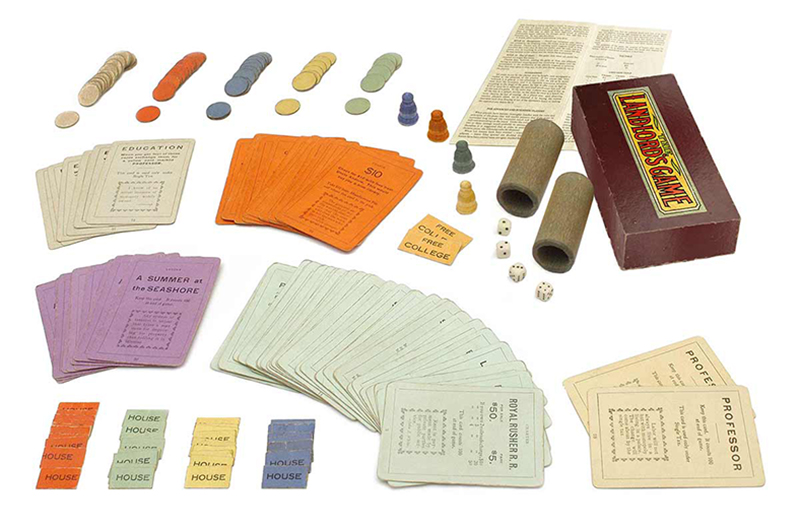
I can't remember one game that didn't feature (a) disputes about rules and the administration of the bank; (b) animosity and dissatisfaction upon exit; and (c) hollow emptiness for the (newly friendless)"winner".
Set a sensible exchange rate to real money and treat the Monopoly money as “chips”.
The tactics and strategy significantly change because there is real external value to the assets and currency - but only for the duration of the game.
Apart from anything else it means the game ends much faster.
Sometimes we become what we set out or destroy.
I am seeing bus stop ads here in Sydney with a tagline from a BTC exchange saying something like "If you're seeing bitcoin on a billboard, it's time to buy".
Now I'm hardly an astute investor but I thought the usual rule is that if your cabbie starts talking about it, it's time to get out of the market.
A tremendous amount of background on the Landlord's Game and Lizzie Maggie.
https://www.thegamecrafter.com/games/bay-area-regional-plann...
(via https://news.ycombinator.com/item?id=10685690, but no discussion there)
https://www.imdb.com/title/tt1250861/
I would have liked it to dwell more on the roots and the meta-level of what the game is trying to say, and how that seems to be missed by most people who play it. But was still a fun watch on a lazy weekend day.
Streaming free on Amazon Prime right now: https://watch.amazon.com/detail?gti=amzn1.dv.gti.1cad6f64-66...
Seems to be based on it. Don't know how closely it relates but it is CC-BY-NC-SA 4.0 licensed and you can just download it.
https://www.pbs.org/opb/historydetectives/investigation/earl...
That's... unfortunate.
[1]: https://commons.wikimedia.org/wiki/File:BoardGamePatentMagie...
[2]: https://smartasset.com/mortgage/price-to-rent-ratio-50-large...
>The 2018 median home value in San Francisco was $1,195,700, and the median annual rent was $22,560.//
So it's probably comparing cheap rental properties with expensive owner-occupied properties? That's likely not very useful as a statistic on it's own unless you've got the distribution of both. Better would be making a comparison of the rental price (including charges) vs TCO of ownership for directly comparable properties -- that would be a lot of work.
FWIW 10x price-to-rent isn't far off right in my area of my city in the UK. Houses prices and rental prices are high compared to wages, IMO.
https://astralcodexten.substack.com/p/your-book-review-progr...
(A bit long, but pretty comprehensive and hey, it's shorter than the actual book).
I'd love to see some examples of what specific laws would be implemented, what taxation would look like (in actual percentages and dollar amounts) and things like that to understand what a system could look like in action.
For real estate, at the optimum land rent, land would exchange hands at a value of roughly $0 (structures on top of the land would modify the total property value). Given the high transaction costs of land, and of changing ownership, there are other forces that shift the true land price away from $0 under a full LVT.
There would need to be exemptions or other ameliorating of the coercive effects of full-land-rent LVT for those living in a primary residence. Nobody wants to force grannies out of their homes, for example. But the coercive effect of land taxation would otherwise mean that land would be used far more productively, with more stable prices and above all more affordable prices. It would also require getting rid of density restrictions that are not based in actual health and safety (ie pretty much all of them). But even somewhat small changes in density can open up massively more land for use.
It doesn't take many homeowners to completely shut off the market for land and corner it all. Not many people watch zoning boards, and fewer pay attention to how limited land use is, and even fewer who are in power do not directly benefit by the massive bubble on land prices.
And we really do have a massive bubble on land prices due to rentierism. So any sane deflation is going to require a gradual phase-in of an LVT, with probably 2+ decades of gentle deflation of land prices. And as soon as that starts in, there are the makings of a tax revolt. In California, we have been suffering from the tax revolt of Prop 13 for 50 years, and we are barely seeing any cracks in the army of anti-tax Prop 13 supporters.
So the politics of a full LVT are extreme, especially in a land where every middle class person is supposed to own a bit of land and defend it like a castle, and often when that defense means stopping any change. A full-on LVT is meant precisely to stop land hoarding, so as long as a majority of people see that land is theirs' to hoard, it's unlikely that an LVT will be passed. Unless imposed from in high by a technocratic elite that's trying to maximize social benefit, rather than individuals looking only to maximize their sole benefit.
"The set had rules for two different games, anti-monopolist and a monopolist. The anti-monopolist rules reward all during wealth creation while the monopolist rules had the goal of forming monopolies and forcing opponents out of the game. A win in the anti-monopolist or Single Tax version (later called "Prosperity"), was when the player having the lowest monetary amount has doubled his original stake."
So a 1% land value tax would be $10,000 a year. A 3% LVT would eat up the entirety of the economic rent.
However, the yield on that property would go down from 4% per annum to 1% per annum, so the value of the land would drop.
Any politically realistic implementation would involve progressively increasing the LVT and reducing other taxes over time, so the first year might be 1% LVT, but eventually the price of the property would drop such that a 100% LVT wouldn't be unreasonable (although an 85% LVT or thereabouts is often thought to work better).
Actual percentages and dollar amounts is impossible to give in general, but the basic idea is that returns to pure ownership of land (without improvements) should approach zero. This should eliminate the risk-free speculative ownership of empty lots downtown that are just waiting to cash out on rising land prices due to improvements made by other capitalists and collected taxes.
Take out "natural" and it seems like any non-inflationary cryptocurrency would be a target for a Georgist tax.
Georgism just makes so much sense because if "mother nature" (or "natural capital", if you want to sound less hippie) is not charging for the things we take from it, then we're basically stealing from it. Even if you're a hardcore capitalist, you have to agree that it's not truly capitalism if it's all based on stealing from the largest provider in the system.
https://news.ycombinator.com/item?id=16261425
A while ago (1999) I made a "Micropoly" board game about the Microsoft Monopoly, with cards for various dot-com companies (Copyleft (L) 1999 Free Monopoly Foundation), using an xml file to define the cards and board and an ugly Perl script to render them with PostScript!
http://donhopkins.com/home/Micropoly/
>Update: I've written an ugly "openopoly.pl" Perl script, and a "micropoly.xml" data file, that describes the specifics of the game. The Perl script reads in and parses the XML database, and writes out PostScript and HTML to render the graphics and web pages. It embeds EPS files with images and cartoons in the PostScript file, and then runs it all through GhostScript, to render out PDF and JPG files with the printable images of the board. It currently writes out one HTML file with links to the small and large pictures of all the property cards, and soon it will write out a web page for each property, and link them all together, as well as an image map for the entire board. Most of the logos, cartoons, and other graphics haven't been put in yet, but the basic functionality for producing the game is there. This is work in progress, but here's a preview of the automatically generated web page index of properties, the full sized board micropoly-board-whole.pdf [1,672k], the paginated board micropoly-board-split.pdf [10,028k, sorry but I'll optimize the PostScript not to draw clipped images and it will reduce in size], and the printable cards micropoly-cards.pdf [5087k], as well as the micropoly.xml file from which it was all generated.
http://donhopkins.com/home/Micropoly/micropoly.xml
http://donhopkins.com/home/Micropoly/micropoly-board-whole.p...
http://donhopkins.com/home/Micropoly/micropoly-cards.pdf
The idea (which I never finished but encourage anyone else to pick up and run with) was to develop a fully skinnable parametrizable Monopoly compatible game template (or variants like Anti-Monopoly), that you could print out and glue onto cardboard, or even play online!
http://donhopkins.com/home/Micropoly/notes.html
Monopoly is essentially the original "Open Source Game" designed by Elizabeth Magie and shared among Atlantic City Quakers. Then it was illegitimately taken over and patented by a giant corporation. Parker Brothers' story about Charles Darrow was marketing bullshit.
https://en.wikipedia.org/wiki/Lizzie_Magie
There's also an interesting story about Ralph Anspach's decade-long "Anti-Monopoly" lawsuit:
https://en.wikipedia.org/wiki/Ralph_Anspach
https://en.wikipedia.org/wiki/Anti-Monopoly
https://www.washingtoncitypaper.com/columns/straight-dope/ar...
https://en.wikipedia.org/wiki/History_of_the_board_game_Mono...
>Also in the 1970s, Professor Ralph Anspach, who had himself published a board game intended to illustrate the principles of both monopolies and trust busting, fought Parker Brothers and its then parent company, General Mills, over the copyright and trademarks of the Monopoly board game. Through the research of Anspach and others, much of the early history of the game was "rediscovered" and entered into official United States court records. Because of the lengthy court process, including appeals, the legal status of Parker Brothers' copyright and trademarks on the game was not settled until 1985. The game's name remains a registered trademark of Parker Brothers, as do its specific design elements; other elements of the game are still protected under copyright law. At the conclusion of the court case, the game's logo and graphic design elements became part of a larger Monopoly brand, licensed by Parker Brothers' parent companies onto a variety of items through the present day. Despite the "rediscovery" of the board game's early history in the 1970s and 1980s, and several books and journal articles on the subject, Hasbro (Parker Brothers' current parent company) did not acknowledge any of the game's history before Charles Darrow on its official Monopoly website as recently as June 2012. Nor did Hasbro acknowledge anyone other than Darrow in materials published or sponsored by them, at least as recently as 2009.