Could be interesting to see what Amiga OS would look like if it was still maintained to this day. There are some systems that are binary compatible with Amiga OS that still see a bit of development, but they are mostly niche projects (still very cool projects though).
Digikam is not an acceptable substitute, it's got lots of quirks, and tends to abend.
Yes, technically it still exists in some form, but not really. The modern version shares little in common with the DOS port - apart from unicode incompatibility, and that's hardly desirable.
Corel have even acknowledged how good the DOS version was by attempting to have a "Classic Mode" with a similar interface. But the macro system is completely incompatible, and all the menus are different. It's a skin-deep facelift, nothing more.
(Happy to share information on how to set this up with anyone who might be interested.)
The current browser ecosystem has more or less two engines: WebKit based browsers and Firefox. We have basically WebKit monoculture. If you'd find a fundamental flaw in WebKit, you'd be able to break most browsers. If Internet Explorer would be open source we would have the chance to get a third engine running. Browser engines aren't trivial and IE also had some good sides after all these years.
I guess if IE would become FOSS this would bring some fresh air to the ecosystem.
https://www.theverge.com/2021/12/21/22848133/duckduckgo-brow...
Google reader. For RSS with blazing speed.
Or ask a friend for his color printer and send stuff there.
32-bit macOS and iOS (before Apple set fire to all the 32-bit games and other software)
Backward compatibility with older versions of macOS and iOS in general
Desktop software in general (before everything became a crappy web app)
Non-subscription software
Smartphone games without horrible monetization schemes
Web sites without adtech
It runs QNX and you could get a terminal emulator for it, through which you had a functional unix like environment with a text editor, compiler, python, etc. It's not updated and all the root certs (I think I'm using that correctly, not my area) are expired, so it doesn't connect with anything that needs https. Otherwise I think it could be an awesome terminal tablet (it needs a better keyboard too)
- Avanor
https://libregamewiki.org/Avanor
- Abura Tan
http://aburatan.sourceforge.net/
More abandoned games:
- Fanwor. The sprite should pallete-swap/blink when it's hit.
https://github.com/gsantner/mirror__fanwor
Now, software.
ROX filer + rox desktop. Fluxbox may work as an Oroborox replacement, but Rox-Lib is tied to Python2. It works under Slackware 15 because we have Python2 and 3 for sure, but other distros are screwed.
This runs circles over XFCE and even LXDE on speed.
http://rox.sourceforge.net/desktop/
ROX related repos:
HyperCard
Two flawed but amazingly empowering tools that expanded the world of computing.
Alternative would be having some printer server/emulator which interfaces and emulates as popular legacy printer(s) and serves it out appropriately to modern devices.
Also see print capture devices which can intercept/log printer output (for data conversion/preservation) http://www.photologic.ca/cap.html
Going to have to look into this more :-D
The developer’s site (Chaotic Software) doesn’t exist any longer, but here’s an old page elsewhere [1] with a description of what it could do.
[1]: http://mac.majorgeeks.com/files/details/media_rage.html
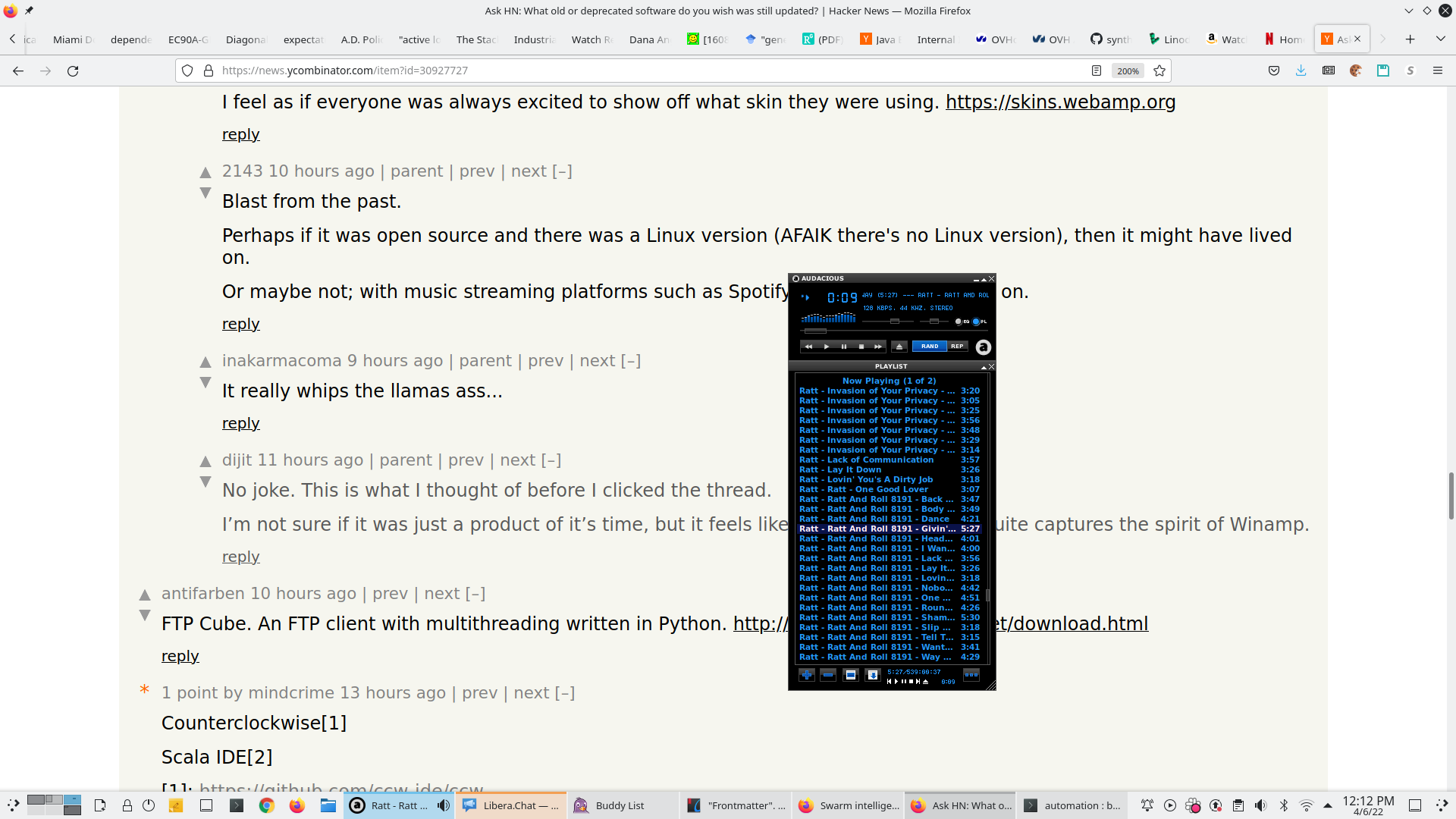
I feel as if everyone was always excited to show off what skin they were using. https://skins.webamp.org
I’m not sure if it was just a product of it’s time, but it feels like there’s nothing that quite captures the spirit of Winamp.
Perhaps if it was open source and there was a Linux version (AFAIK there's no Linux version), then it might have lived on.
Or maybe not; with music streaming platforms such as Spotify, the world has moved on.
Screenshot: https://fogbeam.com/audacious.png
Scala IDE[2]
Still nothing that comes close to UX of it.
Still works but performance is starting to slow down with almost 10 years of data
Also, https://osgameclones.com has zillions of source port and clones for everything.
Stack ScummVM on top and lots of DOS games can be replayable today without burning zillions of cycles at DOSBox.
I know I'm being picky but taking 25 minutes to set up a new game or an old program just isn't usually worth the hassle for me.
The repo is at https://hg.dillo.org/dillo. You need Mercurial, FLTK devel libraries and MBedTLS. With a proper user Agent such as Lynx or the PSP one it will work for a big list of sites.
No JS, but meh. HN works, so does Lobste.rs, Simply Translate, 68k.news...
perl5