This is firing on all cylinders. The organizational structure and performance is a marvel for this.
Apple also made a huge leap forward with their cooling designs. Making the laptop thicker and investing in proper cooling design made a huge difference.
My M1 laptop is significantly quieter than my old Intel laptop at the same power consumption level. It’s not even close.
Apple’s last generation chassis and cooling solution were relatively terrible, which makes the new M1 feel even more impressive by comparison.
The x86 MBP was stuck in a vicious cycle of getting overheated, running the fan all the time at high speed, sucking up enormous amounts of cat hair, and jamming up the motherboard and cooling vents: the hotter it got, the faster the fans ran, the more cat hair it sucked up, the worse the cooling and more snuggly warm the insides got, the more attractive it was for the cat to sleep next to.
Indeed. Turns out there is some utility in function over form. God I hated Ive's bizarre need to shave with the damn thing.
Multiply this by adding the chipsets, other IO controllers, and discrete onboard GPUs.
I suspect Apple are being overly conservative now, partially because these chip designs are new, partially because no internal team wants to be where fingers point if the design is inadequate, and partially because a SoP design gives them a bit more space/flexibility to do so.
Work have me an M1 MBP and I have yet to hear it make a noise, it's amazing.
Then again, Apple has a long history of sacrificing cooling performance for form factor.
I think Rosetta + Swift + SwiftUI might have been a bit much change for the developers at Apple and the users are now paying the price.
I hope they focus on some principles behind stable software next.
Totally agree, plus Sirouji, who seems like a modern day wizard
It would be a marketing failure though, and sustained would translate into a longer-term business failure.
I remember having a conversation with someone who worked on hard drives in the 80s. He got so ^%$^$# excited telling me about all the improvements he worked on between generations; they were mostly things like tighter calibrations, and refinements.
Point being: Don't knock releases like this.
But really we've only had 2.5 released cycles so far. Not much to go by.
Considering that M1 was already an overkill for the most tasks, I think it is a meaningful "tok" upgrade.
Besides, I kind of expect the trend of ASIC to continue. Instead of having more extreme and extreme lithography, it kind of feels more appropriate to have computation specific developments.
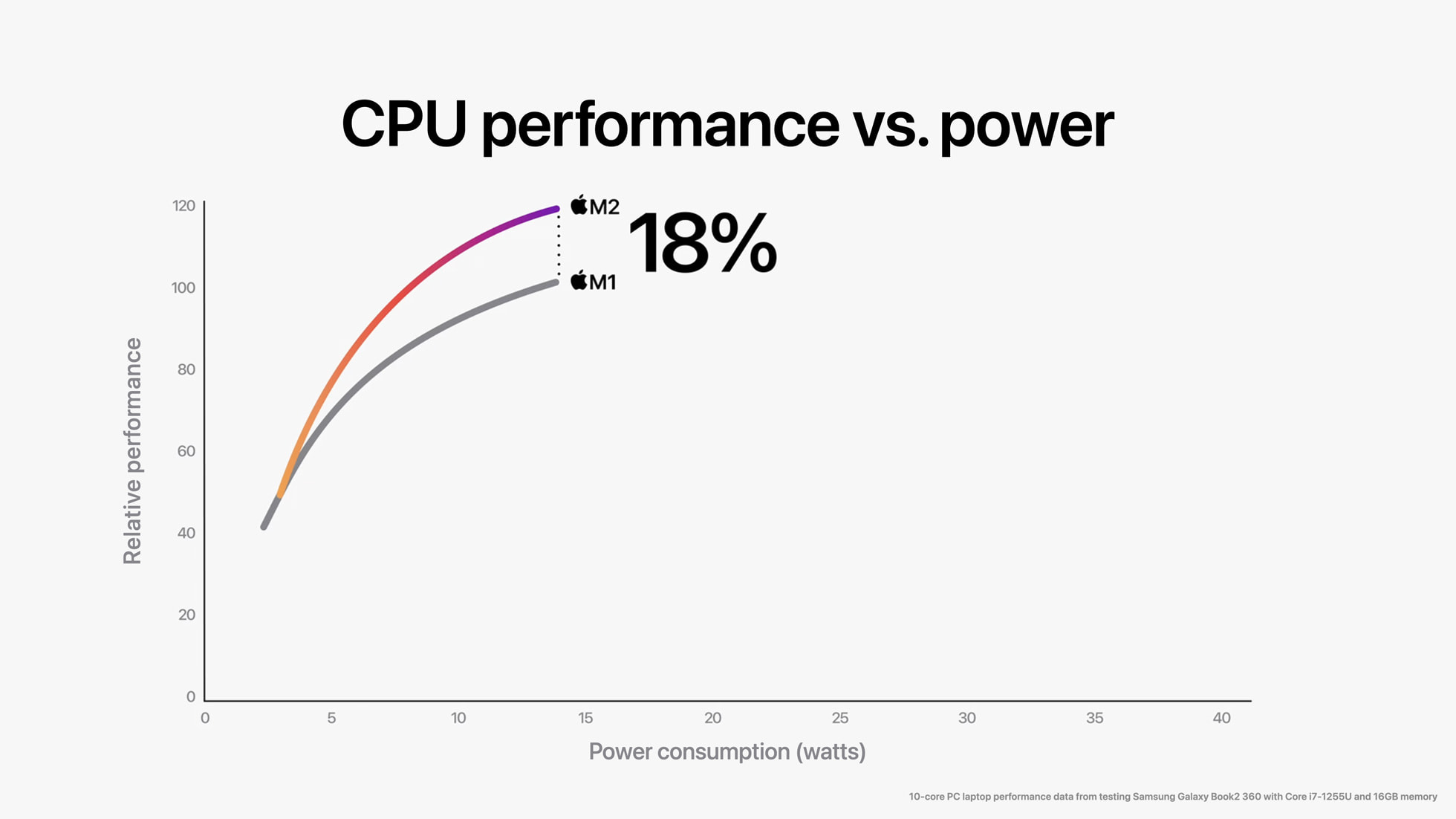
Apple just teased ~18% CPU increase while staying on TSMC 5nm.
Sounds like they are doing just fine.
Also, if Intel can keep up this time, and if tsmc/apple slouches, I wonder if there will be Apple silicon and Intel x86-64/risc macs/apppe devices on available simultaneously?
https://www.slashgear.com/833760/apples-3nm-processor-is-abo...
Edit: Also the pro is missing the magsafe charger. Are they phasing out the 13" pro?
Who would buy one of these? The Touch Bar is an evolutionary dead-end, and the design of the new 14” and 16” Pros seemed specifically targeted at addressing the well-known shortfalls of this previous generation.
13” is the perfect size of laptop IMO, the battery life is insane, the performance is great, the screen is good enough for me (I don’t care about higher refresh rates etc)
If the M2 is just more of the same but faster, yes please. Why fix something that isn’t broken?
I'd have to test the keyboard though, the new pro keyboard is awesome so maybe I don't want to miss out on that.
13in pro starts at $1299. The newer 14in starts at $1999.
If I had to buy a laptop today I would get the 13”. The Touch Bar is no issue to me as I use it docked 75% of the time.
“A 1080p web cam, thinner chassis, mag safe and 100$ cheaper. What a steal”
Yes. The 13" Pro is currently the only pro model with a M2 processor. I updated my comment for added clarity.
- size
- Touch Bar (last chance to buy mbp that does not have useless-to-me Fn keys)
New Macbook Air: New design & M2 chip
New Macbook Pro 13": Old design & M2 chip
Macbook Pro 14" & 16": New design & M1 Pro/Max chips
It's also the only "new" M1 or M2 machine with touchbar (seems to have been dropped elsewhere) and without the new magsafe.
It seems to be kind of a mistake, and a mistake to buy it.
But the phase-out period is very long in recent Apple products (which is probably a good thing especially for enterprise context.)
The 13" Pro is now also the only Mac with a TouchBar, which is just strange.
So, why update it? Redesign it instead.
Likewise in the desktop world, the single core performance of the M1 is on par with top of the line chips, and M2 will be the same, and intel and amd work fine on linux.
Apples decision to keep a locked box has nothing to do with performance, solely to do with keeping people in the ecosystem for revenue.
But I'm also a "weirdo" who doesn't like Apple-made hardware (the trackpad, touchbar, keyboard, mouse, etc. are all inferior IMO), so maybe you're looking for something different there.
I know I haven't exactly babied it, what with it having been plugged in in my home office for basically two straight years during the pandemic, but the battery is shot at this point— getting barely an hour of life. Often it'll be supposedly sleeping in lid-shut mode but be cooking itself for no reason. Then it'll wake up and immediately go into a power-panic shutdown, only to assert that the battery is full after all when it reboots connected to juice. And now the HDMI port is also toast (verified under multiple OSes to be a hardware issue).
Maybe I just got a bad year, but this is supposed to be Dell's premium machine and I don't think I can justify giving them another chance after this. It's just nowhere near reliable enough to be used on the road, and not performant enough to be a true desktop replacement. So I don't know who is using this machine and for what.
Please, it’s not that weird of an opinion.
> (the trackpad […] are all inferior IMO)
Oh.
But I think I agree when it comes to anything like drag-and-drop.
I really like the laptop otherwise, but battery/power management is utter crap on it, both on Windows and on Linux.
Of course an m1's battery life is better. Everything else sucks in comparison imo but I admit this is very subjective.
The track pad and display suck for a laptop in 2022. The display has issues with calibration and resolution (understandable from where they're at right now, but still it's trash compared to an XPS or MB). The trackpad has mechanical issues that cause it to wiggle, its been reported on the forum (and personally to staff a few times) but they don't seem to have a decent way to fix it.
Its been a nightmare calibrating the touchpad to my liking, on my XPS and Macbook it has always "just worked" (even on Linux!)
The entire industry struggles to match Apple’s fit and finish, it will be an uphill battle for a hardware based startup. I do hope they succeed.
For build quality I think they're still behind Asus, Lenovo, and Samsung.
How to install: https://git.zerfleddert.de/cgi-bin/gitweb.cgi/m1-debian/
- One week suspend, resume under linux (reliable).
- Keyboard and trackpad centered under display, and as good as best of class from 10 years ago.
- 4K / hidpi display
- no/minimal fan, cool running
- 12+ hour "typical" battery life; at least 4 when running slack and zoom (and maybe compilation jobs)
- as fast as a 10 year old midrange desktop e.g. i7: 2700)
- don't care about video acceleration, but video out must reliably work.
- No dual GPU switchover garbage.
- not intel brand (the last N Intel machines I have used have had severe chipset/cpu issues)
- ability to not run systemd in a supported config.
All the laptops I have found fail on multiple of these points. My pine book pro meets as many of them as most high end laptops do (so, not all that many), but at least it was cheap and worked out of the box.
Still waiting for a "real" laptop to replace it, but everything I've seen has glaring fatal flaws.
hopefully get some ryzen 6000 series laptop options this year. the thinkpad z13 looks promising, but will have to wait for reviews to start rolling in.
Apple has said that Windows availability on the M series processors is up to Microsoft. Bootcamp is no longer needed, you can now install alternative OSes on the same drive and boot into whichever you want. At least that's the way Asahi works.
Apple's hypervisor API is the way to go in any case. If companies use that Apple will take care of all necessary drivers. Doing things on bare metal will require a lot of work and Apple won't help with that.
It’s the very best such setup possible.
They all have severe drawbacks in some way. They even used the Elitebook brand to make cheap shit and now no one likes it. Gamers wanted the Omen, turned out to be shit.
I bet the thermals are horrible, the keyboard sucks and/or will break in a year or two, the battery life will be bad, the BIOS updates will cause problems with no way to revert, the drives may suddenly fail and Linux still won't work properly on them :D
$$$ but can be had for 40% off.
A good spec with the nice screen and discrete graphics is < $3k.
Upsides: Great for Ubuntu, everything just works. Screen is beautiful. Keyboard is brilliant.
Downsides: Can get hot. Battery life sucks. Still 11th gen - Tiger Lake.
You weren't even able to skip to the next song, like you can on the old function keys. Play & skip to next song are probably my most used buttons, one of which never stand-alone existed on the Touch Bar.
I think it would have been better accepted if Apple make it more customizable right out of the box, instead of relying on half-baked solutions from tinkerers to program it.
In my opinion, it should also have been in addition to the function keys, not a replacement.
Hence, it's a nuisance. Not something I go insane about like some do, but it is a very definite day-to-day annoyance.
I think it's mildly disappointing and I won't miss it.
I'd imagine changing brightness or sound volume + mute/unmute only with on screen controls and/or keyboards shortcuts could work, but that's a lot of shortcuts to remember for stuff that are only done a few times a day.
Hey, Apple: why not just lose the touch bar and make the whole screen taller and touch sensitive instead, huh?
Quite happy with my M1 Pro, a beat and a hell of a purchase.
I think Apple knows a lot of customers care about this and want it to be a barrier getting them into a pro machine. The cheapest laptop they sell with multi-external-monitor support is $1k more than their cheapest laptop overall ($2k vs $1k).
18% faster at the same performance per watt is a nice increase. Interesting to see if this will ever make it to their desktop computers.
18% faster at the same wattage, which means 18% higher perf/watt.
It is commonly assumed that M1 shares high performance Firestorm cores with A14.
It looks like Geekbench scores for A15 over A14 is about 18% in multithreaded, and 10% in single thread.
It is also very likely that the M2 uses the same Avalanche cores as in A15. So I would suspect that this translates to a 10% increase in single threaded performance between M2 and M1 as well.
Incidentally, A15 runs at around 3.2 Ghz vs 3 Ghz for A14. So the majority of the speed-up between A14 and A15 comes directly from increasing clock frequency. M1 runs at 3.2 Ghz.
Also, the first computer where getting the upgraded hard drive (512GB or 1TB) really helps with the low ram because of the integration bus they have with the drive for swap. It's fast.
The M1 generation looks to be a bit of an "introductory offer" to get people looking at apple who otherwise wouldn't have... once they have established their mindshare as being a performance leader worth considering over x86, they can raise prices back up.
M2 starting at $1200 looks pretty nice to me. Avoids many of the corners cut on the competition like: plastic chassis, tiny trackpad, poor fans that get noisier in the first year, poor Intel iGPU, poor battery life, etc.
What will happen with the M3? Will the base Air start at $1500?
Will the M2 Air drop its price to $999 when the M3 is released?
I'm not saying the M2 Air is not worth its price compared to x86 laptops, but it's ridiculous that the cheapest Apple laptop is way overkill for its intended audience. Even the M1 is already overkill for users that typically spend the majority of their time in a browser or using Office.
The best tool is the one you have, not the one that doesn't exist. In September you could then wait for the M2 MAX coming in June. The in June wait for the M3 in September.
I can't imagine telling a client, "I'll get that video to you around Christmas. I'm waiting for another version of a computer that just came out to come out."
When it's raining, you want an umbrella, not to wait in the rain until someone builds a cafe to hide in.
Taking Apple's 20% claim at face value:
Geekbench Single Core - M1, M1 Pro: 1700, M2: 2040
Geekbench Multi Core - M1: 7700, M1 Pro 8-core: 9000, M2: 9200, M1 Pro 10-core: 12400
Of course we'll see M2 Pro/Max sooner or later, which will presumably match M2 on single core just like the previous gen.
If the M2 has 18% higher PPW, and keeps the same TDP / power draw, that's 18% higher performances (remains to be seen whether it's across the board for E-cores, or for P-cores) it's about 25% below the 6+2 M1 Pro, and about 70% below the 8+2 M1P. At least looking purely at the CPU.
The M1 Pro is a 6+2 configuration, so it will have a little bit of an edge in core configuration, but Apple claims 18% faster on this generation, which might cancel out that edge a little bit (I'm guessing slightly slower still, but close). The M1 Pro does have a 40% larger GPU, but the M2 is 35% faster (again, taking Apple at face value) so it should again be similar-ish in gpu performance, very slightly slower (135/140 = 96% as fast).
The big difference is still that M1 Pro gets support for much larger memory, and the 14" has a much better port configuration, the 13" is basically still the same old chassis with USB-C and the touch bar, just updated with a newer processor.
It is just the previous MacbookPro 13" with the M1 replaced with an M2. The Air is better in all regards if I read the spec correctly.
They will need to get developers up to speed porting their apps to ARM before they are even in a position to re-boot their Windows ARM strategy.
But this is a multi-year journey which is likely to give Intel/AMD time to produce something more competitive.
If I buy an ARM machine any time in the next 5 years, it will almost certainly run macOS or Linux, with Windows relegated to an x86 box that I use for gaming.
> But this is a multi-year journey which is likely to give Intel/AMD time to produce something more competitive.
And during this time Apple is going to release M2 Pro/Max, M3, etc. I just have a hard time seeing how Intel/AMD catchup in the laptop space.
a series of strategic and communication mistakes kinda wasted the shot, and when they finally fixed the desktop side of the experience was too little too late.
That's Apple's marketing but the 12th Gen P chips are perfectly capable of keeping up with Apple on the performance side and AMD's likely to be able to compete on the power consumption side as well. Yes, x86 is likely to never match ARM on battery life, but I believe they can be reasonably close for it not to be an issue.
Apple _may_ take over the consumer space but this will be more due to the shift from desktop/laptop computing to phones and tablets than anything with the M* series of processors.
If we could deploy Apple products in a business environment we would in a heartbeat. But Microsoft just is better here currently on a lot of fronts - the last time I chased my tail here it didn't pay off.
If Apple wants to compete for the business market I think they should! We need first class user account management that INTEGRATES with other stuff (ie, google email etc etc). Right now you can federate from active directory to almost anything (SonicWall/VPN for remote users, WiFi for onprem user devices, vSphere for VM management etc etc). If you sync to google you can then use google one click sign-ons everywhere on the web SAAS side.
We then need office running perfectly.
Then we'd probably do our legacy apps on some VMs and chrome for SAAS apps.
We also need to be able to run MacOS virtually. We have remote users who talk to an on-prem VMs, separates their personal and work stuff, we can lock down and monitor the on-prem VMs and they can watch netflix with no worries using home machine. How does this work with Apple? It's easy with Windows.
I think there would be some demand from smaller co's to make the switch if there was a solution which allowed what folks are looking for -> migration to cloud as offices go virtual with controlled "desktops" delivered to users while still allowing in office / warehouse / factory deployments.
I still feel like Microsoft is the strongest software company on earth. Consider that not even the confines of this M1 MacBook prevent me from being able to compile & run my .NET apps without modification. Apple's hypothetical hegemony does not cross over in the same way.
Until Apple can get me to look at their Xcode offerings and think "wow fuck visual studio, GitHub, et. al.", I do not think their takeover of the computing world will begin.
But I agree. Apple is pulling ahead a decent amount here and likely will stay in that leading position for a while, like they did in the phone space, and that makes all the competitors that much less appealing.
That timeframe does not inspire much confidence in me, seeing as it is three whole years after M1-based products first hit store shelves.
As someone who can remember this never changing, that's a pretty steep slope...
https://www.statista.com/statistics/218089/global-market-sha...
If you look at the trend, macOS is gaining worldwide market share while Windows is steadily dropping.
And macOS share in USA has already reached close to 25%.
Note that is for desktop PCs: many people don’t own a PC/laptop so the market share is far far lower than that, especially outside of rich countries. Microsoft is now primarily just business software?
https://gs.statcounter.com/os-market-share/desktop/worldwide
They're also using essentially the same cores between their mobile and desktop products. Apple is their own ARM ecosystem. An improved core for the A-series chips is an automatic improvement for the next M-series chip. Most arm licensees have to wait for ARM to come out with new cores.
The fact Apple can book the initial runs of any of TSMC's process nodes is just one of many of their advantage over other ARM and x86 manufacturers.
But the process node is also not the main reason.
What matters is only microarchitecture. And Apple has by far the most performant microarchitecture design of all CPUs.
Customers kept paying Qualcomm for their SoC with ARM designed cores, so once again, Qualcomm had no reason to actually do anything but sit on their patents.
Intel had a similar story, since Sandy Bridge "x86_64" part of CPU barely changed, most of the performance gain was somewhere from better process, more custom instructions (avx2, etc.), higher TDP (since ryzen).
It's not ARM vs x86, it's Apple ARM cores vs everyone elses cores.
I don't think they have any chance to match Apple in terms of efficiency while buying third party chips. The advantage comes from controlling the whole stack I think. Apple knows exactly what accelerators will be available for each generation, and their communication between hardware and software folks is presumably much tighter.
Is the Wintel laptop/Macbook gap even that much larger than the Android/iPhone gap?
The market for non-Apple devices is, I think, pretty large.
That said, the big business is still big business: Azure (Cloud), Office, and device management (MDM) / active directory are big focuses even in a heterogeneous computing environment that includes Chromebooks and Macs.
Intel or AMD back on their feet can probably match Apple in perf/watt. And I guess they are the closest competitors in the PC market.
In the 10 years between my 40 core HP server's release and the Ryzen 5950x's 16 cores, performance increased ~10%, but the TDP of the 5950x is 10% of the quad xeons in the HP. This is ignoring the fact that a single 5950x cost less in any market than a single xeon in that HP upon release.
Does anyone else remember the Cavium ThunderX processors? Whatever happened to those? the perf/watt on those was supposed to be outstanding...
The biggest problem is the hardware: you're basically just buying a poorly performing laptop with probably lagging Linux support if you get tired of Windows, and you could just buy an M1 Macbook and get superior performance and battery life for the same cost, and you can even just run Windows on that using Parallels and still get good performance. The AArch64 laptop market is mostly just Qualcomm processors and Apple, and if you actually care about the performance profile, there's basically no comparison between the two right now with current offerings; the Mac is the winner, and you can even run Linux on it.
In general, compared to a Macbook:
- It has a touchscreen
- It has a detachable keyboard
- It has a pen input
Microsoft's execution on the device is flawed. (IE, in order to use it as a laptop it needs a much more sturdy hinged keyboard,) but there's clear differentiators in their lineup.
IMO: Apple's lack of a touchscreen and detachable keyboard (or 270 degree fold) really hurts the Macbook lineup. If I could get a Macbook that I could also use as a table, or an iPad that truly ran OSX, I'd be happy.
Me I am a Linux user, had already had a job that "forced" me to use Linux back in 2009 (yes, my boss demanded everyone used Linux, in 2009 and I absolutely did not complain as it had been my choice since 2005).
I came to Mac that year and was very enthusiastic about what I had heard was like a polished, commercially supported Linux distro.
I left three years later after having spent significant time trying to adapt to it.
I was relieved to get back, even to Windows.
Last fall I got a Mac Mini.
Some of the warts are now fixable, but I only use it for things I won't have to do in anger or fear or anything like that.
What you mean to say is: you buy a laptop for which Linux has drivers for. Windows is not in this equation, my friend.
If I had to guess, we'll next see a Macbook Pro 14"/16" with M2 Pro/Max, and the Mac Pro will be M2 Ultra.
"compared to the latest 12-core PC laptop chip [...] M2 provides nearly 90 percent of the peak performance"
That doesn't make sense. Twice the performance of a 10-core Intel CPU, but only 90% of the performance of a 12-core? This implies Intel more than doubles performance when going from 10 to 12 cores. Reading the footnotes, the 10- and 12-core Intel CPUs that Apple used for benchmarking are the i7-1255U and i7-1260P which have respectively 2P+8E and 4P+8E cores (performant and efficient cores). So the second Intel CPU actually has twice the number of performant cores than the first.
This means the benchmark mostly depends on performant cores and nearly doesn't use or doesn't depend on efficient cores. If so, that's a rather useless benchmark for evaluating the CPU as a whole (P and E cores.)
But what this also means is that Apple is being sneaky. The M2 has 4P + 4E cores (not revealed in the press release, but we can tell from the die shot). Thus comparing it to an Intel CPU with only 2P cores (i7-1255U) is guaranteed to make the M2 look better as the benchmark doesn't use E cores (see above.)
What I'd love to see is the M2 put up against a Zen 3 or 3+ mobile CPU like the Ryzen 7 6800U (15–28 W) which straight up has 8 regular ("performant") cores.
It's 2x the perf if you compare the max power draw performance of the M2 vs the performance of the Intel CPU at the same power draw (so not maxed out)
It's 90% performance of the Intel CPU when they're both maxed out, while taking quarter of the power draw
Anyone know if this means much in practice for a typical dev user?
https://singhkays.com/blog/apple-silicon-m1-video-power-cons...
Though Apple doesn’t super explicitly say that.
As for AV1…well, we don’t really know yet. That’s deep in the weeds, and it’s entire possible the M2 does have accelerated decoding, but they just didn’t spell that out yet.
There's a joke here somewhere... all those poor M2 suckers when M3 is about to be released. Something like that.
It seems like MacOS on M1 architecture can play almost everything! Like, there are so many titles that don't have OSX listed as ever being released for, but it can either be played out the box or with a slight tweak. But I guess that does preclude Steam releases if you don't have direct access to the per game, installers.
And nowadays these indie games release on all major consoles, mobile, and windows, macos.
What are you encountering? A few examples on whats missing for you?
https://www.applegamingwiki.com/wiki/Home paints a sorry picture of the state of M1 gaming (partially due to dropping 32 bit support).
1) Update all the first-party Valve games to 64-bit since the 32-bit binaries are no longer supported
2) Bring Proton support to MacOS, which is what Steam uses to run Windows games on Linux and the Steam Deck console.
Works surprisingly well. You can find videos on youtube.
And real function keys instead of a touchbar?
They seem to be making weirdly inconsistent choices in the product line.
I thought they were going to be getting rid of the touchbar (and maybe adding more ports?) and they were only still in the legacy 13" because it was legacy. But apparently they mean to indefinitely have a 13" Pro with a touchbar and a 14" Pro (actually the same size device, just less bezel, I think?) with function keys?
And the new M2 Air has a magsafe power connector (like the M1 14" and 16" Pro)... but the new M2 13" Pro does not? Why?
I was about to buy a 14" M1 Pro, not because I needed the speed at all, but I wanted magsafe, I didn't want a touchbar, and two USB-C ports (inclusive of power supply) is not enough. Also the built in HDMI out was nice.
The new Air has everything I want except the HDMI. Separate magsafe power PLUS two more usb ports (that's enough for me), no touchbar... yeah, I'll be waiting for this and saving significant money over the 14" M1 Pro I was about to get.
I guess if you really love the touchbar, this is the only thing that has it? (That HN hates and we all thought they were getting rid of based on the M1 Pro's). Or you really hate magsafe power connectors, this is the only new laptop that lacks it?
Its interesting that they don't have the same screen. The Air is .3in larger and supports more colors?
Air 13.6-inch (diagonal) LED-backlit display with IPS technology; 2560-by-1664 native resolution at 224 pixels per inch with support for 1 billion colors
MBP 13.3-inch (diagonal) LED-backlit display with IPS technology; 2560-by-1600 native resolution at 227 pixels per inch with support for millions of colors
Same logic for how they keep the iPhone SE with a physical home button.
I miss my 100Mhz IBM PC with 16 MBs of RAM & Visual Studio.
4k video editing - I admit is a valid use case, not something I've ever had to do. But I doubt most people buying these are video editors.
If someone came out with a nub-sized flash drive that sat nearly flush with the edge of the Mac, I'd definitely get one. I was really hoping the base MBP would be revamped, and I'd be able to get an SD card slot and avoid Apple's insane storage tax...
- CPU: 100% faster
- GPU: 600% faster
Apple M1 (2020) vs M2 (2022)
- CPU: 18% faster
- GPU: 35% faster
Diminishing returns.
unless you can charge with both on new macs?
Any benchmarks yet?
That said I'm sure it's nice for _someone_.
Edit: I just realized that the magsafe connector can be disconnected from the brick, and a standard usb type-c cable can be used thusly making the charger as useful as the old one, provided you buy an admittedly cheap in the big picture cable.
I totally get your point and can't disagree with it. But I really love the magsafe connector for power. It's just so nice. usb-c feels slow clunky in comparison. Just for a straight power supply use case, I think magsafe is superior to usb-c.
So I wonder if anyone is contemplating an adapter? There's probably going to be too much of a mismatch of power requirements or something to make it viable.
I actually run with Garmin (Spotify & downloaded music) + Airpods.
Pretty much all disc drives that have been produced in the history of disc drives come with a little pinhole where you can stick in a paperclip to manually push the opening mechanism exactly for this kind of scenario, so you can recover your disc if your computer or drive fails.
Except Apple computers, of course, because such a useful piece of functionality would be ugly and an abomination unto Saint Jobs, or something. So I had to spend a few hours opening up that MacBook that very clearly wasn't designed with "opening up" in mind. I was lucky this machine wasn't in warranty and dead, so putting it back together wasn't really a concern.
It was something like this: https://everymac.com/systems/apple/macbook_pro/macbook-pro-u...
Note that Apple do not mention AMD. M1 and M2 probably still kick AMD to the dirt on the power efficiency front, but the cost for performance end would be difficult to quantify (and the AMD performance ceiling is also significantly higher).
Intel is not significantly faster, just more power hungry. That’s the mean difference in day to day usage.
Did you want to compare the M2 to a specific Intel CPU? The M2 is better.
https://www.apple.com/newsroom/images/live-action/wwdc-2022/...
This was the first comparison on the page. M2 has 18% more relative performance than an M1. You can argue about the relative part, but the certainly included the comparison (and do for GPU, etc...).
Supply chains. Good ol’ supply chains.
The “Mac” is really the “MacBook”—very solid majority of devices sold are laptops, followed by iMacs, then minis, then a teeeeeny sliver of Mac Pros.
Well, probably. People infer it from quarterly earnings. Apple no longer breaks it down explicitly by category. But it’s a very safe assumption the biggest selling Macs, by far, are laptops, and they are prioritizing silicon for those.