Those death-knell types seemingly aren't aware of what day to day operations looks like and how AI makes a great tool, but doesn't necessarily deal with the very human factors of whims, uncertainty, reactive business mentalities and the phenomenon that is best summarised by this webcomic: https://theoatmeal.com/comics/design_hell
In my field they like to call this "hurry up and wait", a nonsensical but fitting description that summarises everything from changing scope to the unjust imbalance of time between the principal and the agent.
(There is a comment further down which suggests that we could just train AI to deal with this variability, I hope that's humour... sweet summer child thinks you can train AI to predict the future.)
Companies are already bloated, imagine when they realize one overworked highly paid senior can replace 10 juniors.
A lot of projects today are not even greenlit because they would be too expensive to make. For instance, there are a lot processes in almost every country that require you to file paper forms, even though we have had web forms and databases for 25 years. This goes even for rich countries. If one programmer is able to do the job of 5 others, we will probably have 5 times as many systems to tend to now that businesses and institutions can afford them.
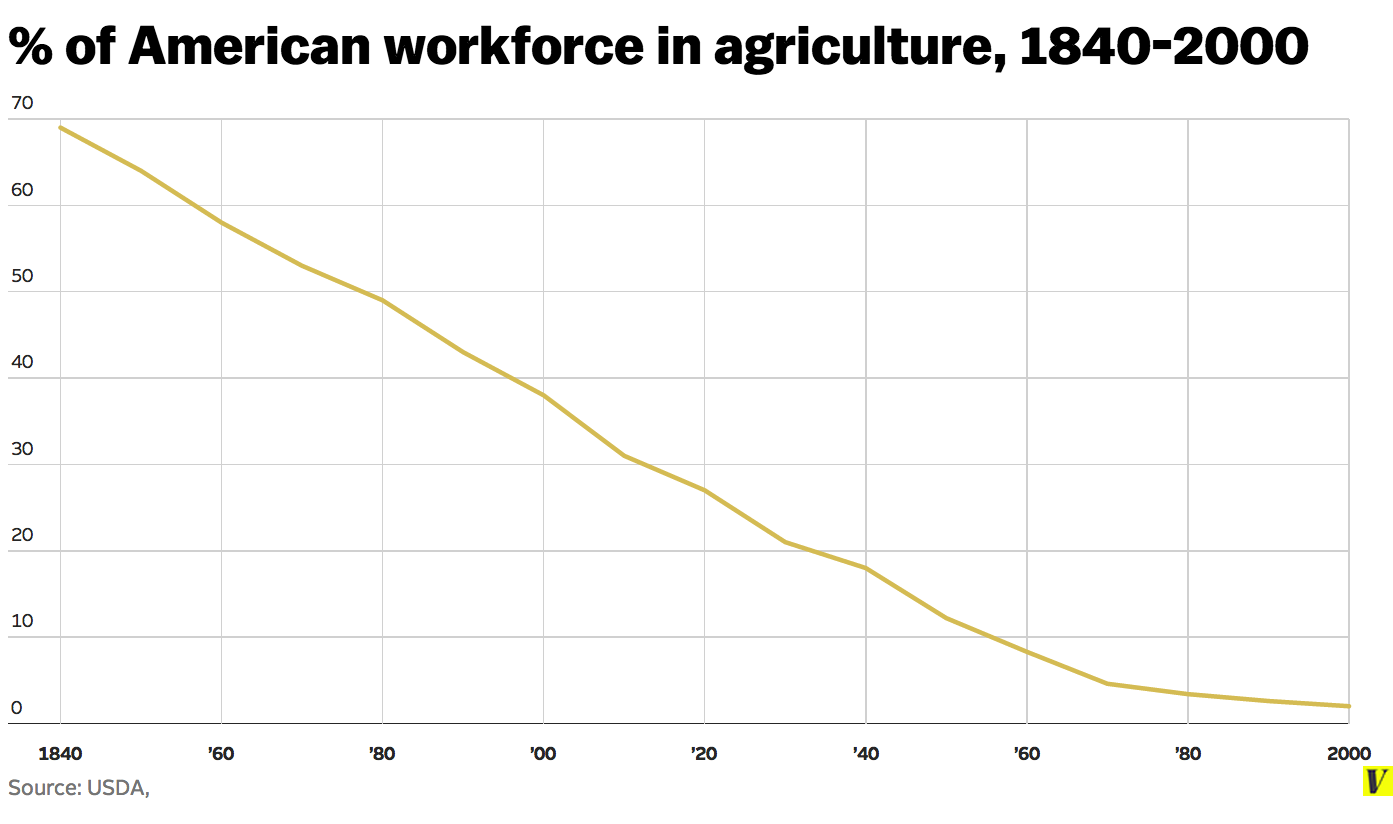
And instead of the 97% unemployment our intuition tell us would happen, we're instead 30x as productive.
The same will happen when/if AI makes writing software far more effective.
The only reason it's not the case in this example is because computers at the time were a tiny early adopter niche, which massively multiplied and expanded to other areas. Like, only 1 in 10,000 businesses would have one in 1950, and only big firms would. Heck, then 1 in 100 million people even had a computer.
Today they've already done that expansion into all businesses and all areas of corporate, commerce, and leisure activities. Now almost everybody has one (or a comparable device in their pocket).
Already cloud based systems have made it so that a fraction of programmers and admins are needed. In some cases eliminating the need for one altogether.
There are tons of other fields, however, more mature, where increased productivity very much equaled job loss...
Increased productivity doesn't necessarily lead to overall job loss, but it will eventually in the area where the productivity is realized. Agricultural employment is a very clear example.
Yeah. The problem is that there’s only one of me. All the rest of you are filling in for the other guy.
Yep. This is where I'm at in terms of personal armchair predictions of the future.
I expect the labor market will be tough for more junior software engineers in the coming years. This might indeed cause backpressure in the supply of new grads/new labor force entrants in this family of fields ("software development").
However, the "highly paid senior" is only around for so long before achieving financial independence and just not working anymore. Then what? The company didn't hire juniors because the "highly paid senior" did all the work. Whoops. Now the company lacks the pipeline of people to replace that senior.
It'll sort itself out in time, but the next decade will be interesting I think. Some companies will realize that they must make investments into the future of the labor force and will do better in the longer term. Other companies might indeed "fire the juniors" for some short term gains and find themselves lacking replacement staff later.
Now some might say that the code will be terrible quality and buggy and full of holes and the users will hate it, it is never economically viable to build enormous systems on a house of cards like that. To which I respond, you just described every piece of enterprise software I've ever used ever.
That is already possible without AI and has been the case for a long time... the issue is nobody will stay to be that highly paid senior running entire projects because at that point you can just run your own shop and pocket the full profits.
I'm not disagreeing with you. Im thinking of going solo myself.
Not to say that this is a bad thing, but the difference between a junior and senior is often much more than the difference in their salary.
Except, there was no AI, but an alternative called an offshored development center. You would send your spec and design document and get, via email or FTP if they were really cutting-edge a number of files that would sometime compile and even, according to the legends, actually work. The way this tech worked is that you generally had to wait overnight for your spec to "mature" into code.
Some places figured out they could hire local engineers for about 5-10x what they paid for this "offshored development center" tech and get better results.
This already happens, the market is just not very efficient about it, e.g. a highly paid senior dev is not working at a company that only needs 2-3 developers, they're working at Google with 100's of devs.
Developer time reduced by 5X CPU time increased by 500x
When CPU cycles are cheap it's a logical tradeoff but it still grates against my sensibilities.
I mean, I already do? And for totally mundane and benign reasons. This has been my experience in this industry for the last 8 years or so, though my first 9 years I felt like the pace was maintainable.
Do more with less. It's so common to come across situations where so and so left, their position won't be backfilled, the targets don't adjust to compensate for the productivity hit, and we can put up or shut up.
Additionally there’s the math behind it. If Company A fires 50% of their staff because AI lets the remaining 50% work at twice the productivity then how will they compete with Company B that keeps their staff and now gets 200% efficiency?
The math is in favor of getting more, not fewer, developers.
Also, if your one programmer dies you now have no programmers and loss of all institutional knowledge, whereas the other company can lose several programmers and still be OK. There is value in having redundant programmers.
If they indeed wait for input from other departments/companies 99% of the time (so they just need to actually program 5 minutes in their 8-hour workday), then they can be already thrown out of a job and have the company do with 1/10 the programmers, no AI required...
AI wasnt needed to cut down on bloat - some combination of a few companies reaping the majority of the profit and reduced dysfunction is enough.
If one can go the job of 5 - they revenue per employee will increase.
They will hire even more employees.