See Practical Engineering's latest video: https://www.youtube.com/watch?v=Nteyw40i9So
Feels a little silly for relatively light humans being transported through high population areas.
I'm also a little unclear how humans could survive a 100mph crash even if their container makes it through. If they were wearing a 4-point harness, I guess? Do they build crumple zones into train cars? Or... just rely on utterly demolishing anything they hit so the deceleration is kept under control? (https://www.reddit.com/r/BitchImATrain/)
Some nice analysis of survivable deceleration here (with restraints): https://aviation.stackexchange.com/questions/16545/even-afte... (100mph=44m/s)
That was used by high speed trains in Germany - until one of the steel tires broke at 300 kilometers per hour and got stuck in a switch, causing the train to detail and hit the support column of an overpass, which collapsed on top of the train. 101 people dead: https://en.wikipedia.org/wiki/Eschede_train_disaster
There was a documentary about it but I can't find the link.
How does a bus get by with far fewer wheels?
I think the answer is that they are still building with the same weight as a train, rather than a bus.
That points out an unexplored engineering envelope for modern trains, made possible by newer technologies:
* Very light trains. Think lighter than road cars, since they don't need crumple zones or crash worthiness.
* Virtual coupling. Basically platooning on rails. Now the cars need to at most push/tow one other disabled car, so they don't need a beefy chassis to support towing long trains, coupling forces, etc.
* Homogenous cars. They all have traction motors, small batteries and sensors and compute. Think a low-range Tesla on rails.
* Autonomous control. Self-driving on rails. No operator cab. Since the train is now quite light, with a reasonable stopping distance, obstructions on the track can be potentially avoided so long as the sensors are adequate.
* Much faster acceleration and deceleration. With leaning, they could also corner faster.
* Probably intrinsically quieter, but now pneumatic tires would probably have reasonable life.
Crashes involving light rail are common in urban areas, because the trains share streets with cars. I don't see that going away as long as human-driven cars are allowed. And because passengers are often standing, the trains must be heavy to improve passenger safety in crash situations.
> Virtual coupling. Basically platooning on rails.
Modern designs typically have very long cars, with only 1, 2, or rarely 3 cars in a train. Longer cars increase passenger capacity and improve space utilization, because passengers can move around freely. They also allow busy passengers save some time by exiting from the right end of the train.
> Much faster acceleration and deceleration. With leaning, they could also corner faster.
Urban trains already limit acceleration and deceleration to improve passenger safety and comfort. Long-distance trains with sitting passengers and grade separation are another matter.
That's a good point. That doesn't mean that trains need to be as heavy as they are, though. Having a crumple zone and weighing 3x of non-commercial road vehicles would still be quite a bit lighter, and would provide safety.
> Modern designs typically have very long cars
I live in Switzerland, and it's common to have train combinations that are very long here, even with long cars.
> limit acceleration and deceleration
There are limits, of course, but they can be relatively high if you strictly control "jerk". That's where computer control comes into play, as it requires high driver skill to stop the train at the right position while limiting jerk.
  A non-trivial part of this difference is that train cars are generally bigger
  than a bus. Light rail is generally more bus sized and they are generally
  closer in weight (though still heavier).
> * Homogenous cars. They all have traction motors
Electric passenger rail systems generally already use EMUs which have a power unit per-car or per pair of cars.
> small batteries
I'm not sure how you're going to have a small battery in a bus-sized vehicle that needs to operate fairly continuously for a good portion of the day unless this is on a partially electrified ROW. EMUs with smaller batteries to serve such routes already exist FWIW.
I think there's a reasonable case to be made to adjust US passenger rail regulations to allow lighter cars (especially in the context of high-speed rail), but allowing pneumatic tires seems like a poor motivation for it.
A non-trivial part of this difference is that train cars are generally bigger
than a bus. Light rail is generally more bus sized and they are generally
closer in weight (though still heavier).
It did no go well, and was hated by both crews and the public. Rode extremely rough because it turns out it's a very different optimization needed.
What? I thought wheel deformation was a huge source of drag and steel tires were one of the main reasons why trains were comparatively efficient.
This is one of the things I strongly associate with Paris: the slight smell of burned rubber when you enter a Métro station of a line with rubber tires.
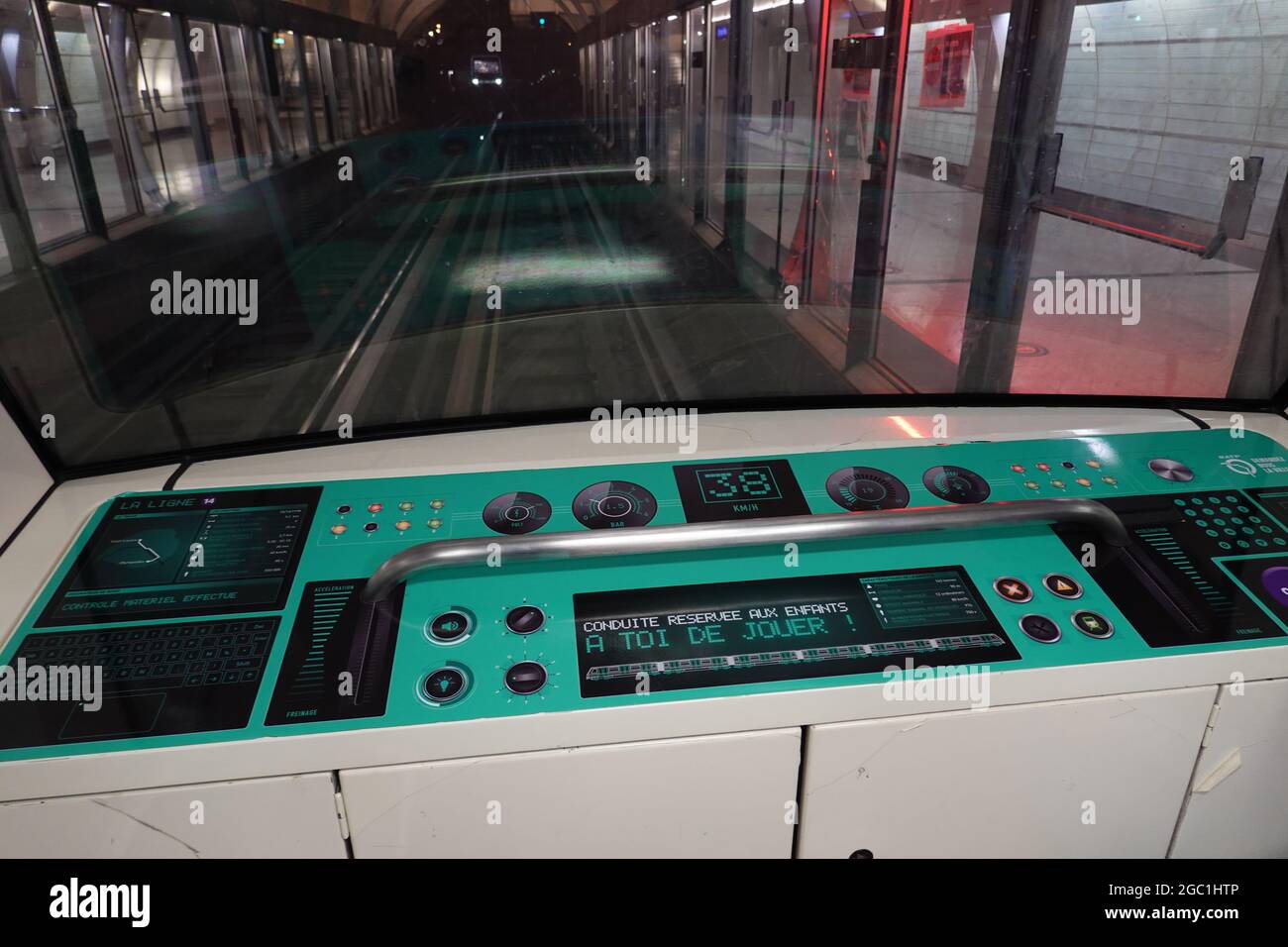
Pro tip for Paris visitors with children: ride with one of the automated lines 1, 4 or 14, and enter through the very first door. There is a fake (printed) control panel for children below the front window [0].
[0] https://c8.alamy.com/comp/2GC1HTP/paris-automatische-metro-m...
I said “used to” because, from what I understood, the development of ABS made breaking characteristics of traditional trains much better than before, which reduces the improvement you get with tires.
(Don't quote me on that though, I got this from a coffee machine discussion with a former metro driver when I was working for RATP 10 years ago so my memory may not be 100% accurate at this point)
It mentions Paris Metro line 14.
Ten of the lines are rubber-tired. Instead of traditional steel wheels, they use pneumatic traction, which is quieter and rides smoother in Mexico City's unstable soils. The system survived the 1985 Mexico City earthquake.
Link to the article - https://www.thedrive.com/news/tire-dust-makes-up-the-majorit...
It's pretty neat.