Creditors are ranked by seniority and get paid out in order by seniority. Equity is below every creditor and has been completely wiped out. Companies are not allowed to take cash or sell the furniture to pay out employees. That money is legally owed to creditors and attempting to stiff them is theft. I'm sorry to those affected at Convoy, but that is the reality of working at a startup that goes through a hasty liquidation. Convoy is not being "cheap" about this, as some are suggesting. Any "retention bonuses" are to keep executives around for long enough to unwind the company in an orderly fashion. Nobody is getting rich off failure; if everyone were to walk away there'd be nothing left and therefore nothing to recover and distribute. It's bad for everyone, but the alternative is worse.
As for the larger situation: Convoy were a digital freight brokerage. They acted as intermediaries between shippers and carriers and make money on the spread between the two. They got into trouble because the entire freight sector has been suffering a double whammy of cost increases due to inflation (ie. diesel costs) and a slowdown in demand. This has caused a number of carriers and brokerages to go bust. Freight brokerage has some other properties that make Convoy's situation particularly serious. In particular, carriers typically securitize their accounts receivable. In freight, this is known as "factoring." Convoy got stuck holding the bag after their partner carriers went under, having already paid them for their service, but still waiting for payment from the shipper.
Worst of all, Convoy had no exits because their only potential acquirers are in the same industry and are also getting completely crushed.
https://usbankruptcycode.org/chapter-5-creditors-the-debtor-...
Wages are fourth priority, but only up to $12,850 per person (one month's salary at ~150k a year).
The three priorities above wages are child support (not really applicable to corporate bankruptcy i assume), liquidator's expenses, and some mildly complex case i don't really understand. Taxes are eighth, two behind grain farmers and fishermen (lol America).
I think that this list might be talking about unsecured claims though. I think that secured claims might be separate. So, for example, if an individual declares bankruptcy and they owe $500k on their house, that claim would come before child support payments. I am definitely not a lawyer and bankruptcy law strikes me as particularly complex.
The third priority is tough to parse. From looking over it quickly, it seems like this might be claims from doing business between when i file bankruptcy and when i go into foreclosure. Again, not a lawyer, but my guess here is that if I'm a store and I file bankruptcy on Monday, but don't have a trustee until Wednesday, and I put in an order for a palette of water bottles on Tuesday, then the distributor of the water bottles might have a priority claim.
But yes this grandparent post is mostly correct. If severance was not built in to any loan contact (it never is). Then creditors are paid first.
It would be interesting to know how much debt they have vs remaining cash and when did it dip below.
Paying severance is extremely low probably even below equity since there's no legal requirement to pay severance.
IDK if Shone did things the most intelligent way, but the general story is not uncommon.
Shareholders/creditors have a mess if the CEO and CFO walk out the door for their new job; it is financially beneficial for them to liquidate assets and shut the door.
Shareholders/creditors don't have a mess when the engineer and a product manager walk out the door to their new job.
That's how the logic works.
If a regular individual declares bankruptcy and then doesn't bother doing any of the required paperwork and legal stuff, saying the court needs to pay them top dollar for their time, things will not go well for them.
Many companies are open with employees about the state of the business.
If you have less than 3 months runway and little prospect of any fundraising, tell your employees. You don’t need to steal money from creditors (?) to pay severance, you just gotta do your best to not blindside people who have rent to pay.
Some great insights here and you clearly know the business. I’m curious about this last statement however. Just how badly are other players doing?
Uber Freight just announced a major overhaul on a foundation apparently provided by their acquisition of Transplace [1]. There seem to be a number of synergies between Convoy and Uber Freight although I may be naive about that. In any case, I’m curious about your view on Uber Freight and whether they are viable or simply playing the long game based on deep capital reserves, and why you think they didn’t acquire Convoy (if that even makes sense as a possibility).
1: https://www.freightwaves.com/news/uber-freights-new-solution...
Unfortunately I had to learn this the hard way (as in I was lied to and assumed they were still going to pay us, and then the payroll money went poof)
Why should employees be prioritized below a property speculator?
This doesn't make any sense. What you're describing is normal course of business. Shipper pay terms are usually longer than when the carrier get's paid from broker. "Carrier's went under", doesn't make any difference. If the shipper doesn't pay, than that's a problem. But to say paying carriers that "went under" contributed to Convoy going out of business just isn't accurate.
Correct.
I can only assume "companies are not allowed to pay out employees" refers to suggestions of severance, health care, etc. in this thread.
Not earned wages, which have high legal priority.
Unless, of course, Convoy had to because all their carriers insisted on upfront payments for reasons. In which case Convoy was propably already screwed any way.
"Nobody is getting rich off failure; if everyone were to walk away there'd be nothing left and therefore nothing to recover and distribute. It's bad for everyone, but the alternative is worse."
Here's one such game. Executives, who enjoy information asymetry, and leverage can parlay this into one final earning event. Threaten to leave the company in disarray, unless they're paid. Coordinated, it's hard to say no to.
Imagine if the top 5-10 execs at an otherwise ok startup coordinated a demand to double their pay/stock or everyone walks tomorrow. They time the move using inside knowledge of cash flow, making the demand irresistible.
I'm not suggesting an alternative, but that doesn't mean a corpse isnt a feast for some.
It should work that way everywhere. Executives need to be incentivized to do layoffs while there’s still cash for it. Defrauding employees is a terrible evil.
Could you help me understand where the line is drawn?
The US staff had to just go. I got my last month's pay + about 6 to 8 weeks.
Yes, what happens in an acquisition vs a insolvency are different.
Detailed the shutdown on a call at 8:30am Pacific this morning. CEO said there'll be no severance or healthcare.
Lot of talented folks in Seattle and beyond who'll be looking for new gigs.
When NCC Group fired me, they gave me zero days notice and no severance.
They did emphasize that my healthcare would stay good through the end of the month, but they didn't seem to have realized that I would be unlikely to find that useful after being fired on October 31.
I would hope most employees know that is a significant risk of working at a startup?!
But yes, harsh, regardless of how predictable.
Also, healthcare shouldn't be employer provided.
"Convoy, which raised $260 million in a funding round last year that valued the business at $3.8 billion, on Wednesday told employees in an email that it would stop accepting shipments until further notice and that it was rescheduling or canceling existing loads." (wsj)
Price per shipment cratered -> Revenue cratered. (They make a % of each shipment) -> Losses spiked up. (Because they had fixed cost)
Flexport had a burn run rate of $600M a year. Convoy had less burn but also less in the bank.
https://www.theinformation.com/briefings/flexport-revenue-dr...No one else thought it important to try and get developers using our product to reduce our reliance on big players and well, here we are. My last check was paid out from the CEO's personal bank account.
Certain spaces are exciting to work in because you can clearly see a need but sometimes the stars don't align for you. I hope the Convoy team (sans leadership) lands on their feet. Q4 is the worst time to find jobs.
Was it largely spot rates, a bid board, and lots of small carriers?
Customers easily could just get rates / carriers elsewhere and walk from Convoy?
No other services making income keeping customers around?
Rates are pretty fluid in logistics, very strange that they would rely on that alone if that was the case.
Convoy could interface with large companies as though they had a large fleet of drivers and trucks. That "fleet" wouldn't require paying for benefits to employees, maintenance or fuel on the truck, and could scale up or down based on demand.
I would have guessed that the network effects of getting this kind of marketplace going would be the hard part. It makes me think that a big mistake in leadership was made.
The logistics industry is really old, backwards at times, and lots of penny pinches.
But supply and demand for carriers and capacity is pretty dang fluid too... market forces are already REALLY at play in logistics lands.
If covid showed anything it was that while there would be hiccups if people can't get to work ... stuff still flows through the system pretty efficiently.
If you want to be a 3PL you gotta manage your relationships with your customers / give them a reason to stick with you.
Just not enough to offer any severance or healthcare. #TruckYeah!
(have co-owned a business where we made folks whole for pay the owner skipped out on during the failure, asset acquisition, and their onboarding with us; plan ahead and you can do the right thing, fail to plan and people will experience pain; you're not saving the business while burning through the severance allocation, you're just lying to yourself that the business isn't already dead)
So it's a (common) choice. They are balancing the +/- against other uses of the last bits of cash. To some degree they do it because the employee pool accepts and expects it, no better reason. If the representational damage was more acute, they might choose someone else to disappoint.
The more common problem is a "hail mary" play, where the management team is perhaps fooling themselves about the probability of success.
I think the ethical thing to do there is discuss it with employees, but that's just me.
That should be illegal.
How much are the executives making from this?
I'm really sorry you're in the middle of this. I hope you can find a better job soon.
Accrue the money, bankrupt one month earlier. Pay the money.
Of course this means companies think twice before hiring anyone.
It may not be that clear cut ...
From the article: The startup, valued by investors last year at $3.8 billion, had already whittled its staff down to about 500 people from a peak of 1,500, and was on track to run out of money in a matter of weeks
If the CEO was still speaking for the company then he's being paid.
Because the executives (almost) always make sure that they are compensated before the fall.
If there are no more company operations and no current employees, there is also no plan and no COBRA.
This could also be an issue if a company restructured so it didn't have to offer employees health care because of size or everyone being part time or whatever: COBRA doesn't guarantee that there is a plan from your former employer, it just gives you a right to pay for it yourself if there is, for a certain period of time.
When a business close, if there is no money to pay the insurance company, the plan will be terminated by the insurance company, and correct, there will be no COBRA. Bad situation.
…if the company still exists (see comments above and below)
Classy. Learning a lot about how certain people treat their employees during these last couple of admittedly insane years. Good for future reference, I guess - though not much solace now. I feel for the employees.
Edit: Wow, more responses than I thought! I admit that the tone of my comment was too reactionary, but my opinion stands. I won't modify the original comment but instead will add this quote from Dalton Caldwell, YC Partner:
"So what happens if you have less than three months of cash? It's important to face the issue head on and account for your liabilities and the scenario of shutting down your company.
In many cases, <2 months is the point of no return. If you are in this state it is immediately necessary to lay off your employees and give them severance, pay down your obligations, and use your remaining cash for shutdown costs. If you don't do this and instead end up with zero cash and outstanding payroll, tax or other obligations, things will get Very Bad." [1]
Convoy raised $1.1b including a $260mm Series E almost exactly a year ago.
[1] https://www.ycombinator.com/library/3Z-advice-for-companies-...
Usually it is the reverse.
If the CEO wanted to continue operations for another month to allow folks to find new work, they could have.
A statement that's just verifiably untrue. Companies that shut down provide severance all the time. It's just a matter of priority.
Not really true. The company is owned by its shareholders, and they may choose to use funds belonging to the company (after paying outstanding obligations) to pay severance, or they may divide the funds among themselves. If there are no funds, they can choose to invest more to pay severance. Obviously they're unlikely to want to do that, but it's not a case of "can't" but rather "won't".
It's a choice.
I shut down a VC backed startup over a decade ago and yes we did provide severance.
Parent is basically saying they gambled you sift landing and lost, as most psychopaths would.
If you want to be coddled and showered with benefits, go join a Fortune 500. Startups are not for you.
This is not normal behavior for any company, and you should run away from anyone trying to convince you otherwise. The people responsible should be treated like pariahs.
So you could work for Bezos, or you could work for these guys. I've made my choice.
I am not a lawyer but I believe that in this case the owner can be found personally liable to the employees.
1. the entire ecomm supply chain got way ahead of their skis during the pandemic thinking boom times would never end
2. no matter how good your software is, supply chain is cutthroat — a motivated low-tech salesperson can always undercut you
3. margins are razor thin, so if you're subsidizing prices with VC money to buy growth you can easily rug yourself
4. when the storm comes to supply chain, the ones who stay alive are those with the biggest balance sheet and diversified business (e.g. Amazon)
Nothing else matters beyond that and the price. And it's entirely fungible - nobody cares if it's UPS or FedEx or some random truck that delivers stuff to Walmart or whatever.
The only way they had a chance was getting their APIs so ingrained in companies they couldn't switch, and companies are rightly suspicious of that.
The company is shutting down. I'd bet you a lot of money nobody gets anything.
Let's define a lot and then I'll take this bet.
Even Elon Musk famously claims that Tesla got dangerously low at times.
I've been through two acquisitions that could have gone this way. (But didn't.) It's really "par for the course" in the startup world.
The Freight business is collapsing after an unrealistic high during the pandemic. Since April 2022, revenue per load has decreased to about 70%, this means less ways to generate a profit under the same headcount.
We also saw a decrease in volume as companies overstocked and consumer spending has shrunk to less than 50% of what it used to be. Just add it all up and you see why so many companies are collapsing, carriers and brokers alike.
Though market.
and you're in a position to be concerned with the accuracy of your numbers, i assume.
CNN Tuesday: "US retail sales rose in September for the sixth-straight month"
https://www.cnn.com/2023/10/17/economy/retail-sales-septembe...
... id be interested in your thoughts on the apparent conflict of viewpoint there.
During the pandemic and boom consumer spending was at X ("what it used to be")
Then it dropped a ton, though in recent months it's been increasing month over month. In fact, it's all the way back up to 50% of what it used to be!
But what we saw during the peak was crazy, and some investors and execs thought it would last.
At least in regards to what pertains FTL freight, we saw a drop of tougjly 50% in volumes as consumer spending is down when compared to pandemic height. I am pretry sure there will be a seasonal trend upwards, but no where in the way it was before.
If you are in the industry, you can easily check how much cargo is moving around. Maybe by November-December it will be less than a 50% drop, but expect it to return by kid January-February.
Especially hybrid or PHEV
Part of the reason being that workers have been ordered back to offices, meaning a significant portion of their income is spent on commute and eating out. Crazy how damaging rto is to everything around us.
A bunch of talented employees? Cool, they are all on the market anyway.
A bunch of tiny commodity contracts? Why?
A pile of code? Is it particularly hard to recreate?
Valuations are having a big wake-up call across the industry. While a company can be more than the sum of its parts, VC-backed tech companies have really struggled in industries where unit-economics rule.
> A pile of code? Is it particularly hard to recreate?
I think you are buying time. Yes, code could be written, but would probably take at least a year.
Additionally, money-wise what matters is net, even if something is overpriced, all that matters in the end, can you make more than you've spent.
p.s. thanks for the interesting question to ponder and discuss
Incumbents are also leveraging decades (or centuries) of investment in land, people, technologies to win in some cases.
https://www.freightwaves.com/news/freight-brokerage-bubble-b...
Great deep dive into how drastically the freight market has shifted the last 12 months and the likelihood that Convoy will be the first of many more to fall in coming months.
Fascinating explainer of a market I didn’t know much about, especially the terms (covenants) laid out by banks that float the money on shipping accounts receivables.
Dozens of platforms like this exist in Europe, not sure why everybody makes a fuss about it.
https://news.ycombinator.com/item?id=37931893
https://news.ycombinator.com/item?id=37937165
https://news.ycombinator.com/item?id=37935804
https://news.ycombinator.com/item?id=37946017
https://news.ycombinator.com/item?id=37945817
(dang: feel free to macroexpand and replace my comment with yours if you happen upon)
Big layoffs coming at Convoy, a logistics startup backed by Bezos and Gates - https://news.ycombinator.com/item?id=37937165 - Oct 2023 (3 comments)
Convoy cancels all shipments, load board is empty, announcement upcoming - https://news.ycombinator.com/item?id=37931893 - Oct 2023 (6 comments)
That’s kinda disgusting imo. People deserve severances.
How you go from "hyper growth mode" (according to the recruiter email) to closed operations within 13 months?
I'd definitely want to know more about how things came to be like this.
Convoy effectively got into the factoring business and extended short term (30/60/90 days) loans to the trucking companies. Now, they don't hold these loans on their balance sheet but rather package them and sell them to lenders as asset-backed lending portfolio.
The thing with these is that typically the originator (in this case Convoy) will need to take the first tranche of losses. (This is where the $240M debt facility came in). As the freight market deteriorated, Convoy was effectively margin called by the lenders and could not come up with the money.
Any acquirer would then have to take up this debt. Even though Convoy may have a valuable asset, UPS is not in the business of managing a debt portfolio. Any acquirer would be dissuade by this baggage.
They raised $260m in April 2022.
"Between the lines: The shipping and logistics markets have turned south since the pandemic era's boomtimes."
I think what you mean is this business makes no sense when interest rates aren't zero and investors aren't looking for places to stuff money.
>The trucking marketplace gained a lot of buzz a few years ago, raising over $670 million from top investors like Jeff Bezos, Bill Gates, Capital G, Greylock, Y Combinator, and Fidelity.
It is really hard to get the kind of exponential efficiency gains in this space that a 'blitzscale'-focused startup needs in order to really succeed.
Trucking is an industry that relies heavily on relationships (trucker <-> broker, broker <-> shipper, broker <-> facility, etc), and you're not going to change that (required for true automation) without already being at an absurdly large scale.
Convoy spent too much effort on chasing things that had the potential to give the company those exponential gains without addressing the high-touch nature of the industry (but were just not a good fit, and ultimately fell flat).
And Convoy—conversely—had very little incentive to spend most of its effort on iterative improvements to the core brokerage (which would have probably led to profitability, but not the kind of returns that VCs ultimately want)
You gotta offer more than just a rate...
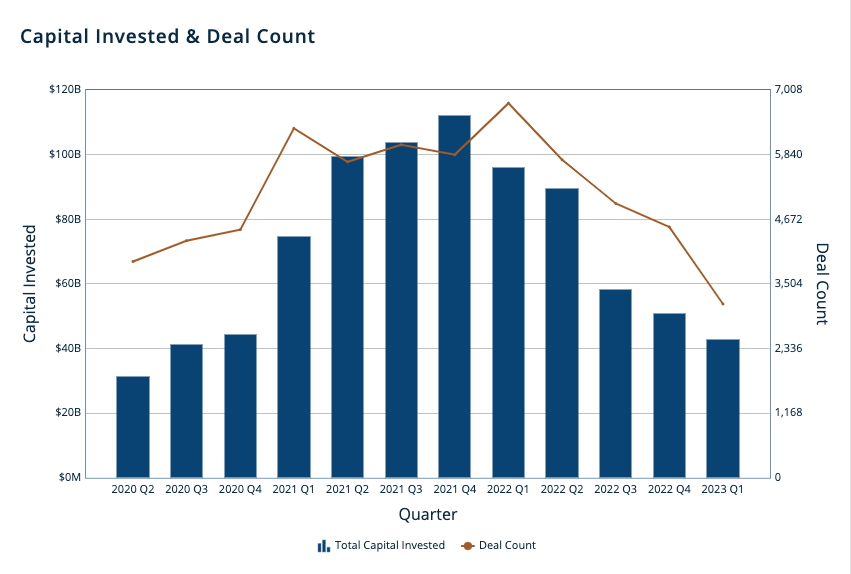
The capital constriction really started in Q3 2022. Here's a graph: https://techcrunch.com/wp-content/uploads/2023/03/Screenshot...
If I had to guess, bankruptcies like this peak sometime next year since many of these companies will find a way to last 24 months on their last fundraise.
Another recent example is Clutter, a moving company that raised $300m, who was forced into a fire sale for $30m.
Cynics would call it fake it until you make it, but for many businesses if they don’t look secure they will find it harder to get new customers in order to survive.
Oftentimes, the founders just grew too fast or flew too close to the sun.
So, there’s an opportunity to pick up the pieces and rebuild, or start from scratch with the learnings.
In most cases, the firm handling liquidation auctions off the firm’s assets, so if you have the motivation to pick up the pieces and grind out a sustainable business, you can usually purchase the tech and customer lists for six or low seven figures (varies based on size of business of course). If you actually pursue this, my advice is to make your offer as simple as possible (don’t ask for a bunch of diligence) and set an expiration on your offer so they don’t shop around. The liquidators are often not incentivized to maximize value - they just want to finish the project as painlessly as possible.
Not sure why this was valued at $3.8B. Wall Street investment bankers smoking crack while evaluating this one.
Well that puts you in a perfect position to value it.
VCs today go after shiny baubles, like “27 innovators under 27” nonsense, and have forgotten they’re mainly looking for high talent very resilient technical weirdos and any other characteristics are bonus.
We don't often talk about how everyone involved in a business takes on risk. This is a great example of all the employees risking being cut off from funds and health care.
Those employees won't be lionized for "learning from their mistakes" when they get a new (better paying?) job, will they?
Those employees also didn't get a say in how the company was run despite the fact that they were taking a serious risk, too. Probably a more serious risk than a founder, given that most founders are wealthy or backed by wealth.
Convoy closing sucks. But it does not suck at all as an illustration of the problems in startup culture . . .
Back that up
The California version of the WARN Act explicitly covers terminating business operations.
https://www.dol.gov/sites/dolgov/files/ETA/Layoff/pdfs/Worke...
I mean there must be something functional anyway at this point no matter how lean and mean.
I'll start the bidding at $1
You were paid a salary for your services while you were employed. You didn't give more, they didn't pay less. Now you're not - that's the end of the contract.
Yes, it's a nice thing some companies do when they lay people off but that can't be an expectation.
Employees do much more than they are contractually obligated to.
There's a reason why "work to rule", meticulously doing exactly and only what one is required to, is functionally a strike. Same with why there was all the uproar over "quiet quitting", where a worker only did their minimum job duties. So this is as acceptable as "quiet quitting" is.
In an industry where it's normal to do more than the bare minimum legally required, someone who does no more than the minimum required is blackballing themselves. These c-levels will never start a successful company again.
That's a recipe for disaster if prices move...
Exec's can probably be faulted to waiting until the last minute/dollar to close up shop to see if they could pull a rabbit out of the hat - but it seems there were about 500 employees also hoping against all hope that said rabbit would be pulled.
Advice for employees - when the writing is on the wall, read it, and plan/act accordingly - best to start interviewing for a new job before everyone else from the same company, in the same area, is doing the same thing.
A possible brokerage opportunity would be to inquire with Carvana or Carmax if you can buy slots on their cross country shipments as capacity allows, and sell those to customers. You'll be at the mercy of their schedules and capacity, but could be a service tier along with other more "white glove" services (dedicated driver "hot shot", semi shipment, etc). You could also buy capacity on freight rail cars shipping back empty to factories (depending on destination and routing). High touch biz, beware, there be dragons.
I think the fact of the matter is, shipping cars is not going to be cost effective for an individual. Trucks are expensive, putting fuel in them is expensive, paying a trained person to drive one is expensive.
Maybe a company like Carvana could offer this as a side service, drop your car off at a local Carvana, and eventually pick it up at another location. Even then, I think the costs are going to be order of thousands of dollars.
Just need to use a direct carrier like Intercity, NOT a broker. Brokers have infested Google SEO.
So because you mentioned it I just called them for transporting by enclosed carrier on the east coast between 2 cities. High end car enclosed carrier.
Intercity wanted $1995 for the same transport that the car dealer (a high end car dealer well established no less) want $1600 dollars for.
Intercity essentially said 'busy time of year etc etc'. Didn't give remarkable reasons why they would be better than anyone else. Picked up the phone right away and was otherwise business like.
https://intercitylines.com/request-a-quote/
Also their website to get a quote they want an 'auction' number. That made me call them (which I would normally never do.)
Additionally their price was higher than other brokers I had checked including the one that just moved a car for me (same route) not enclosed who quoted both enclosed and not enclosed.
Would like to point out that the job of a broker is not to match you with anyone but match you with people who they know and trust and have used. And specifically the broker I used (for the last open move) made a total of about $250 the rest paid to the driver on delivery.
As a consumer I'd assume there are hotshot truckers/services that would be used for this? People have mentioned similar "agent oriented" experiences with moving services and how it's opaque and unreliable.
My local dealer somehow got a lead that I want a very specific year and trim GTI and twice now they have offered to bring one in for me.
The ones carrying cars across the country for moves are quite rare, unscheduled, and harder to find. They also can't carry anything else besides cars on the transporters - you might almost have better luck driving your car into the back of a box semi and letting them load other LTL loads behind it.
You place anything you need shipped on there and various shippers can bid without having to go through a broker.
Do you want to foot the bill?
A wage labourer should be able to expect to know if they will be able to feed their families the next month.
Lol, lose more money than invested.
> A wage labourer should be able to expect to know if they will be able to feed their families the next month.
A wage laborer should make $1,000,000 per year.
But the job is very high revenue (thousands of dollars per cargo depending on the distance) but low profit (5%-10%) in these times.
The worst part though is when you're in that spot you should jump ship, unfortunately, there are sunk cost fallacies involved and sometimes a fair amount of equity that makes you want to try to hold on for just one more month. Who knows, maybe a miracle will happen or a deal will be closed.
I did not appreciate in my scenario that the founder REJECTED a buy offer for what would have been a life changing amount of money for me, because he thought it was too low. We were gone less than a year later, and in the final 4 months, we didn't receive paychecks and were told if we left it'd ruin an acquisition and we'd screw all of our coworkers over. So that wasn't fun. We never got bought and were peddled around the country like prized cattle to disinterested companies that didn't want or understand our tech. Very miserable.
Same scenario for me - so I left - and then shortly after they did sell. Argh.
So they WeWorked it. Instead of focusing on long-term growth strategy for a very good and sustainable business, the top management decided to get rich quickly, destroying the company. But I am sure they did get rich quickly.
Also see: Bed Bath & Beyond
"Please respond to the strongest plausible interpretation of what someone says, not a weaker one that's easier to criticize. Assume good faith."
"Please don't post shallow dismissals, especially of other people's work. A good critical comment teaches us something."
https://news.ycombinator.com/newsguidelines.html
Of course, if you have specific information about fraud or other bad behavior in specific cases, that could be relevant to a discussion. But quoting something generic and then using it as an internet cynicism trampoline is quite a bit below the quality bar for what we're looking for in this forum. It just leads to repetitive, tedious, and ultimately ugly threads.
It’s grown pretty normal over the last ~10 years for investors to enable founders to sell some of their own shares, thus taking some of the round directly into their pockets. Normally called “taking money off the table” the idea behind it is that a founder with a successful company should be able to participate in the success without forcing an early exit that might not be best for the investors.
Is this why BBB failed? My perception is that the retailer was stuck in 2000. The stores always felt stuffy.
And in the end, what do we expect? The executive classes show up, buy their way into these firms that are struggling but have some intellectual/data/brand assets, and the executives slam them into the ground, sell the valuable pieces that fall out, and then sail away to buy their way into other businesses. I was always told growing up that if you failed in business you lost money but it seems once you get to a certain size of business, you can count on either free money from the Government to keep the ponzi-scheme that is our economy these days from toppling over dead, or at the very least, sell the scrap components of a business you didn't build for other companies to hoard until they too collapse.