Definitely agree nobody will vote for anything that costs them anything.
But my kids are mixed race partial African heritage and I do think it behooves us as Americans to think about rectifying that terrible wrong on my wife's side of the family. There are dozens of examples of horribly wrong headed ways to do that (Brazil had some really creative and disastrous ideas), but we should at least acknowledge the lingering effects that still impacts people today that are descendants of slaves.
Maybe I'm just sensitive because it feels like Florida, where I currently live, is trying to wipe away that history. Why inhibit discussion about it?
What’s the rationale for distinguishing between these house valuations by attaching moral metadata to them? Everyone’s economic condition is path dependent. What’s the point of distinguishing between similar economic conditions based on that path?
The typical reason people focus on these economic effects is that Americans broadly agree that people don’t bear direct moral culpability for their family’s conduct or their ancestor’s conduct. So the focus shifts to persistent economic effects. But that just attaches that generational moral culpability to economic valuations. My wife’s inheritance isn’t worth anything because her grandmother was a waitress in rural Oregon. Why is that different than if your wife’s inheritance isn’t worth anything because her grandmother couldn’t get a bank loan? The economic conditions are identical, and the people with moral culpability are dead.
The important context is that there’s more people situated like my wife than your wife. Although e.g. 62% of black people made under $40,000 in 2016, and only 40% of white people, there’s still four times as many white people under that threshold than black people. What’s the logic of singling out a minority of people who are similarly situated economically and treating their economic circumstances specially because of what happened to their ancestors?
My take on your statement is similar to "If the economics of your area is not good, they can just move." Most areas where the economy is falling a person is incapable of selling their home since no one wants to buy their house. This leads to a stale mate of having to stay in the area because they cannot afford to move and doing so would just compound their poverty. Children are often the ones that leave because they are most likely have a near zero dept are more time to build up their economic mobility.
Rural houses where a more sound investment when 40% of the USA employment was agricultural. As the this industry became more automated, the value shifted with employment opportunities. These changes can also be seen in towns and cities built around manufacturing today.
The solutions between the two are the same. Social acceptance and assistance to provide economic mobility. Irony, is that these environments reduce social engagement producing tribalism like states where trust is lost between these groups. This is our problem and we need to stop thinking independently because this just leads to selfish behavior that harms our society.
Creating a better environment for others is a Win-Win versus creating a better environment just for you is Win-Lose or Lose-Lose resolution.
[0] https://publichealth.berkeley.edu/news-media/research-highli...
They were not often near oil refineries, or other sources of industrial polution. At best, you could argue that they were more often closer to it than the districts marked as "best" or "still desirable", but in all, very few of redline neighborhoods were close to industrial pollution. Go look at the actual maps https://dsl.richmond.edu/panorama/redlining/ and see for yourself. Typically, the redlined neighborhoods are conveniently located close to downtown.
> Rural houses where a more sound investment when 40% of the USA employment was agricultural. As the this industry became more automated, the value shifted with employment opportunities. These changes can also be seen in towns and cities built around manufacturing today.
In the context of redlining, observe that agricultural employment was already at around 20% when redlining started, and 5% when it ended, and also the redlined neighborhood were the ones with best commutes and job availability. This is still true, by the way: the ghetto parts of the American cities almost universally are centrally located, close to jobs and facilities, and they are well served by transportation infrastructure (in fact, this is one of the activists biggest complaints: that they're too close to freeways).
The way it’s often taught today is different. It’s teaching about the history as a way to justify or support calls for differential or remedial treatment in the present. And that has the opposite effect—it reinforces that we’re different, rather than being the same.
This is where Americans should wake up and learn some lessons from the rest of the world. Encouraging people to develop ethnocultural identity is something that has never worked anywhere in the history of the world. The idea that we’ll teach kids to see each other as different, but then assume those differences are all “good, actually” is a fantasy. The only way multi-ethnic societies have ever worked is to suppress identity.
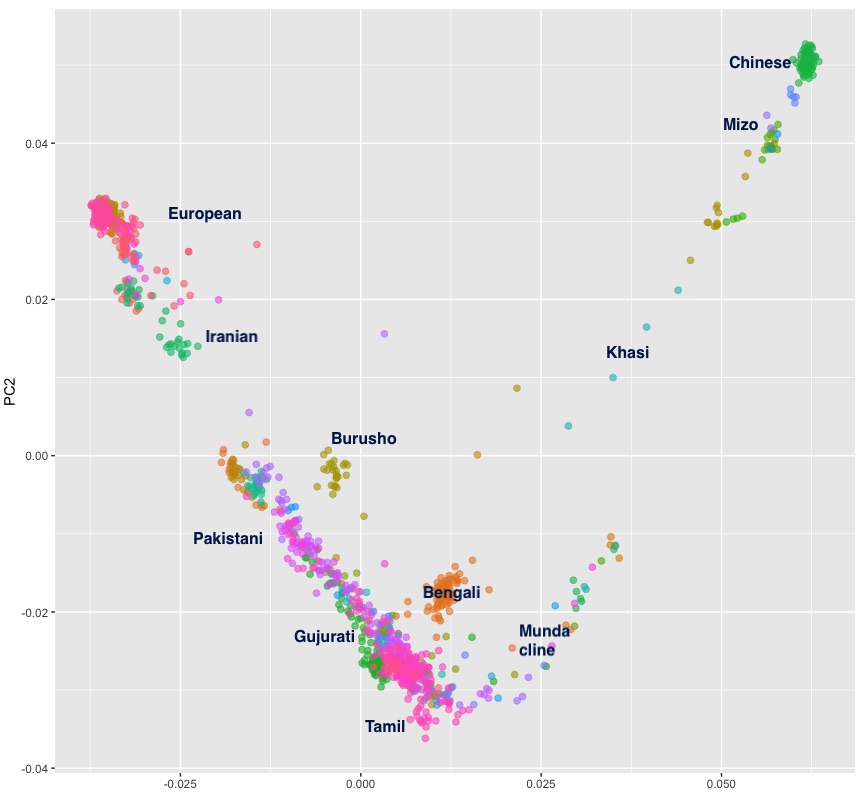
For example, “Han Chinese” would probably be several different ethnic groups if people were being honest. Likewise, “white people” are also several different ethnic groups—you can see the difference between French and German people in their DNA. They’re no more the same than are Bangladeshis and Pakistanis. What has suppressed ethnic strife in America between “white people” is the homogenization of the population and subordination of ethnic identities to a constructed, synthetic identity.
Funny anecdote: I live in a blue state, so they’re trying to teach my daughter about “BIPOC.” She’s the only Bangladeshi in the class, so her teacher gave her a book about a Pakistani girl, thinking she’d be able to relate. And I’m like “you’re not Pakistani. Pakistanis tried to genocide your poppy and grandma in 1971.”
One thing that you definitely can't trace in the DNA is "that group of people tried to genocide my grandparents", but that seems like an important "ethnic group" distinction to you.
This is not to dispute your main point which I take to be that you stop fighting over "ethnic" distinctions by giving people a new unifying identity, but I still find myself thinking that something is lost in the process, even if it is a proven approach.
Racism is everywhere, and often far more dramatic and in your face than what you are describing. What you are describing is still wrong! And was made illegal for a reason. But anyone coming from Asia, Africa, South America, and most of Europe is going to just shrug their shoulders at what you just described.
I have yet to see even the most progressive Western European country that didn’t have a huge hate against Roma/Travelers, or Indian community that didn’t have some serious Muslim/Hindu friction, or Chinese vs Non-Chinese, etc. And let’s not talk about Eastern Europe, or African tribal/clan warfare!
The issue here is that the more you talk about all the wrongs and specifics, the more you highlight finer granularities of identity, the more you base things on some small group, the more it splits everyone, the more different groups/factions end up getting created, the more finger pointing happens, etc.
The more people start thinking of us vs them, their identity and how they are different/split from everyone else, etc. and past grievances, the more they start thinking about retribution, control/exclusion, etc.
For an incredibly evolved version of this, check out a (brief summary of [https://en.m.wikipedia.org/wiki/Caste_system_in_India].
It ends up in a nearly infinitely Balkanized hellscape where the more someone knows about someone else, the more likely they will end up enemies than friends. And eventually, nearly everyone is an enemy with their neighbors, and sometimes even themselves.
If we try to focus on what should happen, and the best common identity we can, and punish divergences from that instead, at least we can be mostly going in that, someone similar direction. And have at least some idea what common elements we can be friends on, and what we shouldn’t talk about lest we become (likely) enemies.
It is far from perfect, but at least it has some cohesive identity and direction, rather than infinite levels of infighting. Nothing is perfect.
Together, we can be strong. Alone, we are weak and easy to pick off.
The issue the US always has had, is that really the only common theme between all its different groups, is the desire to make money, and be left alone to do what they want.
But then when times get tough, inevitably some groups want to make everyone else do what they want and/or take everyone else’s money.
You don't even have to go this deep. Each and every friend of mine who's German of mixed heritage (Black, Asian) has struggled with people who can't imagine a German not being white. As in you, a German born in Germany, get addressed in English every now and then by strangers, because if you're not white, you have to be a tourist.
It’s like “Bangladesh.” Literally, “country of the Bengalis.” If you aren’t brown with vaguely southeast Asian features then you’ll always be considered a foreigner. That’s not “racism.” That’s the nature of nations that arise from being the homeland of specific ethnolinguistic groups.
Ethnocultural groups like germans and Bangladeshis have ancient shared history, language, and culture. When you say that people should assume that anyone who looks any way should be assumed to be German, that erases Germans as a distinct ethnocultural group. It’s completely different than saying the same thing in a country like America.
My family has been in Bangladesh since before anyone can remember, likely back before the language split from vernacular Sanskrit. My parent’s generation fought the Pakistanis to establish the country as a homeland. You cannot, out of a desire to avoid offending a small minority, erase that shared history and reduce being Bangladeshi (or German or Japanese) to a legal designation established with some paperwork.
Not sure why you find that surprising. Being German is not written on your face. Since most Germans are white, most people will make the correct assumption that if someone is not white, there is a stronger likelihood that they are not German. The same happens in Japan with mixed race kids who get treated like foreigners even though they were born and spent their whole life in Japan. That's just how brains work.
If you had no prior assumption you could assume that nobody is who they seem to be and that would make things very complicated for everyday life.
As you say addressing non-white people in English does not happen very often. Why would it? There are so many immigrants that 30% of interactions in department stores supermarkets etc. are with non-white people.
When you are stopped by a security guard in a store, he is invariably of Arab origin.
If you want to see some European racists, go to a soccer/football match between national teams. Or ask a Northern European what they REALLY think about the south. Or even a Northern Italian about Southern Italians. Or ask almost any of them about Eastern Europe or especially Roma.
In many cases immigrants bring their own racism to the US that white Americans are completely unaware of. One of the only direct "racism in the workplace" complaints I've been party to in the workplace was Indian on Indian. Former team lead was fired and replacement was an Indian guy, from one particular caste/region I don't recall. Anyway he immediately tried to due-diligence the caste/region of the only Indian on the team. The rest of us had no idea what was going on until our Indian colleague rapidly found another job and accused him on the way out the door.
I've even seen some crazy resentment in the workplace between patriotic CCP PRC enjoyers vs Taiwanese coworkers "you aren't Taiwanese, it's not a real country".
It's not to excuse any past or present faults in the US, but only to raise the relative performance to other countries&group / how achievable the utopian Star Trek vision is. Our technology and living conditions have evolved rapidly, but HumanOS remains the same. We move ever forward, but its slow.
One issue that often escapes our attention when we focus on group identities and historical grievances is just how much we collaborate across groups. When a white woman (Katalin Karikó, Hungarian) worked on mRNA, the end results of that research were used by all groups and social identities. We collaborate across much more than we like to acknowledge.
But, I fail to see how your lengthy diatribe about modern day racism, most of what I agree with, disputes my comment about reparations. Those are totally different things and that's what I'm pointing out.
After all, there are practical problems of who is eligible, how long, and who gets to decide that.
Not only that, but at that point there is now strong financial incentives to be in specific groups. At least while the money flows.
Not everyone can be eligible, or it loses all meaning. Someone has to pay, or it can’t be funded.
Someone has to be officially the victim, and officially the offender, or such a program can’t actually exist. Etc.
These aren’t modern problems either, and this isn’t ‘modern’ racism, whatever that is. [https://en.m.wikipedia.org/wiki/Occupation_of_Alcatraz]
I hope we can build some common identity as “world citizens” or whatever- but the trend seems to go towards _more_ balkanisation and more division along class/wealth/privilege.
> Humans are tribal. [...], I don’t think just pretending we’re all one [tribe] will work. [...] I hope we can build [a] common [tribe].