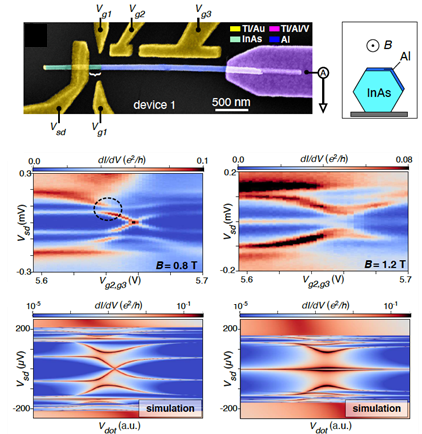
The idea behind topological quantum computing is to utilize quantum materials whose low-energy physics looks like an error correcting code. Since these systems are very large (macroscopic number of atoms), the error rates are (theoretically) very low, ie the qubit is fault tolerant by construction, without any additional error correction. In reality, we do not know how good these qubits will be at finite temperature, with real life noise, etc.
Moreover, these states do not just occur in nature by themselves, so their construction requires engineering, and this is what Microsoft tries to do.
Unfortunately, Majoranas in nanowires have some history of exaggerated claims and data manipulation. Sergey Frolov's [1] twitter, one of the people behind original Majorana zero bias peaks paper, was my go-to source for that, but it looks like he deleted it.
There were also some concerns about previous Microsoft paper [2,3] as well as the unusual decision to publish it without the details to reproduce it [4].
In my opinion, Microsoft does solid science, it's just the problem they're trying to solve is very hard and there are many ways in which the results can be misleading. I also think it is likely that they are making progress on Majoranas, but I would be surprised if they will be able to show quantum memory/single qubit gates soon.
[1] https://spinespresso.substack.com/p/has-there-been-enough-re...
[2] https://x.com/PhysicsHenry/status/1670184166674112514
[3] https://x.com/PhysicsHenry/status/1892268229139042336
[4] https://journals.aps.org/prb/abstract/10.1103/PhysRevB.107.2...
In my opinion, the citations above do not represent a balanced view of the Majorana field status but are rather negative. We published two experimental papers recently that went through a rigorous peer review process. Additionally, we have engaged with the DARPA team to validate our results, and we actually have them measuring our devices in our Redmond lab.
Finally, we have exciting new results that we just shared with many experts in the field at the Station Q conference in Santa Barbara. These new experiments further probe our qubits and give us additional confidence that we are indeed operating topological qubits. We will share more broadly at the upcoming APS March meeting. For more information, please see the following post by my colleague Roman Lutchyn: https://www.linkedin.com/posts/roman-lutchyn-bb9a382_interfe... ."
It is very cool to hear from you!
> In my opinion, the citations above do not represent a balanced view of the Majorana field status but are rather negative.
That's true, but the goal of the citations was to demonstrate there are some negative opinions too. Maybe together with positive OP these form a balanced view.
I understand that it can be very unpleasant to have people like Frolov or Legg trying to prove you're wrong, but I think it shoudn't be personal (from either side). Trying to find alternative explainations is part of science. And Frolov did turn out correct in past, and we did think we found Majoranas when in fact we didn't, and this part of the story can't be just ignored. Citing Feynman "The first principle is that you must not fool yourself and you are the easiest person to fool". While it's tempting to dismiss the critics as broken record, I think it would both increase the credibility of the studies and improve the science if their criticism was taken at the face value. Answering specific points publicly would also create more balanced picture. I'm not aware of the responses to the cited opinions that I could cite to "balance out."
> We published two experimental papers recently that went through a rigorous peer review process.
Peer review is important, but is not the answer to specific claims, eg that TGP accuracy is overestimated, or (if we take Henry's word for it) the promised errata that never came out.
> Finally, we have exciting new results that we just shared with many experts in the field at the Station Q conference in Santa Barbara.
I've read about it from Das Sarma's twitter [1]. It does indeed sound exciting. If you're able to manipulate, store, and read out quantum data from qubit, then I think people will have easier time to agree you have one. There is of course question of non-Clifford gates, but that's a separate problem.
> We will share more broadly at the upcoming APS March meeting.
I look forward to hearing about it. If you (or someone from your team) are interested, I'd love to meet and chat at MM. My contacts are in bio.
Edit: I've also now seen Chetan Nayak's comment in Scott Aaronson blog with some details [2].
You may claim that I have misunderstood something, all I can say is that that is 100% your fault, because you publish nothing but misinformation.
(That is the plural you, and I really do not care which one of you wrote the garbage, you work as a team and you get judged as a team.)
The long explanations boil down to this: quantum computers (so far) are better (given a million qubits) than classical computers at (problems that are in disguise) simulating quantum computers.
given a million qubits ...
"fault-tolerant quantum computing architecture based on noise-resilient, topologically protected Majorana-based qubits."
Microsoft's technology is pretty far behind as far as capacity but the scaling limitations are less significant and the error-correction overhead is either eliminated or smaller.
As soon as the first practical quantum computer is made available, so much recorded TLS encrypted data is gonna get turned into plain text, probably destroying millions of people's lives. I hope everyone working in quantum research is aware of what their work is leading towards, they're not much better than arms manufacturers working on the next nuke.
but here’s what perplexity says: “Exponential Error Reduction: Willow demonstrates a scalable quantum error correction method, achieving an exponential reduction in error rates as the number of qubits increases125. This is crucial because qubits are prone to errors due to their sensitivity to environmental factors25. ”
It has progressed since: IBM Condor (demonstrated in december 2023) has 1121 qubits.
In the wake of cryptocurrency and AI failing to live up to their outrageous levels of hype, many people on this site worry that the "feel the AGI" crowd might accidentally start feeling some other, seemingly-profitable vaporware to overhype and pump.
Come to think of it, maybe we shouldn't invent quantum computers[0].
[0] Yes, even with the upside of permanently jailbreakable iPhones.
But if we were to get bigger and better quantum computers, we should use shor's algorithm. And that would, in fact, break the crypto behind HTTPS, SSH, smard-cards, and effectively all other forms of asymmetric crypto that are in use.
There is a question how likely bigger and better quantum computers are. A decent case can be made that it is unlikely they will grow fast. But it is going to far to say that shor's algorithm is useless because current quantum computers aren't good enough. You can't dismiss the possibility of quantum computer growth out of hand.
It is frustrating to try to unpick the hype and filter the “will never work” from the “eureka!”
Each "quantum" announcement will make it sound like they have accomplished massive scientific leaps but in reality absolutely no "quantum computer" today can do anything other than generating random numbers (but they are forced to make those announcements to justify their continued funding).
I usually get downvoted when making this statement (of fact) but please know that I don't hate these researches or their work and generally hope their developments turn into a real thing at some point (just like I hope fusion eventually turns into a real / net positive thing).
Any sentence in the press release that isn't VERBATIM in the paper should be viewed as marketing, and unsupported by the science, and there is zero incentive NOT to lie in the PR, especially since the ones writing it are rarely even knowledgeable in the subject matter.
https://cacm.acm.org/news/majorana-meltdown-jeopardizes-micr...
Maybe I'm too cynical, but I suspect pressure from leadership to package whatever they had in vague language and ambiguous terms to create marketing copy that makes it appear the team is doing amazing work even though in two years we'll still be in roughly the same place we are today wrt quantum computing.
Reading through the announcement I see lots of interesting sounding ideas and claims that don't matter "designed to scale to a million qubits on a single chip" (why does that matter if we're still far, far away from more than a few thousands qubits?) and zero statements about actual capabilities that are novel or ground breaking.
> In fact, there was some controversy over the first attempts to do so, with an early paper having been retracted after a reanalysis of its data showed that the evidence was weaker than had initially been presented. A key focus of the new Nature paper is providing more evidence that Majorana zero modes really exist in this system.
https://arstechnica.com/science/2025/02/microsoft-builds-its...
Long Term - MS seems pretty committed and serious. Putting in the time/money for a long term vision. Maybe a decade from now, we'll be bowing down to an all powerful MS God/Oracle/AI.
So they are not all in a superposition with each other? They talk about a million of these nanowires but that looks a bit like quantum dots?
>can create an entirely new state of matter – not a solid, liquid or gas but a topological state
There are in fact other forms of matter. In plasma you just have ions (instead of atoms/molecules) just zipping about. In neutron stars, you have pretty much only neutrons collapsed into a packed ball.
You can also make systems at higher levels of abstraction that have some of this matter or particle like behavior. A simple example is "phonons", which are a small packet of vibration (of atoms) that travels inside a solid much like a photon travels through space. I think phonons don't have a "mass", so they are not matter.
Here, they construct a quantum system, some of whose degrees of freedom behave like a matter particle. Qubits are then made from the states of this particle.
For example in some cases they have a "gas" of electrons. It's not a normal gas that you can put in a balloon, it only can live inside a solid. If you ignore the atoms in the solid, in some cases the electrons are free enough to think they are a gas. That is similar enough to a normal gas, and then they just call it a gas.
Sometimes the interesting part is a surface between two semiconductors, so they may have a 2D gas. (I'm not sure if this experiment is in 2D or 3D.)
Sometimes the electrons make weird patterns, that are very stable and move around without deformation, and they will call it a quasiparticle, and ignore that it's formed by electrons, and directly think that it's a single entity. And analyze how this quasiparticles apear an disappear and colide with other particles. It's like working on a high level of abstraction, to make the calculations easier. [2]
In particular, if you arrange the electrons very smartly, they create a quasiparticle that is it's own anti-quasipartilce. In particular, this is a Majorana quasiparticle.
This is somewhat related to topological properties of the distribution of the properties of the electrons. Were topological means that is stable under smooth deformations and that helps to make it also stable under thermal noise and other ugly interference. But this is going too far from my area, so my handwaving is not very reliable.
[1] They probably think my area is weird, so we are even :) .
[2] Sometimes the high level abstraction is not an approximation.
I found this video by minutephysics with more details https://www.youtube.com/watch?v=KbsnY--LFh0 It's not super technical, but I think it my clarify my explanation and add more details.
- Topological phases of matter (similar, but not identical to the one discussed here) have been known for decades and were first observed experimentally in the 1980s.
- Creating Majorana quasiparticles has a long history of false starts and retracted claims (discovery of Majoranas in related systems was announced in 2012 and 2018 and both were since retracted).
- The quoted Nature paper is about measurements on one qubit. One. Not 100, not 1000, a single qubit.
- Unless they think they can scale this up really quickly it seems like its a very long (or perhaps non-existent) road to 10^6 qubits.
- If they could scale it up so quickly, it would have been way more convincing to wait a bit (0-2 years) and show a 100 or 1000 qubit machine that would be comparable to efforts from Google, IBM, etc (which have their own problems).
It is unfortunately unclear how good the topological qubits practically are.
But they are doing a full court press in the media (professionally produced talking head videos, NYT articles/other media, etc, etc) claiming all of those things you've just said are right around the corner. And that's going to confuse and mislead the public. So there needs to push back on what I think is clear bullshit/spin by a company trying to sell itself using this development.
Your comment could get an award for most toxic HN comment ever and that's saying something.
If that is true, it sounds like having a plan to scale to millions of logical qubits on a chip is even more impressive.
Microsoft has claimed for a while to have observed some signatures of quantized Majorana conductance which might potentially allow building a qubit in the future. However, other researches in the field have strongly criticized their analysis, and the field is full of retracted papers and allegations of scientific misconduct.
Roadmap to fault tolerant quantum computation using topological qubit arrays https://arxiv.org/abs/2502.12252
The majorana approach (compared with more mature technologies like superconducting circuits or trapped ions) is a long game, where there are theoretical reasons to be optimistic, but where experimental reality is so far behind. It might work in the long run, but we're not there yet.
I've held the same view that this stuff was sketchy because of the previous mistakes in recent history but I do not work in the field
> While all players are selling a dream right now, this announcement is even more farcical.
Thanks a lot, I didn't get disappointed.
More cynical still: what exactly has the Strategic Missions and Technologies unit achieved in the last few years? Burned a few billion on Azure for Operators, and sold it off. Got entangled and ultimately lost the JEDI mega deal at the DoD. Was notably not the unit that developed or brought in AI to Microsoft. Doing anything in quantum is good news for whoever leads this division, and they need it.
On the bright side, this is still fundamentally something to be celebrated. Years ago major corporations did basic science research and we are all better off for those folk. With the uncertainty around the future of science funding in the US right now, I at least draw some comfort in the fact that its still happening. My jaded-ness about press releases in no way diminishes my respect for the science that the lab people are publishing.
https://youtu.be/wSHmygPQukQ (~7:55)
I don't know if marketing BS could get more hyperbolic than this.
I mean my basement can scale to holding thousands of bars of solid gold, but currently houses... 0.
Quantum is just the next form of sampling the electromagnetic field. It’ll provide mesmerizing computational properties but not rewrite human DNA or beam our consciousness to another galaxy; it’ll fill up RAM and disk really fast with impenetrable amount of data it will take decades to analyze and build real experiments across contexts to verify. Tomorrow will still come and be a lot like yesterday for us.
All in all it’s more of the same
Even if it we do beam our minds it’s just a copy. These meat suits still gonna stop experiencing someday. Life for us isn’t going anywhere.
Maybe, one day, or never.
In the mean time, it will generate a lot of hot and humid hype.
Nonsense. Many of us have installed that glitchy software that makes our screens orange sometimes.
> but not rewrite human DNA
smugly but writing DNA is a quantum process
Is there any way to secure at all?
* see Lamport signatures
https://qdev.nbi.ku.dk/research/topological_quantum_systems/...
No. And it needs telemetry too. Scrollbars are optional. Abusing transient windows, are not.
It makes the statement unfalsifiable: no matter how long it takes, how twisty the path turns out to be, it will always be a direct path, because what is a path after all if not direct?
He didnt say shortest path, quickest path, or any other qualifier that would set visions of nodes and edges and Graph 101 dancing in our nerdy little heads. It's marketing. Good marketing. I hope they can deliver on it.
However, this announcement is a nothing-burger. As I mentioned down-thread, you should view any QC announcement/press-release with extreme skepticism unless it includes replicable (read: open-source targeting hardware other researchers can test on) benchmarks for progress on real-world use-cases (e.g., Shor, Grover, or a newly-identified actually-interesting use-case). OP does not. Nothing to see here.
Worth saying, I am not a cryptographer—I do cryptography-adjacent research engineering. However, given the level of hype going around this industry, I think it's fair to at least expect to see the spec-sheet as it were.
All the best,
If their claim is true, then would that present an issue to RSA encryption? I find it difficult to find information on this topic that is digestible to a layman.
My understanding is that the benefit of quantum computing is parallelism, and I'm not sure how today's encryption standards would be safe from brute force attacks.
IMO new breakthroughs in our understanding of physics would be needed first to make substantial progress in QC. As long as MSFT isn't investing in attosecond lasers or low temperature experiments, RSA will remain secure.
All the best,
The people who signed off on this name a) do a lot of drugs or b) didn't notice because they have never come anywhere near weed
From the user's perspective, of course.
I rue the day that I decided to play the game of "What word is Majorana 1 similar to?"
Cuz, and I know the armchair psychoanalysts will have a field day, this is what my mind pieced together...
Major ana*1 (remove the asterisk and treat the one like an ell)
What is Win 11 boot time on this processor ? Will it be supported in the next version of Windows ? /s