In 1990, there was no difference in life expectancy between wealthy white Americans and comparably wealthy Europeans (Fig 3 in the first link) Since then a gap has opened up among all levels of income (even the wealthiest white Americans now have lower life expectancy than comparably wealthy Europeans.) The second link looks at the biggest death causes (heart disease and cancer being #1 and #2) and conclude Americans have worse outcomes for both of these conditions.
Basically, Europe continued to improve while America stagnated in life expectancy over this time.
Interestingly, even in 1990, comparably poor Europeans had longer life expectancy than white Americans. So this isn't exactly new, but it seems all of American life expectancy has been stagnating, and wealth can only mitigate this to a certain degree.
This has very little to do with location or genetics and everything to do with education and culture.
When I visited New York a few years ago I was shocked about how much smoking there was everywhere.
Of course, people didn't quit nicotine entirely, many moving to snus[1] instead.
Every one of those points is also true in Europe (apart from possibly healthcare), unfortunately. Car dependency and car-centric development is almost everywhere, places like the Netherlands are an outlier. Fast food and ads thereof are also everywhere. Many people smoke. Etc.
It's the degree of things. I live in Ireland, in a village of a few thousand people a few km outside the city, what you might call a "suburb" in the US. I don't even have a driver's license. It's rarely an issue and can go about my life by foot. bike, and public transport.
Not anywhere near US levels. Netherlands isn't an outlier. You can get pretty much anywhere in Switzerland with good public transport. Denmark, Germany, Austria, Northern Italy, France, Belgium, all have excellent public transportation networks with wide coverage.
> Many people smoke.
This is the one "healthy living" area where Europe lags the US. But many people in the US vape and I'm not sure it's any healthier.
Less so than regulation, just the market making it difficult for a lot of people to eat healthily, less-processed, and fresh with regularity.
This is talking about places that don't have a Whole Foods nearby. (Or often any grocery store!)
Sometimes my wife convince me to try American candy/foods that we buy in these "foreign foods stores" locally, because she grew up eating some of them in her country.
And every time we check the contents by reading the nutrition-labels or checking with apps like Yuka, it turns out that the stuff Americans put in the mouth and stomach are filled with stuff that is outright illegal to put in foods here in Europe.
So if I were to guess, it would be related to what is legal to put in foods/consumables.
It sometimes is annyoying though, especially around foods and medicine when something is not yet approved in Europe e.g. It's really hard to get Allulose (sugar alternative with similar properties benefitting baking); As far as I can tell it's not actually "illegal" in Europe, it's just not approved as a food, so no-one risks importing it..
https://impact.economist.com/sustainability/project/food-sec...
Which is also indirectly related to universal healthcare: since sick people cost money to the state, the government is incentivized to regulate foods more closely.
Therefore, things like public smoking bans (as we have in the UK) as well as public health campaigns around alcohol consumption and healthy eating become palatable. Regulating harmful foodstuffs becomes more important. The cost of smokers' adverse health was (and still is) enormous, and reducing that burden benefits everyone.
The true issue is secondhand smoke. That for me is what it all is about: preventing unwilling people from being exposed to smoke, full stop.
About as many people die from smoking than from secondhand smoke. Think for a minute how horrifying that is.
Large portion of americans eat like they have free healthcare.
What shocked me about the US when I went, was how much peptobismol people chugged down. There was not one meal in my 1 week stay there that I could digest without issue.
https://publichealth.jhu.edu/2024/americans-die-younger-than...
It's wild what you guys can find in your food. An example that keep baffling me is the near-impossibility of finding bread that isn't sweet in the US.
My understanding for Scotland/England it is a question of alcohol/drugs to some degree. I suspect it is similar for the comparison to US.
That means poorer countries tend to have worse healthcare, and less good outcomes.
It’s much more than money.
https://www.nationhoodlab.org/the-regional-geography-of-u-s-...
Obesity is primarily caused by the 1-2000 micro-decisions we make each year about what to eat, when, and how much. A free visit to the doctor now and then is just not going to move the needle much on that one way or another for most people, most of the time. Even if it could we have to ask why a $0 doctor visit would be so much more effective than a $100 doctor visit.
No, the effects you're seeing what Europeans are more fit than Americans on average is coming from somewhere else. I think the real answer is the obvious one: Food here in Europe is simply worse tasting than in the US in general. I've been here for 5 years across twice as many countries; I've never had a pizza here that even matches Little Caesar's back at home, in terms of lighting up my little monkey neurons, to say nothing of Costco. If I ever go back home I will break and get one of the two within a week of reaching the airport.
Capitalism is an optimization process that has optimized the heck out of food reward signal. Your only real options are either to be poor enough that capitalism doesn't care about getting you the 'good stuff' - easier said than done when being poor sucks, and when the good stuff is constantly getting cheaper over time anyway - or you fight back with even harder optimization in the reverse direction. You could argue Europe is some mixture of both compared to the US.
All the baby boomer men in my family would be dead if it wasn't for the American health care system.
Even suffering heart attacks, they didn't miss a beat to get back to going out to eat, drinking beer/wine and being massively overweight.
If you go to any restaurant at night it will be packed with fat old people stuffing their face. Most on medications so that they don't have to change their lifestyle.
No country has ever had the BMI of old people that America has right now. It is a wealth curse.
I think the proximal answers for "why" are in the World Health Report, which tells you why people die.https://www.who.int/data/gho/publications/world-health-stati...
Some of those you'd assume are to do with health care in general, but some (alcohol and tobacco consumption) are more like direct causes in and of themselves.
Probably best not to go all at once. ChatGPT estimates the shoulder-to-shoulder standing capacity of San Marino is only 244 million people!
The US can claim "#1" status in 3 areas only:
- a large number of top-class research universities (other countries have these two but in much much smaller number)
- the most dominant military-industrial complex
- deregulated pro-business environment that is a good place to make a fortune if you're talented & lucky, or know how to bullshit investors
Take the absolute value and the numbers and you get an ok map of how likely someone is to be trying to mislead you if they're comparing all of the US to just this one nation.
You could make a pretty similar map with US states vs US average.
Correlation is a hell of a drug[1].
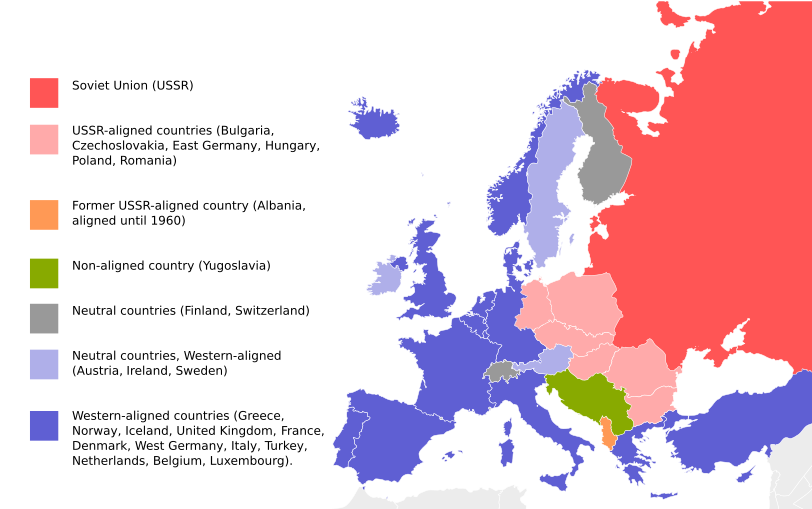
The parts of Europe that weren't a part of Soviet overwhelmingly have better life expectancy than USA. Including the ex-soviet/communist states is like adding Mexico to US statistics.
Edit: Map of the soviet blocks, you can see it very closely correlates with this life expectancy map. When people compare Europe to USA, they compare western Europe, the soviet block states are not relevant in the comparison.
https://upload.wikimedia.org/wikipedia/commons/c/cd/Europe-b...
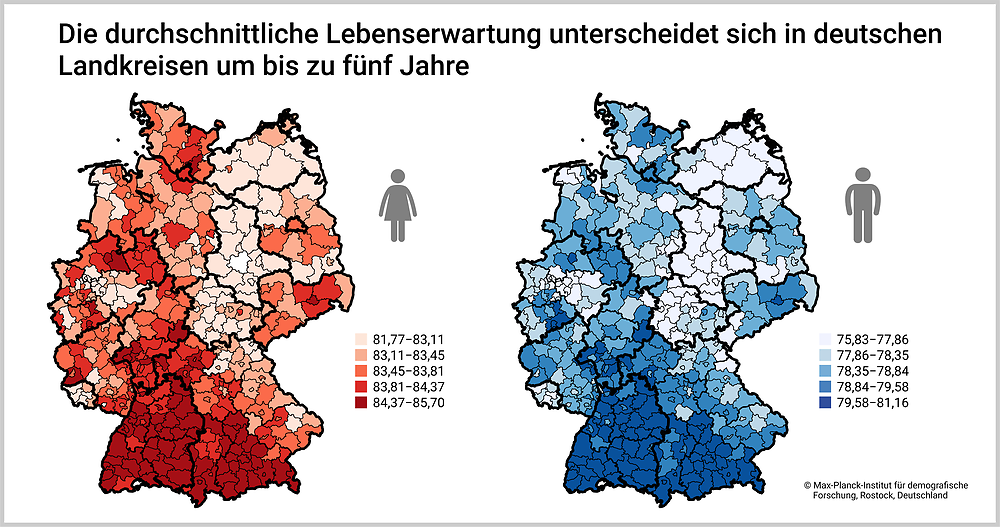
A clear East vs. West and to a lesser extent North vs. South difference is obvious. In Western Germany, most region with very low life expectancy are those regions that were under strong economic pressure in recent decades (usually former mining areas, such as the Ruhr Area and the Saarland).
Here is a 2020 map of life expectancy: https://www.demogr.mpg.de/media/13419_main.png
And here a 2019 map of household income: https://www.wsi.de/de/einkommen-14582-einkommen-im-regionale...
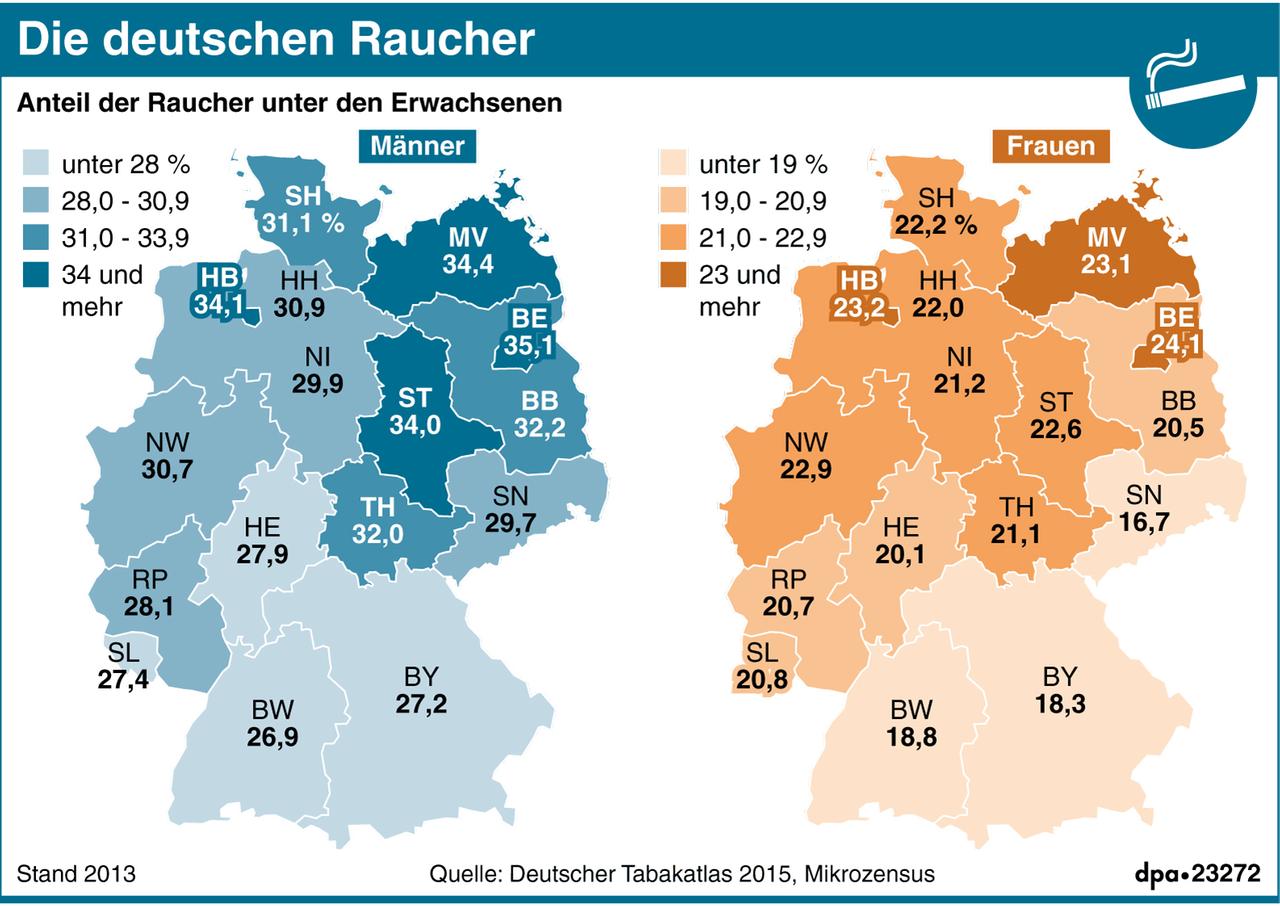
Differences is smoking might also have an important impact. Here is a 2013 map: https://bilder.deutschlandfunk.de/FI/LE/_f/47/FILE_f4790b165...
This seems to imply an even closer correlation.
Of course, correlation does not imply direct causation. The underlying causalities might be various, complex and different from region to region.
So I expect the picture of future retirees will look very different between countries with growing economies and the ones with declining/stagnating economies.
Those are basically all in yellow on that map.
So I guess the positive ones are the "democratic socialist" countries?
> Social democracy and democratic socialism are related but distinct political ideologies. Social democracy, often associated with the Nordic model, focuses on regulating capitalism to create a strong welfare state and reduce inequality through social programs, while generally supporting a mixed economy with private ownership. Democratic socialism, on the other hand, envisions a more fundamental transformation of the economic system, often including greater public or worker ownership and economic democracy, while also emphasizing democratic principles.
All countries in West Europe implement social democracies. They greatly outperform the US.
Countries in Eastern Europe are still enduring their legacy of communism/democratic socialism, but 30 years ago they experienced a radical swing towards the blend of neoliberalismo professed by the US.
Lastly, you look at data showing how the US greatly underperforms in key quality of life metrics, and the conclusion you opt to extract is cherry-pick those to look down on? That's tragic.
Probably loads of other differences too.
It has always baffled me a bit that Europeans keep making this basic type error, by comparing individual European countries that were relatively cohesive and healthy until recently, to the whole of the USA that suffers from a whole host of benefits of diversity. Europeans simply have no understanding of the real America beyond what they see in movies or hear on Reddit. How could they, most people in America don’t even have a clue what America really is like due to endless barrages of propaganda from childhood on.
Isn't USA a country? How is a country-by-country comparison "typical Reddit ignorance"?
I'm gonna use my typical Reddit ignorance to guess you are indeed from the USA.
Many states in the US are as large as countries in Western Europe. Both Texas and Alaska are larger than France in land size.
If the US broke apart, California and Texas would take 2 slots in the top 10 world economies (by GDP) with NY at 11 and Florida behind them beating out Spain. Less known states (in terms of world recognition) beat out many countries too. Illinois beating Switzerland & Pennsylvania running about even. Ohio, Georgia, Washington (the state, not dc) N. Carolina soundly outpacing Belgium, Sweden & Ireland. etc
For size, population and GDP, the combined countries of west Europe (that is fuzzily grouped together for these purposes) is comparable to the collection of states in the US. Thus, should either be compared by similar US State to single European country, or USA to the Western Europe conglomerate of countries.
That is how many Americans see the US. Culture, customs and even beliefs and language* can vary between states in ways one would think they are in a different country. This way of American's seeing the US vs Europe also relates to geography, sure, most Americans can't point European countries on a map and name them, but how many people outside NA can locate & name US states that are not CA, NY, or maybe TX?
* yeah it's pretty much all english, but there are a few distinctly different version of english where some could have trouble understanding each other (as can happen in large countries). Some 13% speaks Spanish. While it's all Spanish, Texas Spanish is not the same as California Spanish; try using your very limited Texas Spanish in Spain if you want funny looks.
The simplest things are incomprehensible to you due to seemingly emotional states of mind, like that comparing the Netherlands to the USA is a nonsensical exercise in performative intelligence.
You were told the USA is a country and the Netherlands is also a country; thus you cannot even realize that violating the two is logically and realistically insane. In sure you’ve seen Idiocracy, right? It’s like that scene where the “cabinet” keeps repeating the phrase about “Brawndo being what plants crave” as the protagonist is trying to explain the use of water to grow plants.
I wish you well and hope you can break free of the little boxes you’ve been conditioned to think in by your masters.
Your access to booze, cigs and healthcare is very different in NM than it is in MA.
The first one doesn't include a few European countries. The second is completely backwards - health generally has been on the way up across the board for decades.