I kept scrolling though multiple articles as they seem to have a format type for these types of articles where its numbers a small paragraph and a high quality photo. Simply love it.
Is this good archaeology? I worry it might be something else.
At Karahan Tepe is the pit full of pillars, with the human-face head on the outer rim .. whenever I see this pit, I get a picture in my mind that the entire site was green and fertile, and this pit was filled with water. It would be the ideal device to teach kids to swim - and so on. It's such a fascinating human discovery - the mind serious wanders.
I encourage anyone who is new to this subject to let the imagination run wild. What kinds of people could create these T-shaped pillars, carve them, use them in their building construction .. and then some day, decide to cover it all up with rubble and stone, to be buried for millennia and discovered by some strange, future civilisation.
It makes me wonder what, 12,500 years from now, of our own crazy civilisation might be unearthed, and strange new utility assigned to their purposes ..
What makes me wonder is that why did these hills survive, and why are we not finding similar things in north Africa and other civilization cradles.
Maybe these were one off sites with limited use and were later just left alone, while anything in Egypt had continuous settlements so things just eroded over time, with the things like pyramids as exceptions.
To directly answer your question though, the Tas Tepler sites survived because they were buried and the locations they're in are pretty bad places for people to live today. They're way up on hills around the urfa/harran plain where there's outcroppings of the stone used to build them, but also without water. People seemingly just carried water up the hills from cisterns farther down. The locations of those cisterns also suggest that there may be further sites we haven't found, because some of them don't correspond to anything we know of.
Colonial New England barely exists outside of active preservation attempts.
In my honest, personally informed opinion, there is much to be said for ignorance of the subject - and I don't mean you personally, just generally - at large - human cultures have a very intractable level of mystery, among our languages and human history, as a whole.
In anticipation of this fact, I personally invest myself in certain mysteries. The Tepe civilisation is one - but the things to be learned at Narwala Gabarnmang, are .. personally, I admit .. astonishing.
We do in fact have tens of thousands of years of human history to comprehend.
The issue is, we rapidly discard a lot of it in the rush to preserve just a bit of it.
So if you look at Africa it stayed for the longest times with hunter & gatherer cultures until neolithic settlers came back into Africa from modern Turkey.
Moreover Africa in large parts is either moist or desert/savannah, both of which do not help preservation. And there are simply much fewer archaeologists going around Africa.
Possibly covered by the Sahara, or if we're talking along the coast, underwater. Or covered by current settlements.
> other civilization cradles.
Because people still live there and built on top.
I hold some hope for new methods of underwater archaeology to uncover sites on the southern coast of the Black Sea and in the Persian Gulf. The latter especially because it was vast, rich floodplain during the last glacial maximum, and the oldest known true cities sprouted into existence on it's northern shore pretty much instantly after it flooded. I like to think that the oldest city ever built lies submerged in mud and water somewhere in there, just waiting to be found.
(Not that there would be necessarily much to find anymore, they probably didn't build out of rock.)
Because it's low density arid scrubland that is primarily inhabited by Kurdish and Turkish herders, and was a no-go zone during the PKK Insurgency.
I get it though, it'd be interesting to consider it, but like I said we'd need to forget things first for a long time. But another thing to consider is that the ancient Egyptians had archeologists for ancient Egyptian stuff already, with their history going back from 3000 BC to 30 AD.
I totally agree that the tepes challenge our timeline of when humans made cities and whatnot, but so much of their arguments is the perfect fit of stones or how flat stones are and saying it _must_ be done by modern tools.
I think they have left out how much you can get done from a construction standpoint when you have forced labor or no labor rules like we have had for some time now all over the world and especially in the West.
When I was first in Delhi and went to the Red Fort, I was shocked when they said they built the whole thing 100s of years ago in 9 years. Think about how long it would take us to build something like this now. https://en.wikipedia.org/wiki/Red_Fort
So, I really want the ancient atlantis civ in the Sahara to be true, but the guy's I've seen promoting this are too removed from the scientific method to really be taken seriously.
This guy does some good debunking of a lot of the Netflix/Youtube Alt Archaeology people -- https://www.youtube.com/@miniminuteman773
I saw a video where as a stunt a residential construction crew went from a vacant lot to a complete single-family house ready to occupy in less than two days. And that wasn't a prefab house, it was a regular wooden frame suburban house built using all the usual construction methods. They did it by staging all the materials right there and having all of the carpenters, roofers, painters, electricians, plumbers, etc standing around ready to jump in as soon as they were needed. Granted that was a small project, but the point is that with a sense of urgency construction can proceed quickly, and it doesn't require sacrificing worker safety.
I assume it was a limited number of people how knew how to make things and they kept roaming around setting new sites etc. Similar to bridge engineers etc. most of what they make just disappears in the background but they keep building things that makes our modern life possible.
It's time to kill the "slaves built the pyramids" myth. "Aliens built the pyramids" has exactly the same amount of evidence.
Unless you're referring to wage-slaves, who definitely were the middle-management of the crews. We've found graves of Jewish construction bosses.
Do they? We know non-sedentary people in the Americas sometimes built large mounds and extensive fish works.
https://www.reddit.com/r/Archaeology/comments/kxquwx/is_gobl...
Links?
definitely sedentary neolithic people had forced labor. all the Sumerian legal texts that were some of the first writings ever included legal definitions of slaves, for example. but the pre-neolithic Anatolian people were nomadic animistic people with no social hierarchy.
It is absurd to claim "hunter-gatherers were fairly egalitarian" and "had no hierarchy." We know that tribes in north west of the Americas, pre European contact, did not practice agriculture and had slaves. What evidence exists counter to this that supports your view? I assert it is literally impossible to make your assertion. Just because burial perhaps didn't differentiate or demonstrate a hierarchy, that doesn't support that the living didn't.
Citation required.
The truth is, we don't have much but speculation and narrative about the people of Gobekle Tepe, and even assumptions about them being hunter gatherers at all are based on centuries of bias and assumptions, with a whole lot of cultural chauvinism and religious nuttery baked in for good measure.
We're going to have to start analyzing humans more skeptically and rationally, as opposed to taking most of the modern historical narratives as gospel.
Modern humans have existed genetically for 300k+ years. At one point about a million years ago, the Early Pleistocene bottleneck had the population of human ancestors under 2000 individuals. 700k years later, the first modern humans were born, and the first situations in which we had the opportunity to establish culture.
We know from the great north american megafauna die off, climate records, and archaelogical evidence that something happened around 13k years ago to basically reset whatever human civilization there was. It took around 3000 years before the "neolithic revolution" , cultures demonstrating mastery of stone tools, pottery, more sedentary lifestyles, specialization, and so forth. It took another 4,000 years to reach the point where we had started creating written records again, started creating monuments and technology sufficiently durable to last to modern days, and then so on and so forth, with relatively uninterrupted and steady progress to the present day, each culture and age building upon the previous.
I think it's silly to think that it's only in this last 12-13,000 year period that we reached any of the cultural and technological milestones, and that every culture previous to that must have been hunter gatherer, because hunter gatherer are the default "feral human" prototype culture.
We bred dogs from wolves successfully around 45k years ago. That would have taken a generation or two in a nomadic context, or one really spectacular single lifetime for a sedentary person. Even so, you think that for the 250k years prior to that, not a single culture developed writing, wheels, pumps, discovered metal forming, or other technologies?
The human population was scarce, and because of that scarcity, the majority stayed in the absolute best, premium locations - beachfront. A vast proportion of settlements would now be well off the coast, and we have indeed discovered artifacts and evidence of such in various places where researchers have looked.
I'd be willing to bet good money that over the last 300k years there are many 10,000 year cycles and catastrophes where civilizations have risen and fallen, many achieving high levels of technology, perhaps even discovering electricity, advanced chemistry, medicine, and so on, but due to catastrophes, small populations, they got reset back to baseline. I'd bet that it didn't happen 30 times, as often as possible during the course of events, but I'll also make the claim that our current peak of civilization isn't the only good run that human race has ever made.
We are probably the only ones that made it to mass production, definitely the only ones that succeeded in scaling up resource extraction to the levels we saw back in the 1800s. I think there are probably caches of artifacts, evidence left out offshore that technology will make visible to us, that will show a much richer tapestry of events and cultures and history than the somewhat limited and biased narrative that modern historians have put forth as definitive.
funnily enough, the lack of neolithic culture, social hierarchy, or permanent sedentary lifestyle (all hallmarks of "civilization") and all archeological evidence suggests they were much healthier and more peaceful than neolithic humans. that's why people link "Garden of Eden" mythology originating in ancient Sumeria to the ancient peoples' observation that people became "civilized" but at what cost since it made humans less healthy, more violent, and presumably less happy due to the novel concept of social inequality
If you mean to say and advanced civilization, then no this isn't really upsetting any orthodoxy.
You would have thought that in a world with curious billionaires someone would pay for a ROV submersible to explore that, I certainly would if I were one.
Before the last glacial period == 100,000 year ago. This is 12,000 years ago. If we assume (big big assumption here) that there's only really a single unbroken line of civilization, and also assume (big big assumption) roughly exponential growth till now, then no, 100kya would be too long ago.
But those two assumptions are not really safe to make. It's just that we _can't_ know yet.
I suspect that the Sphinx water erosion thing is real and correct, and the Sphinx much older than ancient Egypt.
https://www-trthaber-com.translate.goog/foto-galeri/karahant...
They must think we're stupid.
That's when I realized the guy was a kook and it was all rubbish. He was into it for the money, btw. The "click-bait" of the time. And in my opinion Hancock is Däniken's spiritual descendant.
I don't think we were in any doubt about the ability of people 12,000 years ago to think abstractly.
Why throw interdisciplinary shade?
> I haven't seen any indications of paint residues on the pillars, but we know that many of the statues in these enclosures were also painted bright colors that would be missed by a digital reconstruction.
Wouldn’t a digital reconstruction just have whatever textures were selected? If there’s no indication of paint residues, they can look for other clues of course. But, without any other evidence, what’s the alternative, right? Guessing would be bad, don’t want to mislead people.
Wouldn’t a digital reconstruction just have whatever textures were selected?
But just to highlight some knowledge gaps, it's usually not clear what damage was caused during the backfill process, what the exposure conditions for these pillars were during their lifetimes (e.g. roof or not, though these earlier rectangular rooms are generally agreed to have covered with wooden beams), and even the dating is a bit suspect in this area.
Plus, the relevant team may not even have a LIDAR scanner to do that properly as that's fairly specialist equipment. Etc.
Getting to the point where it's possible and reasonable isn't easy.
I see the boar statue is painted inside its mouth ... with red ochre.
Man we haven't change much, have we? :D
It's from basically the same period and culture as urfa man, but at a site that's been initially dated a few hundred years earlier and is generally understood to have been inhabited first. It's contemporaneous with the famous T-pillars at Gobekli Tepe. The important thing is that this is the first T-pillar discovered with a human face, aside from the one with just a human outline.
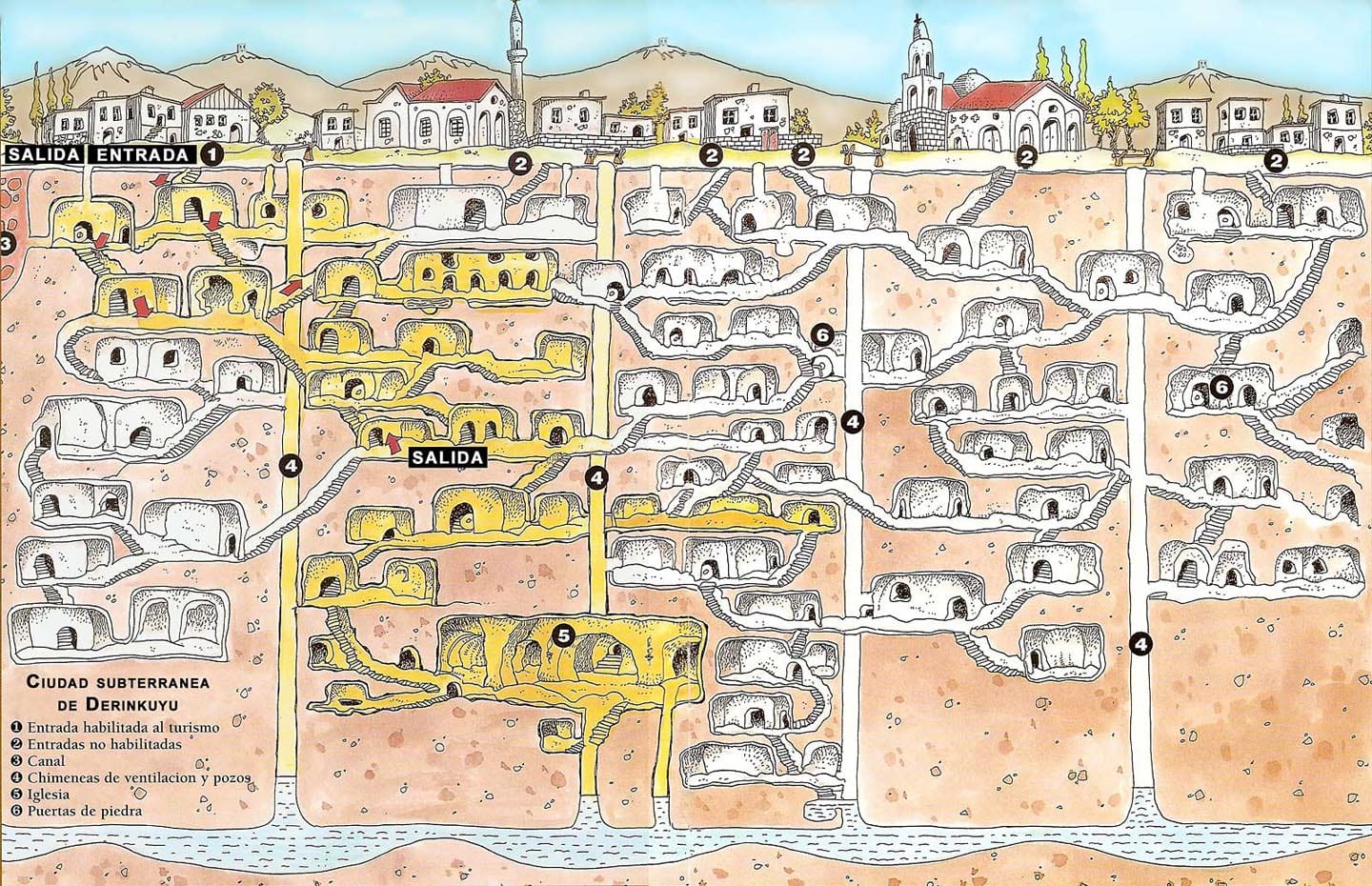
Those unfamiliar with Derinkuyu must change this hastily. Do your own research, but please see this image (pardon the url - I've been flagged for... browsing the Internet and can't access it directly):
https://external-content.duckduckgo.com/iu/?u=https%3A%2F%2F...
And an underground map here: https://www.lolaapp.com/wp-content/uploads/2024/09/derinkuyu...
There is/are video/s available and they are more than worth watching.
I can't remember how to spell the many other regional wonders, so won't try.
Edit: ignore anyone who comes along and tries to dismiss this particular example or the surrounding region as trivial, insignificant etc. Explore for yourself and be rewarded accordingly.
But it does please me that I'm wise enough to treat this place as a den of reptiles. I am right about that much, often enough.
PS: Derinkuyu is amazing, reptiles or not. And so is Turkiye
As for article, imagine, at those times and for thousands years after in most places humans were still hunting-gathering..
In Göbekli Tepe not only human faces, they are also many stone craving of animals or better known as Noah's Beast [3].
Both historical sites Göbekli Tepe and Karahan Tepe, are not very far from Mount Ararat and Mount Judi, they are within a few hundreds of km in Turkey where Mount Judi is the closer of the two.
Mount Ararat is claimed by most Bible scholars as the site of the landing of Noah's Ark after the great flood [4].
According to Quran scholars, however, the actual site of the Noah's Ark resting place is Mount Judi as the word Judi is clearly and specifically mentioned in the Quran in the story of prophet Noah, inside Surah Hud 11:44 [5],[6].
In the Bible however, no exact mention of the name of actual site, and the Mount Ararat is just a mere speculation by the Bible Scholars based on story of legends [4].
[1] Göbekli Tepe:
https://en.wikipedia.org/wiki/G%C3%B6bekli_Tepe
[2] The Oldest Temple in The World and Its Mistery:
https://archaeotravel.eu/the-oldest-temple-in-the-world-and-...
[3] Noah's Beasts Released on the Hills of Göbekli Tepe:
https://archaeotravel.eu/noahs-beasts-released-on-the-hills-...
[4] Mount Ararat:
https://en.wikipedia.org/wiki/Mount_Ararat
[5] Mount Judi:
https://en.wikipedia.org/wiki/Mount_Judi
[6] Surah Hud 11:44:
And it was said, “O earth! Swallow up your water. And O sky! Withhold ˹your rain˺.” The floodwater receded and the decree was carried out. The Ark rested on Mount Judi, and it was said, “Away with the wrongdoing people!”
https://en.wikipedia.org/wiki/Karahan_Tepe#/media/File:Karah...
We humans are predisposed to see anthropomorphic shapes in things. I understand why that could be interpreted as a face, but at the same time, it could just be a random shape. It’s just a “T” shape. Sure, it could look like a nose and a pair of eyes, but it could also just be... something.
https://en.wikipedia.org/wiki/Karahan_Tepe
And you can look at similar things from the Taş Tepeler sites in general:
https://en.wikipedia.org/wiki/Ta%C5%9F_Tepeler
The T-obelisk things, with their long skinny arms, do seem to represent figures. I wonder why they have to be that stupid oblong shape at all. Dual purpose as roof supports? Or just tradition, tradition causes wacky things. Looking around the various carvings from related sites, it's also evident that they were greatly interested in penises.
Some things never change.
"The arm and hand reliefs on the T-shaped standing stones found in Göbeklitepe and its surroundings have long strengthened the idea that these stones symbolize humans. This new find, which was unearthed in Karahantepe, is described as a new turning point in Neolithic period research with the fact that the human face was carved on a T-shaped standing stone for the first time."
"With its sharp lines, deep eye sockets and blunt nose, it carries a style similar to the human statues found before in Karahantepe."