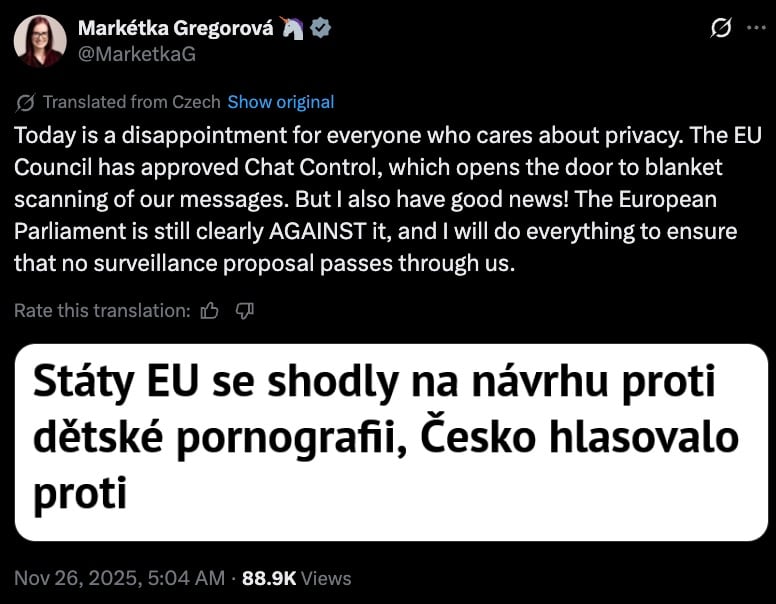
What has actually happened is that after about three years of faffing about the Council finally decided on it negotiation position begore the Coreper 2 meeting last week, thought it seems they ran put of time at actual the meeting and had to have the formal approval this week.
The Council is only one of three parties that draft new laws, so now there's are still several rounds of negotiations left.
Nothing substantial has happened to the three texts since last week, it's just that "chat control is back" drives traffic and "Council preparatory body formally approves draft position that got consensus previously but didn't formally get passed because people were fighting over Ukraine stuff for too long" doesn't.
While I agree with your point, it's still crucial to raise awareness of Europe's actions. It may be a small step, but it is not insignificant.
1. this wasn't fast, it took ~5 years and most (but not all) of the problematic parts have been removed
2. It also wasn't "fully rejected" or anything in the decision which gained some awareness of hacker news, just one specific draft was rejected, not the proposal as a whole (but IMHO it should have been).
3. it's not passed just approved by the council, which consists of the various head of states elected in their respective countries (i.e. is the easiest part to pass something controversial), but still needs to pass the European parliament (elected through the EU elections)
4. and then it must not be shot down by the ECJ or ECHR, both might shot it down, the ECJ for it being excessive/disproportional, and the ECHR because privacy is accepted as a human right by it (in general, there are exceptions so not 100% guaranteed). Or shut down by the German supreme court (same reason as ECJ and ECHR) which has somewhat of a veto right (or else Germany wouldn't have been able to legally join the EU), idk. if any other countries supreme courts have similar veto rights, but idk. why they shouldn't have)
The constitution is always supreme, because the ability to agree to the treaties derives from the constitution.
This only applies where countries ceded sovereignty to the EU.
Technically in Germany non of the sovereignty was ceded but transferred based on two different articles in the German Constitution. But that transfer is neither absolute, nor automatic. Practically it means that in most situations it is "as if" it was cede, but just in most situations.
This leads to a situation where if the supreme court rules that some EU regulations or similar are against the German constitution you have a conflict between the constitutional articles which transfer authority and the ones the court ruled to have been infringed one.
But in the German constitution not all articles are equally, the first few have special protections and extra hurdles to amend. And the article which transfers powers to the EU _is not one of them_. This means that for any of the more protected clauses Germany has not at all ceded the authority of their supreme court to do a final judgement on.
In such cases if the German supreme court says no, it's means no for any application of law in German no matter what the EU courts say. And there are only 3 ways to fix that, 1. the EU amends their regulation, 2. Germany amends their constitution (practically impossible in such cases), 3. the rule informally applies to everyone but Germany, 4. Germany leaves the EU which would likely mean it's end.
So while everyone pretends there is no issue (3rd option) can in some situations be viable and given that 2 is non-viable it pretty much always ends with a compromise of amending things just far enough to not longer cause an issue with the German constitution.
Systematic breaches of privacy through mass surveillance fall under that especially protected articles in the German constitution. And option 3 doesn't really work here. So it's one of the rare cases where German Supreme court actually matters on EU level.
Through practically it hardly ever matters outside of very very few cases:
- because of Article 1 (the most protected one you could say), the ECHR has more or less implicitly the same amount of power as the supreme court, only if the ECHR does rulings in conflict with human rights would that not be the case (so in practice never)
- as one of the core founding members and the country with the largest population (and seats in the EU parliament are distributed based on population) Germany can normally make sure such a situation doesn't arise
- and the breach must really be of a constitutional article standing above the one which transfers power to the EU (which most are not)
- you have to propagate things up to the supreme court, while all other courts will rule based on EU law/ECJ decisions
but it doesn't mean that it never happened,
e.g. there had been one case where the German supreme court ruled that a) something is against the constitution and b) that the EU organ which caused this acted unreasonable in a way which isn't covered by the transfer of authority. That case go resolved with compromises, but was neither the first nor will it be the last where "in practice" the German Supreme court overruled EU decisions, even if it on paper doesn't (because it only overrules what happens with law in Germany and overruling an EU decision would affect other countries, too).
Yes however EU has very limited capabilities to enforce that. They can bully smaller countries a bit more but Germany can do more or less whatever it wants
Saying "forced" about this is like if someone offered me a job, me reading the offer and saying "can I do a 4-day week?", the company's response being "yes, here's a new contract for you to sign", and describing that second contract as "forced" on me.
This has been the typical modus operandi in the EU. There is always a correct answer and the people are free to choose as long as they choose it.
I'm not sure how you can have already forgotten the fact that we have to upload or face or ID to access websites.
Ofcom (the communications regulator charged with imposing the censorship laws) literally maintains a public list of non-compliant websites that anyone who doesn't want to give their ID to a shady offshore firm can browse for example.
In 2029 it's likely we'll have a more libertarian government:
https://www.politico.eu/europe-poll-of-polls/united-kingdom/...
Reform will repeal some of the awful legislation that's been passed over the last few years (e.g. Online Safety Act). They've been loud critics of government overreach.
https://www.ft.com/content/886ee83a-02ab-48b6-b557-857a38f30...
A lot of politicians change when they get in power.
Haha you're so funny.
If Reform get from, what is it right now, five -- or four, or six, depending on how the wind blows — MPs to 326 MPs, which is enough to secure the majority they think they are getting, then libertarian is not what that government will be.
It will be populist, white and significantly authoritarian, because pure tabloid authoritarian thuggery is the only possible strategy that could cause a swing larger than any in history, against two parties (labour and liberal democrat) who currently hold 472 seats and represent a sort of centrist blob between them.
And this is to say nothing of the challenge they will face finding 326 non-crazy, credible candidates for 326 very different parliamentary elections. And to say nothing of the foreign influence scandal that currently engulfs senior Reform figures or the catastrophic issues already affecting Reform councils like Kent. Do you think Reform could succeed without Farage? And do you think Farage's reputation is going to somehow be improved by the Nathan Gill situation?
I accept they will be the largest minority. But the parliamentary maths to get to an outright majority is really extreme; the system does not support such things easily.
Maybe they will get to largest minority and then campaign for PR/AV/STV, and maybe finally people will understand something like it is needed. But Farage will be a lot older in that election.
(It surprises me to see people who are so keen to believe that a council election wave is necessarily predictive of a national election wave because, what, somehow everything is different now? Why is it different?)
As long as you are white British. If you're anything else you're probably going to be worse off under Farage.
It's a shame that if you want to vote for someone with different policies to the two main parties, you have to accept that you are also voting for an outspoken racist.
EU politics don't play much of a role in the media. The older and more cynical I become, the more. I am convinced: that's by design. That way, national politicians can move politically wanted, but publicly unpopular things to Brussels and blame the EU. We are just exposed to that much EU lawmaking news because we are directly affected as a subculture.
During the Brexit referendum days, I learned that British friends of mine did not even know they had EU parliamentary elections - I had to prove to them via Wikipedia AND had to read them the name of their representative (who just so happened to live just down the roar), nor did they care. Made many things more clear to me.
The EU seems to be taking the opposite approach - countries push any unpopular law into the growing EU layer to prevent local backlash affecting them. As comments around this call it - "political laundering". A great term that I shall be borrowing.
[1] Relatedly, the philosopher Jimmy Carr has a great line about the failing of communism is about scale. It works locally at the family level but it can't scale to the level of a country.
The "proposal" was made something like 3 years ago, the killing never happened and the passing, if it passes, will happen in at least one year from now because this will definitely take a long time to get through parliament and even longer to get through the trilogue.
The process is many things but quick it is not
This message brought to you by the Bureau of Sabotage
The democratic process needs a revamp but it shouldn’t be driven by the general populations attention span.
The attention span of the general public _shouldn't_ matter. That's why we elect politicians.
Hmm, now whose fault is it that the EU institutions are so complicated and opaque? The citizens? The journalists? Or maybe...?
The problem is mostly the sheer amount of things going on, you couldn't possibly keep up with it all.
And in a democracy if you don't know how your own laws are made the fault is always yours as a voter
They are not. People just don't bother themselves to spend half a calory in brain power to read even the Wikipedia page about it, and just repeat shit they read in forum posts.
I mean, here on HN, a website where people are supposedly slightly above average in terms of being able to read shit, the amount of times I read how EU is "bureacrats in Brussels" "pushing hard for changes" is weird.
If EU is a trade union this is a severe overreach, if EU wants to be a federation, there's not enough checks and balances. This is the crux of the problem.
The issue is that this is a legislation that only ones in power want(censorship on communications channel where they themselves are exempt from it), that has been pushed over and over again under different names(it goes so far back - it started with ACTA talks and extreme surveillance proposals to fight copyright violations) and details in implementation and/or excuse(this time we get classic "think of the children")
Your problem is with the leadership of countries, not with the EU as an institution. I agree that it is a problem btw, but I think you got the wrong culprit. This isn't pushed on the states by the EU, this is the states using the EU to push it and launder the bad publicity.
I wonder who could have a vested interest in depicting the EU as a repressive regime...
Well, here is the guy from where that comes from, the minister of justice of Denmark. He certainly represents a good part of Denmark, even though he may be irrelevant to any other EU country.
its more likely than it has been in a very long time with multiple smaller parties gaining seats. Nationalists in Scotland and Wales have been around a whole, and NI always had its own parties, but on top of that we now have Reform and the Greens making gains.
It did not pass.
I think the problem here is that you don't understand how the system works.
The EU parliament still would have to approve this for it to become legislation.
This is akin to a national government proposing a law, and the congress having to vote for it.
There is a lot wrong with the EU (the system). Opaque power structures, backroom deals, corruption. But I wouldn't call it an autocracy.
Similar to the Political Bureau in former communist countries, but still an autocracy.
> But I wouldn't call it an autocracy.
It has most certainly started to walk and quack a lot like an autocratic duck, it wasn't the case 10 to 15 years ago, or not as visible, to say the least, but the pandemic and this recent war in Ukraine have changed that.
Two years ago and she has received damages however similar attitudes still abound with marked police disapproval of attempts to display the English National flag - in England.
Please don't use AMP.
Either way politicians prefer to push unpopular stuff like this via the EU because the responsibility gets muddied - "we didn't want it, the EU regulation requires us to spy on you!".
This, the article says so in the first paragraph. The bullshit justification hasn't change in the last couple of years afaik.
You defeat them one day, but they're still there, and they keep trying, day after day after day.
State always drives towards despotism and total control, society always drives to anarchy, and when there's balance, then you have Switzerland, otherwise slide towards Somali or Russia.
https://news.mit.edu/2019/narrow-corridor-acemoglu-liberty-0...
The real problem is that the State tends to grow like a cancer. When it gets to a point that it lords over tens or hundreds of millions of souls, it's already impossible to control and contain.
Any time you have a government, you will have a government that wishes to spy on you to make sure you will never attempt a competing government/army.
The economic argument is that with states, you can benefit (to varying degrees, depending on the state's lowercase-c constitution) from the economies of scale. Fixed costs which might make things like electrical grids, public transit, and plumbing prohibitively expensive on an individual basis can now be built efficiently, and with the fixed overhead cost split so many ways, the cost to the individual becomes much easier to swallow.
Almost as soon as systems benefiting from economies of scale arise, you'll want ways to govern them fairly -- the ideal here being a (relatively) neutral party outside of the services' regular users who can manage these services and the policies which surround them. Obviously, this is something we're still figuring out: we're always trying to balance cost, representation, efficiency, and effectiveness, but we've got a good idea of what doesn't work.
I won't belabour the point since I think it's clear where I'm going with this, but to paint the two parties as natural enemies is a bit simplistic IMO. One arose in response to the natural needs of the other.
I think the comment you were replying to has a better sense of things. Government becomes an entity onto itself, and prioritizes its own existence, far past the original mandate at its genesis. A constitution becomes acculturated as a default, not because each successive generation ratifies and legitimizes it anew, but simply because with its perpetuation comes power that is hard to displace.
This isn't merely cultural. The powerful interests as the head of the state have an interest in maintaining such a thing. Yes there are benefits, but your modern list ignores the true driver, which is far less luxurious. State formation is simply another form of human domination. Dressing it up as economic efficiency might make for good academic papers after the fact, but the reality is they arose out of the need to dominate others or be dominated. Feats of engineering in the ancient world were constructed to revere the state or benefit in wartime. The United States used the same rocket technology it contemplated annihilating the Soviet Union with to put men on the moon. In all cases some benefits do trickle down to the common man, but always the state itself ends up as the highest priority.
I think the issue today is, on balance if you look at the real equation between whose domination do I fear, increasingly it is your own state, there are less trickle down benefits occuring, and far more avenues for such "benefits" - like the phone in your pocket - to be deceptive, ie appear as a benefit while actually being another instrument of control.
Plumbing doesn't spy on you. And it solved a real problem and improved lives. Increasingly today in modern societies people see states with more contrived demand, "bullshit jobs", less external threats, and yet more and more state domination. Democratic checks may prove even more fatal - turn over the ancient apparatuses of domination over to a mob.
So anyway, I just ask you not ignore the obvious. People didn't want states to get cheap electrical grids. They submitted to it because they didn't want to be hacked and pillaged in their own beds. The true "natural needs" of our species are far more dire than any of those relative luxuries you have listed.
Historically, the formation of most large states was not a voluntary merger of smaller states for the benefit of all but the conquest of smaller states by larger states.
Instead of having a tree with a king at the top and your local police station at the bottom, be a part of the governance for the river that you live near, for the city that surrounds you, for the grocery store in your neighborhood, for your local fire department, and let all of them have codified relationships with each other that are determined by codified processes.
I believe the limitation on this was technological; that we had to get people into a room, get Robert's Rules out, and shout our way into decisions. Those limitations are gone; we all have phones. We should be able to participate in the governance of everything, or if we really don't want to think about that crap, hand our proxy to someone who does, get alerts on what they're doing with it, and revoke or transfer it instantly.
Let's see some real social networking.
Authorities and banks avalanche everyone within their reach over all available communication channels with "warnings" about scams and frauds.
What direction are they aiming with this total control?
Moving money needs source of funds, documentation etc... doing any business requires you to doxx yourself to the world and to vendors in the name of transparency.
Luckily though none of this is a problem for large multinationals :) which the EU cares about most in the end
Partly it's they don't have the same pro-privacy culture that say Germany and many of the eastern european countries have.
People also think the current Danish PM was also offended by a former prominent Danish politician and cabinet minister who was arrested for CSAM possession.
I think this theme of the EU, this lack of taboo against continually bringing unwanted laws until they pass by fatigue, it may well be the death of the institution as a whole. every time they try, every time people hear about it, more and more think worse of the EU, and unlike most western governments, the existence and function of the EU is actually severely vulnerable to what people think of it. no other major government takes as much reputational damage from laws that don't even pass, and the existence of no other major government is as vulnerable to reputational damage as the EU is right now. all it takes is another 1 or 2 major exits and the whole thing will slowly collapse, which is insanely sad
Somewhat relevantly, the UK already has their own version of this legislation in the Online Safety Act which lead to a bunch of small-medium UK community sites closing and the likes of Imgur, pixiv and 4chan blocking the UK.
You also say that the collapse of the EU would be insanely sad. I also understand that perspective.
What I don't understand is how somebody could have both of these points of view at once, in the same comment no less.
EU delegates and council members have to report their meetings with lobbyists.
Palantir and Thorn lobbyists (just the most famous ones, but you can add another few dozens security and data companies) are recorded meeting many times with countless of them, including Ursula von der Leyen.
It's really as simple as that, sales pitches convincing them of all the benefits of having more intelligence "to catch criminals (wink)".
So, US interests? Which means the NSA?
Palantir sells software for analyzing data, like Excel but on a large scale. If "Chat Control" passes, they will need software to analyze the data they collect, which is exactly what Palantir sells. It is just business.
I don't know about Thorn but it looks like the same: they sell software that may be of use for implementing "Chat Control".
Even if the NSA was not involved the same data and security companies would have the same incentives imho.
It's currently held by Denmark so it's the Danish delegation that's mostly doing the brokering etc for this semester
Especially since putin shows us exactly what happens if you try.
Everyone operates on self-interest but not everyone is smug about it.
https://en.wikipedia.org/wiki/Regulation_to_Prevent_and_Comb...
And if everybody will do the scanning, maybe they will be sending all of this data to the giant EU server then that will look for 'problematic citizens' like in minority report.
Who knows, but it seems like running your own private chat for your own and your family and friends will be the only way to have some privacy in a few years.
The Signal CEO has repeated that they will rather leave the EU than start doing the scanning.
From a practical side, if the client and server are open source then the project is survivable even if the supporting organization is wiped out. For now users don't demand it nor do they understand it. At minimum, the clients must be open source and buildable, all encryption must happen on the user's device and there should be some control over the end server connections. It is also critical that there are near foolproof workarounds for tunneling the traffic in severely locked down countries like China. This is one of the big problems with requiring a phone number, for example. If users in China can't use a communications tool then it's bullshit.
Some projects like Delta Chat are criticized for one reason while the critics take at face value unverifiable claims from other projects. Delta Chat checks a lot of boxes along with user control and deployment of servers.
SimpleX is a good concept but I'm not sure how it can scale -- which is a detail that shouldn't be ignored. How Signal expects to continue with no visible revenue source is another good question.
XMPP should not be written off either. If I had to bet on a protocol having users a decade from now, that's the one. AI coding agents are going to rapidly iterate on improving the front end stuff. With all of the privacy busting age verification coming from the US, I'd be willing to bet the replacement for Discord will be something XMPP based.
On one side the EU funded open source projects to try to break away from the US tech giants, while passing laws to kneecap their own tiny open source alternatives (Cyber Resilience Act etc.) If the US & the EU wants to exist in the next century they need to be going the opposite direction. It was bad enough that western tech companies built China's great firewall and assisted authoritarian regimes elsewhere.
Most end users don't understand that keeping communications secure is not a given, it is really expensive and difficult. Adding wacky, difficult, very expensive or impossible to follow requirements is the fingerprint of EU bureaucracy and not just unwelcome but very dangerous.
For the EU Elon haters -- with the growth of Starlink, Elon Musk or whoever controls SpaceX is going to have a deep view of global internet communications in the years ahead. That will include an ability to block, filter, and allow things either they or those who control Starlink choose. Any regulation which weakens or cripples the security of internet communications is ceding power to that entity, whoever it may be.
The only way you fight this is by moving forward and faster than them. Because their eternal weakness is that they are slow and somehow stupid. But tech oriented people got pretty lazy in the last 2 decades:
- We let ISPs be the only gatekeeper of the Internet
- We let big tech dominate the mobile OS space
- We embrassed the Cloud and SaaS (not your computer)
These 3 things made us sitting duck to any authoritarian government and now we pretend to be surprised we are getting shot.
Here is what we can do before it is too late:
- Buy a $10-20 LoRa device and setup Meshtastic, Meshcore or Reticulum https://reticulum.network/
- Buy one for a friend
- Run openwrt and consider things like like B.A.T.M.A.N https://www.open-mesh.org/
- Connect and explore yggdrasil https://yggdrasil-network.github.io/
- Try I2P https://geti2p.net
- Get into a protocol like NNCP https://www.complete.org/nncp/
- Self-host at least a few services you can and care about
- Setup a DNS like https://opennic.org/
- A fair amount of understanding and use of the good parts of crypto/blockchain
- Get out of GMail, Outlook, iCloud, etc.
(there are probably many more)
It is gonna take the governments time to figure out what those things are and how to block and attack them.
Plus you will get more satisfaction and knowledge than with writing HELM charts, web apps or using AI.
Or Matrix? No experience with it though
It rewards or penalizes online services depending on whether they agree to carry out “voluntary” scanning, effectively making intrusive monitoring a business expectation rather than a legal requirement.
The legal mandate was shot down by the EU courts, but every country then figured out their own loophole and as a result data retention is effectively mandatory but not by clear and public law.
The (actual) solution should be to fix legislation to adequate protect privacy, because they'll attack this next.
But meantime, a technical solution is better than nothing.
If a P2P solution that solved the aforementioned Signal issues were to have excellent UX, then that could probably work.
Lastly, what counts as "excellent UX" for technical and non-technical people seems to differ. For example, I consider Discord and Slack to be quite intuitive and easy to use, but multiple technical people have expressed to me that they find it to be very confusing and that they prefer other solutions, such as GroupMe in one example. To me, GroupMe shoving the SMS paradigm into something that's fundamentally not SMS is more confusing and poor UX, but to these non-technical people that seems easy. I suspect that Signal's shortcomings that I perceive are an example of this: making UX trade-offs that work great for non-technical people but are less good for technical people. I'm not sure what these specific UX trade-offs are, but I suspect that it's something akin to having a conceptually sound underlying model (like Discord or Slack servers/workspaces and channels), versus having really obvious "CLICK HERE TO NOT FUSS" buttons like GroupMe, while having graceful failures for non-technical users that can't even figure that out (like just pretending to be SMS in GroupMe's case if you can't figure out how to install an app, or don't want to put that effort in, something that many people know how to use).
But some friction is to be expected.
> While some 19th-century experiments suggested that the underlying premise is true if the heating is sufficiently gradual, according to modern biologists the premise is false: changing location is a natural thermoregulation strategy for frogs and other ectotherms, and is necessary for survival in the wild. A frog that is gradually heated will jump out. Furthermore, a frog placed into already boiling water will die immediately, not jump out.
But of course some HN commenter had to do: 'well actually...'. :D If I would write something like: 'Better late than never' would you be correcting me too? 'Well actually studies shows that it is better never...'
I recommend some chilling with a nice cup of tea.
But people like to sensationalize stuff
This is less worse than the original proposal
Oh and honestly game chat rooms should not be private.
(of course personal 1:1 messages should)
Services are obligated to do risk analysis and take appropriate safety precautions against high risk actions. High risk actions include "anonymous accounts", "uploading media", and of course "encrypted messages".
The moment they catch the next random pedo, every messenger app on their phone will be tasked with explaining why they didn't do enough to stop the pedo. They'd better get their business together next time, because otherwise they might be held liable!
There's no law that says you have to hand over arbitrary data to the police without a warrant but when Telegrams shady owner landed in france, he was locked up until his company pledged to "work together with police better".
Don't be fooled by pretty words, none of this optional stuff is optional for any messenger the government doesn't already have the ability to read along with.
Technical gotchas are not the same as legal gotchas
And what my undersensationalized friend do you understand by the word chat?
> Czech MEP Markéta Gregorová called the Council’s position “a disappointment…Chat Control…opens the way to blanket scanning of our messages.”
From this translation:
https://reclaimthenet.org/wp-content/uploads/2025/11/CnZOD1F...
Then you're being dishonest. Your intention is to cause a stir instead of to inform (a word related to the word information). Because you are leaving out what she wrote about EP; the EP is, according to her, clearly against this. Why leave that out? What is your agenda? You just disqualified your entire article.
Perhaps it met the criteria for a Major Ongoing Topic (MOT) or a MegaMOT, or the "flamewar detector" kicked in, or just that it wasn't convenient to discuss, but we'll never know since the precise moderation action applied to individual stories is opaque.
Yes, I know Brexit was a failure and the UK is no better in terms of privacy but there has to be some sort sort of political repercussion for the people who made this possible.
Since there seems to be nothing else to do, then voting to leave is better than the status quo.
I believe that EU countries having trading agreements, sharing technology and sharing intel would be good but what we have now as the EU is not that.
It has become a single point of failure that is too easily gamed by lobbyists.
Before the EU, you needed to have lobbyist in 27 countries to get all of them to agree to something, now you just send them to Brussels and only need to convince 15 countries to agree to something for it to be approved.
We basically made the system easier to game. And now we are paying the price.
You say that you are apolitical, but you sound like an extremist. What should I believe, what you say you are or what you actually do?
If the EU politicians start working against my interests as a citizen, then why shouldn't I penalize them? If the EU as a whole starts working against my interests as a citizen, when why should I keep supporting this system?
The fact that you label me as an extremist for voicing my opinion (which I can only assume is different from yours) is telling. Your view of democracy seems quite skewed and if you were in charge of my country, you can bet I would vote you out too.
This is a forum where everyone is free to participate. If you don't like opinions different from yours, then feel free to skip them instead of insulting other people. This is not high school.
the requirement to backdoor e2e was dropped, and who knows what will eventually remain of the reporting requirements, etc.
of course if a company is processing unencrypted images they might be required to use some service to flag them
...
will we end up in yet another false positive flood? who knows
Do you think Meta, Google and them are not scanning every bit of data hosted on their servers to ensure they're not hosting things they don't want to?
Do you think they don't cooperate with governments to share those findings?
I don't disagree that this push is silly, ineffective, and bad for democracy. We should fight it and fight for the right to privacy.
However, people are acting like we have privacy right now. What evidence is there for that?
It is not direct state imposed laws requiring you to be scanned wherever you are and every service you are using (including ones you built yourself)
But going off what I said, I acknowledged this sort of legislation is bad and that a right to privacy is needed. How do you arrive at "beatdown citizens in a government they have no passion about"?
All I did was point out the reality right now, even without this legislation.
Also it is not just in Europe — digital ID is coming in USA starting January. State by state. Thanks to the Republican-dominated supreme court, and of course it is also done in the name of protecting the children:
https://www.internetsociety.org/blog/2025/07/dangerous-us-su...
This “papers, please” is now happening quickly all around the world. Here we maintain the updates:
https://community.qbix.com/t/the-global-war-on-end-to-end-en...
This is why people will increasingly need open source alternatives, not owned by large corporations, but it needs to be far better than Mastodon and Matrix. People expect the convenience of Instagram and Telegram, and open source will have to match it. That’s why I have spent about $1 million to quietly build https://github.com/Qbix/Platform
It is time to start rolling it out. This is supposed to be the People’s Platform. Anyone who is interested to get involved, find my profile on HN and get in touch by email. Put “hacker news” in the subject, so I can find it among all the bulk email. I would love to hear from people who want to join forces and contribute to something that’s already had about $1M and 10 years of work behind it, something By the People, for the People.
We are welcoming anyone who has skills, some free time, and is looking to actually do something meaningful to help liberate people from what’s coming. Whether you are a developer, want to contact journalists, or just want to promote this in a community. (And to the HN people who like to downvote this kind of stuff… just this once consider that we need to actually _cooperate_ on producing free, open-source alternatives to Big Tech, not do the weird infighting thing.)
Edit: Based on the downvotes, you obviously didn't. This is a PROPOSAL, not a LAW. It needs to be voted by the EU Parliament (you know, one of the 3 components of democracy as in "separation of powers").
Voting once every 5 years for groups which are organised cross-country, but not letting citizens vote cross-country, and this being the only democratic organ and the one with the least power, with no consequences for any of them breaking election promises, is imho not “letting the people decide”, but “oligarchy with the illusion of choice”
You'd basically have to rely on magic to know how those politicians you vote in will decide to vote on because they join some sect that lobbies them to vote against your interests.
And we all know no voter aside from the 1% will ever think this far. It's exactly like you called it, the illusion of choice
- Sanctions against Russia backfired (from the EU at least)
- Trump-Vance slapping the EU around in a humiliating fashion (re: that guy that cried at the Munich security council, EU being forced to adopt unfair trade deals with the US)
- look at the body language from Macron, VDL and Xi’s meeting a couple years ago, VDL is being sidelined on purpose, meanwhile Macron given royal treatment
Liberalism is dead, and these career bureaucrats are clinging to any remaining feeling of control:
- they can’t do the antitrust thing because Trump is wagging his finger at them
- they can’t project power externally
- they can’t engage with China (idk why, maybe due to their feeling of superiority)
… so they resort to projecting power internally
Nobody wants this, including they themselves, which is why they specifically exempt themselves from it.
Whoever wins the bid for the (visually hashed) child porn database Whatsapp uses is bound to receive billions of API calls the month the contract goes live. They won't make whatsapp pay for that directly, of course, but I'm sure they'll be "covering operating costs" with government grants to "protect" the public. They get to be rich claiming everyone is a paedophile yet to be caught while pronouncing themselves the foremost fighters against child abuse.
As for why politicians turn out this way, they're just pretty ordinary people (often quite impressive people actually, relative to the norm). Most people don't get an opportunity to show off how useless their political principles are because they have no power or influence. That's why there is always a background refrain of "please stop concentrating power to the politicians it ends badly".
The question is more why do the shit politicians rise to the top. Outside forces (rich people and companies) have too much power and can exert too much influence.
In this case I’m particularly curious about the Danes. They insisted on this more than any other previous attempt. They are forever soiled as fighting against the will of the people.
It's been sold as "for the children". A very substantial proportion of the population are natural authoritarians, and this is red meat for them. Never mind that "the children" that they profess to be protecting are going to grow up living in an increasingly authoritarian surveillance state, this is what authoritarians want for our future, and they see it as not only morally good, but any opposition to it as indefensible.
Dumb and greedy voters, traditional and social media, and electoral interference are known reasons. But it's also a matter of compromise: you vote for a party because you agree with a bunch of their points, but almost certainly not all. Topics like privacy are ignored by the general public, so politicians are hardly held accountable for them.
So that you can blame them for your problems.
"By filling the checkbox below, you consent to Persona, OpenAI’s vendor, collecting, using, and utilizing its service providers to process your biometric information to verify your identity, identify fraud, and conduct quality assurance for Persona’s platform in accordance with its Privacy Policy and OpenAI’s privacy policy. Your biometric information will be stored for no more than 1 year."
  * Each user gets a key to sign a message, there's also one for decryption like E2EE
  * The platform owners get a part of a backdoor key for decryption (per message) as well (call it another end in E2EE if you want)
  * The feds get a part of a backdoor key for decryption (per message) as well (call it another end in E2EE if you want)
  * A watchdog organization also gets a part of a backdoor key for decryption (per message) as well (call it another end in E2EE if you want)
  * If the feds want to decrypt something for actual anti-terrorism/anti-CSAM purposes, they convince both the platform owners and the watchdog org that they need keys for specific messages
  * The watchdog automatically publishes data like: "Law enforcement agency X accessed message Y decryption key for internal case number Z" (maybe with a bit of delay)
  * That way the users who have their messages decrypted can find that out what was accessed eventually
  * If the feds are snooping for no good reason or political bullshit reasons, they can get sued
  * If the feds are snooping too much (mass surveillance), it'd become obvious too cause you'd see that they're accessing millions of messages and maybe a few percent lead to actual arrests and convictions
  * This kinda rests on the assumption that courts would be fair and wouldn't protect corrupt feds
Further, don't let people here bait you into revealing these types of things for them. Some ideas are just meant to be data dumped/remain forever in silence.
Of course I have 0 belief that it wouldn’t get hijacked/corrupted by horrible people anyways so whatever.
I see no clear indicator that the situation has improved since.
E.g. what do Spain and Poland have in common?