That said I think there's a new market here. If the average Airbnb listing is rejecting applicants of color maybe there could be a special "diversity friendly" designation on Airbnb or other sites. Perhaps users could add some flair, something similar to the LGBT pride flag that some business add to their windows, to their profiles to signify they sincerely welcome all applicants. Hopefully this doesn't sound too ignorant.
If mass rejection of specific groups is occurring, there's some money to be made here by sending out the right signals. Just think of the profit made by some gay/lesbian bars in the 1970s and 80s.
I just want to point attention to the (perhaps ironic) fact this sort of reasoning is exactly the same one used by the (allegedly) racist hosts and drivers in the story, i.e. people are much more prone to accept what they are told (mostly in sample size = 1 cases or anecdotal generalizations) if it aligns well with their beliefs (e.g. "another BnB host told me a black guy thrashed his house", "we all know that girls can't code").
A (very) rough characterization of the process, I think, would be:
1. Creation: For this or that reason an a priori belief is formed, e.g. "world is inherently racist" or "blacks are much more probable to be criminals".
2. Filtering: The facts that are reported are filtered using a selection bias (usually, mostly subconsciously) so that facts that strongly agree with the belief are remembered more. (The fact that news items generally report on low-probability, high-standard deviation items, a la man biting the dog, makes this effect even stronger)
3. Update The belief is then updated by the facts with their relative weights determined in (2)
The above (well known and documented, e.g. Blink EDIT: Sorry, wrong reference, see below) process is not a bad thing! AFAIK, it's default brain operation. It takes quite a bit of control and patience to push back the default process at all thee levels.
Note that I'm not arguing that racism, etc. does not exist; however, before jumping to conclusions, like the OP and his/her friend did ("AirBnB doesn't work for black people"), we need to be a bit more careful.
Doesn't Blink posit that a person's extensive experience in an area can lead them to a quick, gut reaction that is, in fact, correct, even before they are able to verify it?
It seems that Andrew's friend probably has had a fair amount of experience with being mistreated due to his skin color. His reaction to being denied a room 3 out of 3 times was perhaps hyperbolic, but certainly applicable to his experience with the service. (Andrew noted his friend's interactions with the driver, so it wasn't all his friend's imagination).
You could use the ideas noted in Blink to look at this scenario from a variety of perspectives, not just confirmation bias.
There are two different kinds of generalization here, I think:
As you state, "Brandon" probably has had to endure many other forms of racist behavior, e.g. taxis not wanting to pick up black clients, so his generalization to the new domain Uber was perhaps justifiable, but how about generalizing to AirBnb. AirBnB host population may be very different than the general population "Brandon was used to deal with" (I don't have data to back this up, hence the "may be", but I think that is a very high probability hypothesis, esp. in SF) yet he was quick to generalize, although the refusals may have been due to other factors. In other words "Brandon" has reliable data from a different population that he is now attaching to a new population.
The OP and greendata, OTOH, are generalizing to various beliefs based on a single data point of "Brandon".
It's always disturbing to me how much commentary in threads of this type on HN is devoted to asserting that the individual who's actually experiencing the problem is misinterpreting it. I love data, but demands for data/citations in situations where the problem is experiential are too often used to dismiss people's real, upsetting experiences with privilege and prejudice.
"it rings 100% true" does not necessarily imply any conclusion. It just means that the initial data on the new sharing economy are inline with other older experiments which study almost the same thing (taxi cabs, cleaning services, etc).
I'm not sure I trust Malcolm Gladwell as a reliable source any more.
An inconvenient truth. Or perhaps the elephant in the room.
The only method I can think of would be to monitor when hosts reject minority guests but then there's a risk that you punish hosts who reject a minority guest for some unrelated reason.
I think the key here is to make it voluntary and not push it on people or make it a top-down standard. Its absence should not imply racism. Perhaps the flair could located on another site where users of the shared economy list themselves as "diversity friendly". If you see a listing with the diversity "flair" and one of the reviewers is a person of color, you know that place is worth applying to as a person of color.
After all , you don't tend to see "blacks welcome" signs displayed at hotels, because that is the assumed default.
This issue also strikes to the heart of some of the libertarian ethos around the sharing economy generally and Uber/AirBnB in particular. People are really racist.[1] Just getting the racism to the levels experienced by Andrew's friend experienced involved a century of the federal government beating the states over the head with troops, court orders, etc. The elimination of overt racial discrimination in private businesses is actually a wonderful example of concerted government action addressing a problem that according to free market theories shouldn't even have existed in the first place.
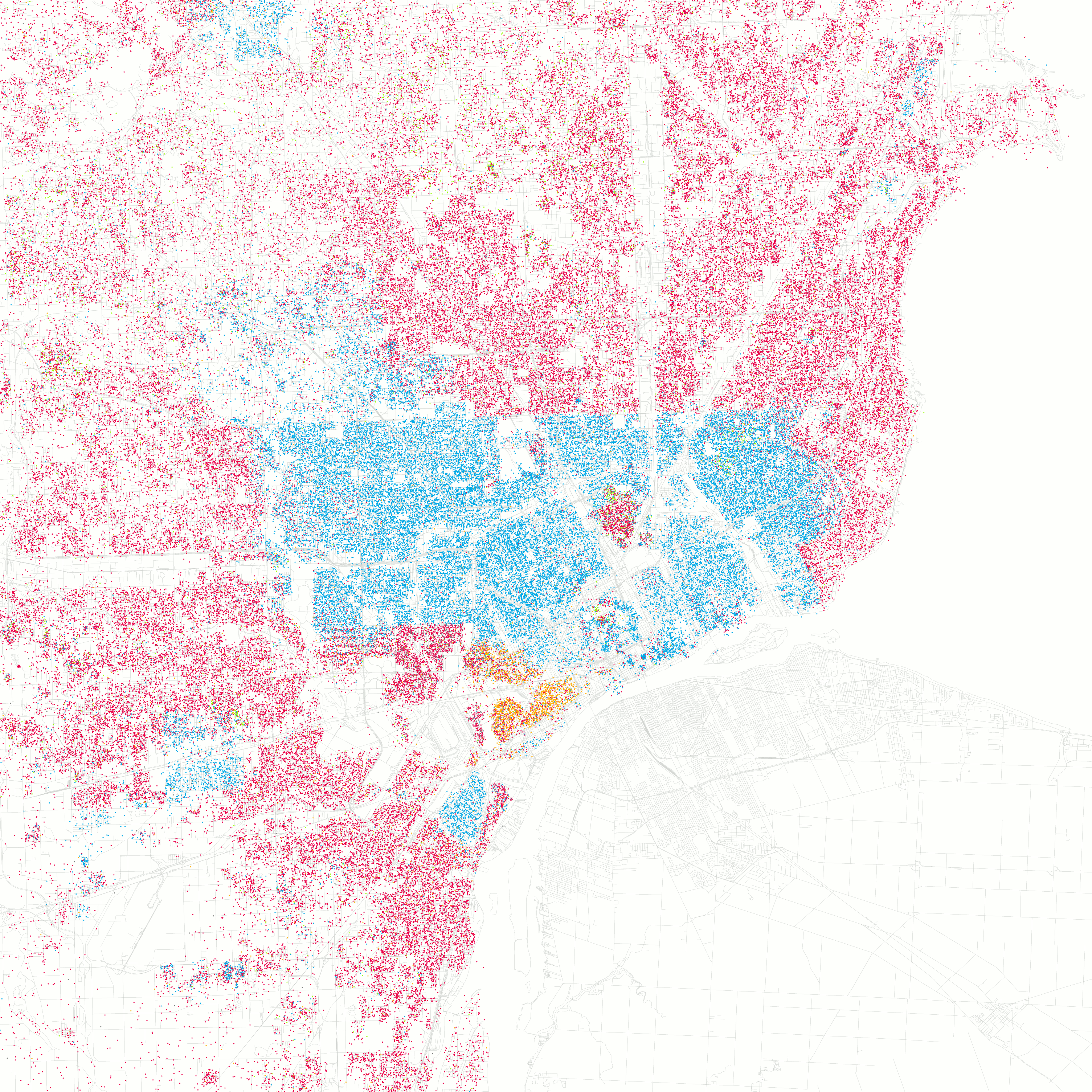
[1] I think Americans are much less racist than almost anyone else. I'm Bengali by ethnicity, and my observation is that people on the subcontinent are racist enough to make a south Georgia redneck blush. But even then sometimes I look around at maps like this: http://upload.wikimedia.org/wikipedia/commons/f/f1/Racial_Di... (race map of Detroit with black areas in blue and white areas in red), and think we'd still have legal segregation if the courts hadn't forced it down peoples' throats.
Not really, it's just in the rest of the world being openly racist is just fine, in the US (and Canada) you have to pick when you can be openly racist and pretend otherwise the rest of the time.
> think we'd still have legal segregation if the courts hadn't forced it down peoples' throats.
We would.
Call it white guilt if you must (though it's really a misnomer), but the fact that Americans are aware of their own racism makes the situation much, much more tolerable than in other places.
Sure, covert racism is still a problem (a big one at that), but at least there is awareness and a substantial degree of introspection. Both of these are absent in more racially homogenous countries, where not only is racism overt, but there is so little public consciousness of it that extreme racism is accepted as a matter of course.
In the US the words "oh good, you're not dating a black girl" will be outright rejected as racist, or at least give people pause and cause discomfort. I've personally experienced the exact same statement tossed around in another country as if it was the most natural thing to say in the world.
Because you're white, he assumes you agree with him. In a lot of the US, 'thank god you're not dating a black girl' will only cause discomfort if they think they're in mixed company, not because they think it's wrong. Once the person who they don't know about leaves, so does any discomfort about saying what they really mean.
He doesn't say that shit to me anymore not because it's wrong, but because he's figured out I don't agree with him and look at him like the idiot he is.
However, Thomas Schelling, an authoritative economist with published papers in peer-reviewed journals coined a model of segregation, that was named after him.
Shelling segregation model showed that a preference that one's neighbors be of the same color, or even a preference for a mixture "up to some limit", could lead to total segregation, thus arguing that motives, malicious or not, were indistinguishable as to explaining the phenomenon of complete local separation of distinct groups.
That means that segregation may occur even with communities that consist mostly of non-racist individuals or individual with very low level of racism.
Racism is a big problem, but emotional, visceral approach to it doesn't help anyone.
Btw, I learned about this model in Coursera Model Thinking mooc. Highly recommended, very interesting for anyone who is interested in deeper knowledge about the world.
A common term for that is racism. Are you saying that segregation can spring from racism? I'm not sure that anyone was confused about that.
"That means that segregation may occur even with communities that consist mostly of non-racist individuals or individual with very low level of racism."
I'm not sure that anyone could be confused about that if they aren't emotionally invested in the discussion. And I am not interested in debating things on emotional grounds.
If you reallywant more information on Shelling segregation model, it can be found here: http://www.youtube.com/watch?v=dFl3Cfw12bo. This is a 10 minute lecture from Coursera mooc.
Just to clarify Milton Friedman (A champion of free market economics) readily acknowledges racism. His argument is more along the lines of "in the long term racist businesses will lose business to more accepting and diverse ones."
It's sort of cute in the abstract, but it ignores the reality of people suffering now.
Just another point against Friendman and his "understanding" of the world.
This assumes that the business differential exists and is large enough to matter.
I generally point out the lack of non-smoking bars/nightclubs before all the anti-smoking laws went on the books. Everybody agreed that non-smoking venues were a good thing, but non-smoking bars/nightclubs simply did not exist because the business differential was too high (smokers were so much more profitable than non-smokers that even though non-smokers outnumbered them nothing would cater to the non-smokers).
In the case of AirBnB, how much profit will someone give up by not serving <ethnic group>? Not much since most of these places are just getting a little bit of profit for renting out extra space.
For example, if 5% of blue people trash your house, and you can't distinguish the 5% from the 95% easily, it may be rational/profitable to discriminate against blue people.
In the south, whites don't mind if blacks are around, so long as they aren't uppity. In the north, whites don't mind if blacks are uppity, as long as they're not around.
Having spent time among both southern rednecks and northern intellectuals, it rings painfully true.
A number of replies on this, but some have, I think, understated the issue.
In all honestly, I would say the U.S. is just about the least racist country on earth. If racism is not seen to be a problem elsewhere, then it's largely because of ethnic homogeneity, not lack of racism.
EDIT: It looks like I'm being misinterpreted here. Obviously, there is racism in the U.S. It is a huge problem. We all know this.
But the reason it might seem to be a larger problem than elsewhere is because of our unusually ethnically diverse population, not because of unusually high levels of racism. Also things like our incarceration rate -- the highest in the world, by far.
To a large extent, the political boundaries of the world are drawn along ethnic lines. Where this doesn't happen: former colonies in Africa, much of Eastern Europe after the world wars, etc., etc., you often get people killing each other. Look at the Rwandan genocide, or the mess that Yugoslavia turned into when it stopped being just Yugoslavia, or the decades of troubles between India and Pakistan, or any number of other examples, to see the result.
And then note that these kinds of things are not happening in the U.S. -- not to that extent, anyway.
America is a deeply racist society. It's built on the genocide of the Native Americans who are still largely kept in poverty in virtual prison camps we insultingly call reservations, by racist policies.
The legacy of racism against African Americans is still deep and real - have you any experience as a black person in the Southern states? If so then I'll respect your opinion on that topic, but as a White person who came to the US from a different country, and then lived in Texas for a few years, the levels of racism are disgraceful.
The entire hispanic ag-business-driven immigration problem hinges on institutionalized racism.
Then we don't even touch on disparities like over-concentration of poverty in minority communities, incarceration rates, under-representation in positions of power and seniority etc.
I don't know much about Europe, but as I look at the conflicts bubbling up in the U.K. and France over Arab immigration, I am inclined to believe the lower prevalence of racism there is more a function of less racial friction in more homogenous societies than actually lower levels of racism in the culture. As far as historical racism, I don't know if we want to compare scorecards with the continent that invented colonization and the African slave trade...
That said, my point of comparison is Asia, specifically the subcontinent. I'm ethnically Bengali (first generation immigrant), and my wife is Oregonian (her family moved there in the wagon trails), of English/Dutch ancestry. If our situations were reversed, there is no way Bengali society would have accepted my wife in the way American society has accepted me. She could move there and live there for the rest of her life and she'd always be "bideshi" (foreigner).
But I can see that African Americans often have a tough time here.
I can also see the plight of Koreans in Japan, and Muslims in much of India, and Turks in Germany, and Kurds in Iraq, even though I am not part of any of those groups, either. Racism is everywhere. All of it is disgusting, some of it is horrifying, and much of it is significantly worse than what we see in the U.S.
Name me one country that wasn't founded on war and violence.
The situation with African Americans is still flawed and stratified, but has undeniably improved very significantly. Primarily in that they have equal opportunities on a federal level, although obviously social class and environment still play a big role in feasibility.
I'm not sure exactly what you mean here. There are sentiments against Hispanic immigrants, but the USA also has a very large and legitimate issue with illegal immigration. You can't blame everything on racism.
Incarceration rates are horrible for the entire country, no matter what way you put it. Blacks do have the highest rates, but whites aren't that far behind. It's not just a racial issue. I'd actually say that race is a fairly low concern here, rather the main one should be that the US penal system is fundamentally broken and frequently gamed by private prison corporations.
As for underrepresentation, equal opportunity should not be confused with equal representation. There are obstacles, but lower numbers alone should not be used to make such a conclusion.
Even given the institutional racism evident in things like incarceration rates and educational outcomes?
To clarify, I'm not saying that racism is not a problem in the U.S. Certainly it is.
If other countries don't have huge number of minorities in prison, then it is because (1) they don't have huge numbers of minorities, or (2) they don't have a lot of people in prison.
But in the U.S. we have both the world's highest incarceration rate and an unusually ethnically diverse population. Add to that the racism that everyone has, and we get the kind of problems you mention.
Based on what?
Have you ever lived in any continental European country? As someone who has spent about half their life in northern and western Europe and the other half in America, I can tell you with 100% confidence that Europeans are, in general, more xenophobic and racist than Americans.
To fight anecdote with anecdote...
Moving from the UK to the US I was shocked by the pernicious levels of institutionalized racism and the undercurrent of subtle racism. It's everywhere.
There's certainly more of a veneer of tolerance here, which covers up a deep seated pathological racism, which is missing in parts of Europe, so when you experience racism in Europe it's more blatant and obvious.
What you do get a lot in Europe is a lot of discomfort with the muslim minorities - whether white, or of color - which is often falsely equated with racism (because racists are often also Islamophobic too). However it's a mistake to conflate the two. With the religious issues it's mostly a stance on the totalitarian nature of the religion and the cultural practices that adherents look to bring, which are often incompatible with accepted norms and values in those countries (particularly regarding the treatment of women).
Europe has had at least one genocide over the issue recently. That's a bit more than "discomfort."
Would you please provide some examples?
In other words, it's easier to be racist but nice anyways if you don't fear the tiny minority.
I would speculate that upper middle class people (who tend to have louder voices) have more egalitarian views than whatever median.
Racism is a universal human problem. Humans naturally divide things into different groups and are almost "programmed" to make snap statistically unsound judgements based on a few data points which may or may not be correct. Humans are also "programmed" to want to eat sugar till they drop. These are issues where we can use our higher minds and education to alleviate if not solve.
Totally agree with this. Human beings often denigrate other people, based on relatively minor differences, with a view to elevating themselves. It is utterly childish, and yet people persist in doing it frequently.
Research shows that if a neighborhood is "becoming more black" or "becoming more white", that has implications for property valuation. (Yes, this comes from racism, in case you were wondering.)
Who wants to be the guinea pig to wager the value of his house on diversity? (... and it's fine if you do, just be aware that it has implications)
Well, some things improve. We don't have slavery or Jim Crow laws any more.
If the goal is to observe racism as it functions in our society, cool. If the goal is guilt-driven self-flagellation about the distinction between startups' marketing copy and the reality of the situation, less cool.
They told him that after several bad experiences they no longer host black guests.
It's quite possible that their experience with black guests was negative. But by telling your brother of those negative experiences (which he had no need to know), weren't they, at least in some sense, effectively differentiating themselves from another, negative category of blacks?
They told him this after he was there for a while and got to know them, and he said it came up in normal conversation.
I suppose they could have been trying to differentiate themselves, or, they could have been attempting to bond with him over their (perceived on my brother's part) mutual dislike of lower class black people.
But given the situation, I think it's more likely that they had no ulterior motive. They had a few bad experiences with black guests, and decided to use race as a heuristic for determining suitability as a guest.
This is how nearly all racism starts, it's unfair and we should strive to eliminate it, but people are always going to make generalizations.
https://en.wikipedia.org/wiki/Internalized_racism
It's a bit different from having prejudice against a "different" group, but related.
Black comedians have always joked about being passed over by cabs, well before Uber, Lyft etc. In the long run, I think these services actually improve things .. On the curb, all a racist cab driver sees is how someone looks .. but now everyone can develop a reputation that goes well beyond appearances. In addition, by taking care of payment, prejudiced drivers don't have to worry that some groups are less likely to pay at the end of the ride. Eventually, they will realize that the color of one's skin is a terrible predictor of character and (hopefully) become less racist.
So, the "sharing economy" is not itself racist, but due to its peer to peer nature it exposes the lingering prejudices in our Society. But, since prejudice requires a lack of reason or evidence, the sharing economy also provides a way forward. Through AirBnB, for example, we can not only see what someone looks like, but we get information about the content of their character. Granted, it's not perfect (nothing ever will be), but it's a start.
Before I start, I'd like to note that I am a young white, non-handicapped male.
Most of my participation in the shared economy comes from hitchhiking, and I've done a lot of it. Only once has a car stopped that had a black passenger in it. I don't think that black people are racist towards white hitchhikers, but I think there is a deep barrier of trust at issue. Black people do experience racism at so many levels of society, that when it comes to shearing excess resource with some white opportunists.. HELL NO!, I wouldn't do it.
I'm not saying that black drivers are racist towards white hitchhikers. I'm trying to demonstrate that there is a huge racial gap in our societal battery. White people are privilege enough to be able to trust a fellow citizen. Normally, experience tells black people not to.
ps. The same can be said about women, handicapped, and the homeless. But definitely the case of black discrimination is one of the most severe there.
pps. The pattern I described seems to brake with anarchist and charity groups. I've done food-not-bombs, homes-not-jails, occupy, and there blacks, whites, women, etc. participate together in a shared ecosystem. I wonder why?
There is little surprising or special about the sharing economy resonating these patterns. However, It does provide an excellent venue for study and potentially creative mitigation.
However, there's also a bias against new guests (with no history).
And, there seems to have been a big increase in the percentage of marginal listings that are not-really-available. (Perhaps, far more people are casually listing places without real intent to rent or diligence in checking requests and updating calendar availability. Or perhaps with higher usage, those are the only kinds of listings that are left in the last few days.)
My experience: the first few times I used AirBnb, even as a last-minute booking, availability was accurate, most hosts got back to me right away, booking was quick and easy.
The last few times I've used AirBnb, in New York, Berlin, and Portland, I've had a positive feedback history and there are more listings showing as available than ever. But, many hosts take over a day to respond if at all, and often then tell me the spot isn't available. I've had to send ~10+ inquiries, instead of ~2, to achieve one booking. So a few 'sorrys' in a row, on a booking a few days in advance, doesn't seem that suspicious.
Because the host gets to perform a 'social/internet x-ray' on a prospective guest, you always wonder if the real reason for the 'sorry' is that you're just not to their liking: by race, gender, age, coolness, politics, career, whatever. You never know for sure. That's both a strength and weakness of the AirBnb system: people can meet and host others they're most comfortable or interested in... or express longstanding and unfair prejudicies.
In the case of taxis the driver only sees appearance-based characteristics when they choose whether to pick someone up. In the case of Lyft the user has a long history of ratings which indicate whether they're a good person to drive around.
All you have to do is try booking the same place on a different dates (assuming you have an account in good standing/positive reviews/etc). If they keep rejecting you, then not only are you sure you have a bigot on your hand, you have a paper trail with enough proof to go after them with a lawyer.
This is something that isn't even possible in other environments (like say, cabs that just conveniently don't see you standing there hailing them). If anything, the digital sharing economy can be a huge help to fighting bigotry.
If AirBnB landlords receive applications, maybe they just wait for an attractive one (ie a single male landlord could prefer to rent to attractive women).
I'm not trying to defend racism, just wondering how to alleviate the problem. I suppose traditional hotels don't get to look at a profile of the people who book with them. At most they could infer something from their name.
http://www.gaynz.com/articles/publish/2/article_13302.php
http://www.queerty.com/gay-couple-told-theres-no-room-at-the...
http://www.advocate.com/news/2007/03/30/gay-couple-turned-aw...
Racist would mean that hosts don't want to rent their apartment to people of other races (ie whites only wanting to rent to other whites). Here it seems that hosts are making a judgement call about the renter and using race as a parameter. They appear to have no problem renting to Asians or Indians, just have an issue with one particular ethnicity.
Wouldn't a more accurate headline be - 'Airbnb hosts don't want to rent to black customers' (even if it's highly anecdotal)?
a) disliking all races different from one's own b) using one's life experience to form opinions about people and grouping them by - age / race / occupation / ethnicity / etc.
I think that using same word is wrong - as they are completely different phenomena.
Basically, the general definition of racism is more about prejudice against one or more races, rather than about uplifting one specific race above everything else.
That is what it means, at least according to the dictionary.
Or, you know, we could just educate people and get rid of racism in a way that doesn't swap one bad thing for another (like racist policies intended to favor non-whites, which I assume you're referring to).
I wouldn't call policies which lessen the power of the white supremacy 'racist'.
Racism is an insidious cultural disease. It is so insidious that it doesn’t care if you are a white person who likes black people; it’s still going to find a way to infect how you deal with people who don’t look like you. Yes, racism looks like hate, but hate is just one manifestation. Privilege is another. Access is another. Ignorance is another. Apathy is another. And so on. So while I agree with people who say no one is born racist, it remains a powerful system that we’re immediately born into. It’s like being born into air: you take it in as soon as you breathe. It’s not a cold that you can get over. There is no anti-racist certification class. It’s a set of socioeconomic traps and cultural values that are fired up every time we interact with the world. It is a thing you have to keep scooping out of the boat of your life to keep from drowning in it. I know it’s hard work, but it’s the price you pay for owning everything.
- Scott Woods (http://scottwoodsmakeslists.wordpress.com/2014/01/03/5-thing...)
http://m.motherjones.com/politics/2014/02/21-things-you-cant...
Equivalent:
"21 things white people can't do in Germany: Be the nation's leader while having a tootbrush mustache"
... can't do any more.
Like "Can't divorce an ex Pro Football player [link to story about OJ Simpson killing Nicole]"
Or "Can't drive truck down street [Link to story about Reginald Denny]
I know those are older stories but those are the ones that come to mind with little research.
To combat this, they would need to enforce a strict rule that highlights that you cannot refuse someone based on their color, gender, orientation. Of course this only works in an ideal world.
Maybe stereotypes exist because they reflect data?