I've actually switched over to a product called Ample which is similar to Soylent but a bit more health conscious with ingredient choice. Still, I've got nothing against Soylent.
http://d8m5oga7foiu.cloudfront.net/wp-content/uploads/2016/1...
http://files.soylent.com/pdf/soylent-drink-nutrition-facts-e...
What I don't understand: the REI market is the one place where Soylent is inarguably better than any other product in its niche, and nobody seems to give a shit about that.
I carry a bag of dry Soylent in my SAR pack. When I get sent out on an assignment, I have no idea how long I might be out for. For less weight than any other option, I have dinner and breakfast and lunch if necessary.
If I know in advance I'm going to be out hiking for more than about three hours, a pre-mixed solution of it in a Nalgene, with a quick chug here and there, really beats back the fatigue.
The REI market is not small, and it's got a huge focus on ultralight, ultralight, ultralight now. Soylent really seems to be missing an opportunity here.
Which of those examples are actual food replacements instead of liquid candy blasted with vitamins?
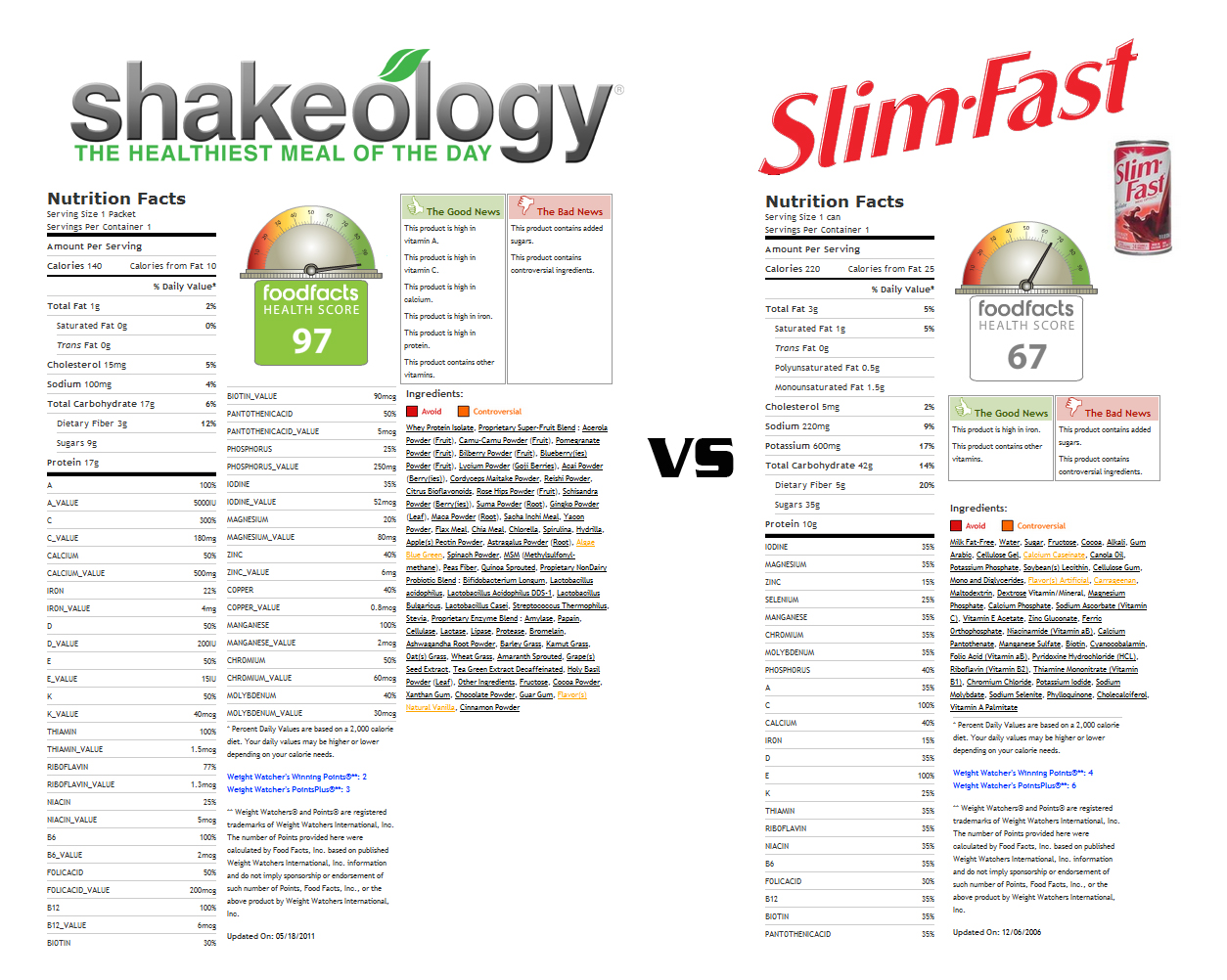
Slimfast high protein is the only option I see online that doesn't include huge amounts of sugar, but a single 180 calorie shake also gives way too much vitamins and protein to be sane times 10, which is what you need to get a day's worth of calories from it.
Weight watchers shakes look like they have exactly the same issue as slimfast high protein, except with more sugar and more servings required.
So here you are crapping on the product, but you actually haven't pointed to a realistic replacement for it.
Not really. Soylent is much cheaper than Ample, and that's a major plus for the cost conscious (which is a lot of people!)
As for the other ones - honestly mostly marketing I'd imagine. I've never heard of any product billed as a "nutritionally complete" meal. SlimFast to me sounds like a dieting product (as do weight watcher shakes), which isn't what I want at all. Non-dieting meal replacements, where they exist (I don't know the name of a single one!), just don't seem to target the same market that Soylent does.
Do other products exist that do what Soylent does? I don't doubt it. I've never heard of them, though.
That's all it is. If Soylent brands itself as a normal meal replacement, that's not sexy. So Soylent branded itself as a food replacement - which is more interesting and more dangerous (I just cannot trust that replacing food with Soylent won't have unintended health consequences down the line).
I agree with the common sentiment that Soylent's original goal/purpose - a simple powder/drink that could serve as one's sole source of nutrition - is sort of ridiculous, but it actually led to a remarkably well balanced product unlike anything on the mass market. It's remarkably filling and nutritionally well balanced for a convenience food.
Glycemic Index/Glycemic Load: a quick search doesn't give me SlimFast's GI/GL info, while Soylent does post the number.
No, none of the products you mentioned is anywhere near as nutritionally balanced as soylent. And those that are, clearly came after
Unlike the examples you mentioned, Soylent is not a "lose weight" brand.
As an undergrad in college, Soylent is everywhere. Can't remember the last time I saw any of those other meal replacements.
Protein powder (whey or soy pick based on lactose tolerance) + powdered oats + whatever for flavoring (eg. cocoa powder and coconut flour) in a shaker bottle - add water/whatever milk - shake and consume.
Throw in fiber supplement if you don't get enough fiber like psyllium husks.
Waaay cheaper than soylent if you buy smart (bulk), scale macros according to your requirements, at home or if you have a kitchen at work you can pre-mix powders in a container then scoop out, mix, drink and clean up in 10 mins tops.
Take some fruit along if you want - like an apple or a banana. Honestly soylent seems like a shitty version of a protein shake diet - low satisfaction is there but you get none of the gains.
"Geez, you don't eat only Soylent! It's just an occasional meal replacement!"
"Okay, then how is it interesting when there are dozens of competing products in the meal replacement category?"
"Because those aren't a full dietary replacement. You can't live on only Ensure (insert many other products here)."
"Okay....but you just said..."
I don't get Soylent. Not only is food one of the greatest luxuries in life -- one of the greatest rewards -- it's laughably easy to have a nutritionally complete lifestyle with minimal effort or time. But if I were enfeebled they all sound pretty terrible.
From the horses mouth, most use cases I've heard are pretty sensible. Very few users treat it as their entire diet. You've a good point that food is great, and it's good to do it right. I'd hope students would take the opportunity to learn, but they rarely do. Still, Soylent or equiv >>> pizza. Most other arguments against it/characterisations are a little circular at best, or reduction to absurdity at worst.
I honestly don't think it exists, though. Cooking and preparing food takes time and creativity.
> Not only is good one of the greatest luxuries in life
See, I promised myself I would leave this thread before people started toting out the arguments isomorphic to "you only eat Soylent 100% of the time! You monster!" - and yet here we are :). I thought I made it clear in my OP, but I don't eat Soylent for every meal- just the meals where, in the absence of Soylent, I would have had something worse.
Does that clear things up?
[1] https://www.theguardian.com/technology/2017/apr/24/new-statu...
Care to elaborate? I can cook and know how to eat a balanced set of macro-nutrients, but I find it quite difficult to be consistently health concious when eating out all the time and cooking regularly is anything but minimal effort and time.
So Soylent and real food hardly need to be enemies.
totally agree with this. soylent feels too much like... dog food for humans
Even low quality food is likely to give me a modicum of satisfaction, when a meal replacement does not.
I can't get the hate either, though.
If you are happy with it and improves your life, more power to you (and to Soylent).
I believe the fact that someone just wrote them a $50MM check is a fine reason to make a critical assessment of their actual value.
What does that mean? How did you make this judgement?
Off the top of my head, probiotics are a big thing that you don't see in Soylent. Spirulina is included. Omega 3 fatty acids. The emphasis on whole foods rather than nutrients is another thing important to me.
From what they've written it is clear they are taking a significant focus on nutrition, as the expense of, er, expense. This is a trade off I am willing to make.
I don't want to spend my days pouring over the latest nutrition research to see what I should be eating. Before Ample I would spend a lot of time chasing the latest research, yet continually feeling like there were huge things I was missing. It gives me great peace of mind to see that apparently smart people are doing this work in my stead. This is a huge advantage I cannnot overstate.
I've been getting 90% of my calories from Joylent for about 5 months.
90% for 5 months? Any specific situation or just prefer it that way?
Personally, I'd prefer to get out of the home /office, stretch, clear my head and eat the (kinda) old fashion way. Everyone has the same 24 hours...
[1] https://www.amazon.com/Calorie-Mate-Balanced-Chocolate-Ounce...
Whole foods, in bar form. Pretty good when warmed up (think banana bread, but slightly gritty, from all the fiber) but not exactly recreational when cold. Short shelf life.
I'd never again trust Soylent with my health for all their problems.
One crucial thing is that the water you mix it with has to be very cold, otherwise I did find it to be difficult to drink. Once you hit that temperature threshold though, it makes a world of difference.
At least for me.
I've never been bothered by the taste of any version of Soylent, even 1.0, so I could just have a unique experience.
In what way is Soylent any better than a handful of almonds and a banana?
But if you want a low-carb product with a wide range of flavors, check KetoChow [2].
[1] https://faq.soylent.com/hc/en-us/articles/212769503-Glycemic...
To be clear, I'm not a nutritional expert. But I've had people who know more than me tell me clif bars are basically non-nutritious.
I'm guessing you and many other commenters haven't hit the age where heart disease, high blood pressure, and pre-diabetes start raising their ugly heads. All of those conditions are depressingly common in the Western world and require medication with various side effects to treat. Each one of those microwaveable meals, though tasty and convenient, takes you one step closer to a rather unpleasant conversation with your doctor.
Given this, it should hardly be surprising that there's a market for a convenient meal replacement that is, if not actually healthy, then at least health-neutral.
("Just prepare your own healthy means and exercise more!" you say? Easier said than done. Just because you are able to do it doesn't mean everybody is in a situation where they can do the same.)
And that's precisely why people turn to Soylent and its competitors, because they are attempting to be healthy, balanced sources of nutrition. A bowl of instant ramen might be tasty but it's not going to get you much in the way of protein or vitamins.
Is "a fruit" really a healthier alternative as a meal replacement?
"Which fruit" is also a question that requires some overhead to answer (bananas are convenient but I don't like the flavor, oranges are delicious but messy to eat, etc)
I actually do prefer to have a Soylent in addition to whatever fruits I have available. It's not like you're swearing off all other foods if you choose Soylent as an option.
Everything that was an option still remain to be options, Soylent adds to the list of available options
Meal replacements is a well-defined and established category
The closest I ever got was avocado. Avocado is delicious and satiating. Takes a bit to prepare, but that's okay.
Avocado: the true Soylent competitor?
(Probably not. :))
I do think they have brilliant marketing, though. They turned something that was for old, dying people and made it cool. So I see all the "research" stuff they post as kind of a joke or marketing, because it has all been done and available for over a decade in terms of product...
Please walk down to the local drugstore and actually look at the nutritional labels. Than tell me they are the same.
I've noticed many people mixing up "supplement" with "replacement". For example, Ensure (the commonly cited "alternative") is a supplement - not a replacement.
In fact, FDA regulation differentiates between "dietary supplements" and "food". Go ahead and research how Ensure is classified then compare that with Soylent.
I think many people approach Soylent as a way to solve some of their problems, but people should realize it won't be and can't be. Another person I knew had bought a few boxes of Soylent attempting to lose weight. In reality, she did not change her weight appreciably, as all she did was consume the same number of calories she would have otherwise.
Lastly I would like to add that there is some debate over the actual nutritional efficacy of the composition of Soylent. If you look at the bioavailability of their calcium supplement, calcium carbonate, it is significantly less than the one found in milk, calcium phosphate. However, Soylent will still claim that it is possible to have 100% D.V. of calcium with 5 bottles.
Overall, Soylent is probably not a healthy solution to your problems.
I drink Soylent occasionally -- once every two or three weeks, maybe. Normally I use it if I know I'm going to eat a huge dinner, or if I ate a giant lunch and don't need to consume many more calories in the evening. It works great for me.
Yes, if you misuse Soylent, it will not be a good thing for you. That goes for, like, everything.
Anyway, I'm not really a fan of Soylent. I disagree with its health benefits. I think the company is pushing it as a far more miraculous product than it is (especially considering the recalls they received for their health bars which seemed like poor quality control). I also think it tastes awful, but obviously that is completely subjective.
"ergocalciferol should not be regarded as a nutrient suitable for supplementation or fortification."
D2 and D3 are metabolized so differently that they result in the "production of unique biologically active metabolites."
Ergocalciferol is the version used in the Soylent powder, while the bottled version doesn't even deign to inform the consumer what they are getting (it just says Vitamin D)
The fact that this problem exists and has existed for years with many of their ingredients indicates that they aren't even doing shallow research into nutrition.
(https://www.MealSquares.com try to provide multiple sources of all micronutrients from different food groups)
This medical professional's nonchalance about the difference is in pretty stark contradiction to your bizarre claim that they "aren't doing even shallow research into nutrition". There's a million possible reasons they may have decided not to optimize solely for bio-availablility, just as my doctor did.
Is that the primary difference?
You are saying your case (and that of your friend's) apply to everyone. I've lost a lot of weight using Huel (a similar product made in the UK), because it makes calorie tracking incredibly easy and allows me to avoid thinking about food except when I specifically choose to eat something.
Just because it wasn't suitable to you, and your friend didn't find a use for it, doesn't make it bad for everyone.
My experience with Huel was that it allowed me to reset my relationship with food to a more healthy one. My analogy is music - in the past I sat down and just listened to music, sometimes with friends. I still do that, but now I have a phone with me all the time, and headphones, and I listen to music almost all of the time. It's a constant, background thing, rather than (only) a special event.
Food had become something similar for me - I wanted to be eating all the time, to always have some flavour. For music, that relationship wasn't a problem, but for food, it has meant I'm overweight.
So I tried Huel. I don't think about food most days now - I drink, I drink a given number of calories of Huel (helping me lose weight).
Then, sometimes, I go out and eat something really nice with friends or family. Or I just feel like something and I make something nice. I still enjoy food, but it isn't a constant thing.
Now, you could do a similar thing with a normal calorie controlled diet, and in fact I did by using a calorie tracking app a few years back - but I didn't stick with it because it was hard, because every time you go to make food it's a tempation. Avoiding food entirely made it easier for me.
It's definitely not for everyone, but there are plenty of use cases.
You raise a great point about self reflection and Soylent. To stop cooking entirely is madness, and Soylent can enable antisocial tendencies or depression. They shouldn't brand themselves as a complete dietary replacement for food.
Freudian?
Does that include takeout/eating out? Because I know tons of people (myself unfortunately included) that have stopped cooking entirely and rely on takeout. It's not ideal but I wouldn't call it madness.
I found that it did nothing to satiate my appetite and that I'd be hungry, bloated and gassy all day long. The bloating and gas were incredibly uncomfortable and never really subsided. Eschewing the normal 3 meals a day routine and doing 5 meals didn't seem to help. Despite the fact that I was only consuming 2000 calories, 500 less than recommended for my size/weight/age/sex, I managed to gain weight.
The powder was messy and would coat whatever surface I prepared it on with a fine dusting. The liquid smelled unpleasant after a while and eventually I started to smell like it when I sweat. The liquid was basically an oil and solid particulate suspension so if you spilled it on anything it was difficult to clean up because the particles would work their way into fabric. Not such a problem for clothes but more so for furniture or car seats.
From a social perspective it really sucked because meals are a time to socialize it was awkward to go out with people and not order anything. I gradually moved to half days which actually curbed the weight gain I was seeing and eventually motivated me to give it up.
2500kcal is only suitable for people living a very active lifestyle or exercising a lot. Note that going to the gym for 45minutes 3 times a week is not being active.
When I spent an hour lifting heavy weights 5 times a week, my weight was stable at around 2500kcal.
The reality is that unless you work as a construction worker or other type of job that keep you active most of the day and/or exercise a lot (my 5x a week were heavy compound powerlifting lifts), chances are you need to adjust those recommendations down substantially.
Ultimatly the only thing you can do is to gradually lower your intake until you're losing weight. That you were adding weight at 2000kcal is not that surprising.
I've not tried Soylent, but I've trued Huel, and compared to what you described it seems a lot more pleasant, and more importantly, if anything I've found it hard to eat enough on it because it fills me up so much. The biggest problem for me in using it as much as I'd like is that filling me up doesn't stop me craving food - it's a reward thing for me.
You were eating too many calories. 2500 for maintaining body weight is a lot. Perhaps you were overestimating your activity level?
When is someone going to disrupt the smell-o-vision for the internet market?
Was Soylent ruining your health, or enabling you to let your health decline by isolating yourself? If the later, I don't think that's any reflection of the product itself.
This resonates with me. When I tried Soylent, it was because I was working WAY too much, and that "always-on" mindset carried over into other parts of my life. I felt like I didn't have time for food - I needed to be productive instead! Soylent markets to this extremely well, and it worked on me.
I stopped using Soylent when I found a healthier work/life balance, started meditating regularly, did a bit of traveling, started exercising more often, and met a new love interest. I wouldn't say that I'm a stellar cook, but I enjoy preparing meals - it's just another thing to try to do well.
So Soylent isn't really for me - though there probably are some lifestyles in which it makes sense.
It doesn't leave a lot of time for cooking healthy things (or, more accurately, I would rather spend the limited time left over after work for reading and producing music rather than cooking and cleaning my dishes and kitchen) and most packaged/prepared food is pretty unhealthy. Soylent and Joylent and Jake mean I end up healthier.
In the same way that "ball is life" gets a lot of kids to pay a lot of money for sneakers and the faint possibility of a future as a pro athlete, you'll get goods that signal your commitment to that lifestyle. Same with startups. Ergo, as startup culture does well, so does Soylent.
The only person that I know drinks soylent only to surpess the hunger until lunch, and doesnt plan on drinking only soylent. So far they say its doing its job good enough.
What's your opinion on that ?
It is marketed as a most-of-the-time meal replacement.
Am I wrong?
Name one that a) provides a proper amount of needed nutrients and b) is as simple and convenient as Soylent (or equivalents).
> Calcium carbonate is the most common and least expensive calcium supplement. It should be taken with food, and depends on low pH levels (acidic) for proper absorption in the intestine.[26] Some studies suggests that the absorption of calcium from calcium carbonate is similar to the absorption of calcium from milk
1 in 3 Americans are obese and the next 1 in 3 are overweight. We have no idea how to feed ourselves. Skepticism seems appropriate.
With the extra time I found myself, instead of rushing between lunch and work, wandering around listening to audiobooks or podcasts. I started enjoying these walks so much I extended them. On one podcast I heard about Blue Apron. I've never liked cooking, but the release of lunch's tediousness pushed me to give it a try.
Dinner is now, three times a week, a home-cooked meal for myself and one other. (Together, Blue Apron and Soylent reduced my daily caloric intake appreciably, at least on weekdays.)
I think Soylent was a great crutch during my downtime. I don't think it encouraged depression. In my case I argue it kept my body healthy while my mind wasn't, which is itself a bonus.
But it is a convenient solution for when you want a quick, kind of nutritionally complete meal that's convenient.
Of course, the founder didn't really position it that way? The hype was all about it being a meal replacement for ALL your meals - which is what caused your problem.
I'm honestly not sure how healthy it is, but I'd be very surprised if it was worse than what I'd do otherwise.
Now I agree if you have 5 bottles a day as your only food source, that's probably not great. We don't really understand human food needs as well as we say we do, and we kind of just get by as a kind of coincidence through variety. Having the same thing over and over and over almost garentees you get it wrong, no matter what it is you have.
One thing to keep in mind is it's not only depresssion that could cause the poor time management that Soylent benefits from. The whole "gotta be working every minute of every day" ethos of SV can feed into this very easily as well. Which isn't also to say that the two can't be intertwined...
I ordered one case of cacao but don't really care for the way their chocolate flavor tastes.
I love the flavor of coffiest. If not for the high amount of caffeine (and reasons of general food sanity) I could have it all day every day.
I actually don't believe your analogy holds. My mom uses Dropbox but she would never use rsync. But my mom can drive to Target or open her Amazon app and buy Ensure just as easily as she can order Soylent.
I do think Soylent is just rebranded Ensure/Slimfast and there's nothing wrong with that. For the most part, Ensure targets baby boomers, Slimfast targets gen-xers or people who want to lose weight, and Soylent targets millenials/professionals. Again, nothing wrong with it (so long as you don't act like Soylent is some revolutionary/brave-new-world product).
Soylent's difference is in marketing and positioning, not nutrition.
I remember seeing that they had a position open for a software engineering role. If I remember the job description correctly, they've built out their own online store?
I recently saw that you can buy their products through Amazon - I wonder if it was money well spent to roll out their own web store versus using Amazon/Shopify. As a past customer I don't remember seeing any particularly unique feature that made hiring in-house staff for this aspect necessary.
Nonetheless, the drink is ok. I tried it for a few months. Instead of avoiding cooking, I have embraced it, and now cook incredible meals for $3-$4 using my Joule sous vide. Eating real food has changed my mood significantly.
If anyone in SF wants to buy a whole box of Soylent Original (white bottles), I will sell an extra I have for 40% off. Must pick up, located at Chavez/Bryant.
As a customer, I don't think about that at all. They may open source their recipes and products, but buying bottles from them is still relatively cheap and by far the most convenient option. Also, whenever mistakes do happen, their support is excellent. This is why they'll continue to get my business.
There are a lot of companies out there that aren't run of the mill tech companies but are still able to massage their way into that category (another example is We Work). There is so much money chasing outsized returns that companies/founder with a good plan, strong team, large enough addressable market and the right network are close enough for many VCs.
People getting excited over devices that do what ovens or hearths do at a 24x slower pace? Figures the popularity of soy formula.
(And yes, my oven turns even the toughest cut into "incredible quality" in 3h tops =)
Of course, those are average food prices in the US so YMMV. If you're in NYC or LA/SF, it's going to cost more than that no matter where you shop.
1. It contains enough calories for an average healthy adult to live on (2000/cal/day, give or take)
2. The sugars used are high glycemic index
3. You will incur no major nutritional deficiencies/toxicities by long term use
4. It costs no more than $14/day (or $8/day for the powder) while satisfying all above conditions
Most diet drinks fail on condition 1, most meal replacements you're aware of like Ensure fail on conditions 2 and 3, and the leftovers usually fail on condition 4.
To that end, I don't see their product as all that unique or difficult to replicate, and I also foresee headwinds for them if/when they try to market to a broader base of consumers who already have powders, shakes, bars, and hundreds of other meal substitutes to choose from.
/r/soylent is a popular place where people talk about meal replacements.
I think they are kind of like Kleenex, they will become the common name for the genre.
As for taste, I tried Soylent and it tasted like wet cardboard to me. I ended up switching to Schmilk (you mix the powder with milk) and the now discontinued 100% Food.
So brand defensibility + economies of scale. Though somewhat tenuous.
So... it doesn't matter.
That said, Soylent has improved my diet significantly. My entire life I have struggled to consume enough calories. Adding one serving of Soylent per day has allowed me to do two things:
1. Increase the number of calories I consume so I am in a daily surplus (I've gained a healthy 13 pounds since 2015 thanks to Soylent).
2. More importantly Soylent has accustomed me to eating larger meals. I can actually go to a restaurant and eat a full meal. I'm sure you can understand how much that has improved my social life.
Prior to Soylent I was consuming Ensure daily for more than five years but it's not enough calories to make a difference plus it's way more expensive.
Could you explain? I just checked the prices for 12-packs of original soylent is CAD$3.56/bottle in Canada and USD$2.69/bottle in the US. That's an effective exchange rate of 1.36 CAD/USD, and the current exchange (as I type this) is 1.37 CAD/USD.
Or are you just complaining about an overall recent price increase? I have been paying CAD$29 per 12-pack since April 2016.
I just ordered a 12 pack at $3.75 a bottle ($45/case - the price shown when you're not subscribing) and was charged $45USD which turned out to be $61.64 on my credit card, or $5.14CAD a bottle.
Do you use it as the occasional convenient meal replacement or how far do you go into replacing all real food?
I suspect there is both, but what I am getting at is how much Soylent's long-term success depends on people seeing eating as a nuisance that should be optimized away versus something that should be savoured and enjoyed.
To me this is in the context of the larger question of personal utility maximisation. In the grand scheme of things, we have just started being able to really monitor and improve all aspects of our lives (in terms of time spent, convenience), and there is the question of how far we (most people/potential customers) ultimately want to go. It has become clear that there is the potential to optimise away friction/time spent in almost all human habits, but it is not yet clear if we really want to keep going down that route.
Will we keep optimizing things like meals just because we can until there are (conceivably) nutrient implants that make eating unnecessary, or will we sort of revert and see that maximising utility of every interaction does not lead to overall greater satisfaction?
In one world, Soylent could eventually dominate, in the other, it will remain a niche product because eating and food is too important too most, also culturally speaking.
I replace the majority of my meals with Soylent, but the point isn't to replace all meals...
>I suspect there is both, but what I am getting at is how much Soylent's long-term success depends on people seeing eating as a nuisance that should be optimized away versus something that should be savoured and enjoyed.
In my opinion, eating real food is an indulgence, not a nuisance. People who are very busy frequently cannot find the time to prepare nutritious, healthy meals from the bare ingredients, and purchasing ready-made food that is nutritious and healthy can be prohibitively expensive for some people.
Soylent is meant to replace a fast food burrito or a McDonalds breakfast sandwich, not a home-cooked steak dinner or a meal at a restaurant with friends and family. In my view, Soylent is not about minimizing the amount of time spent on preparing and eating food, it's about providing a convenient, nutritious, and (relatively, compared to fast food) cheap source of nutrition for those times that I don't have social obligations and I don't want to/don't have time to cook something for myself.
Cooking doesn't take long. At all. You can prep an entire week worth of meals in 1 hour. Refrigerate them, freeze them. We have thousands of years worth of food preparation and preservation technology. Cook on Sunday, eat until Saturday.
As for being expensive: again, it isn't. If cooking at home was expensive the world population would be 2 billion tops. Poor people cook at home because it's the only way they can survive. If a woman in Paraguay working two jobs can do it and feed her family, so can you.
> it's about providing a convenient, nutritious, and (relatively, compared to fast food) cheap source of nutrition for those times that I don't have social obligations and I don't want to/don't have time to cook something for myself
You can fix yourself a sandwich using good products that is just as nutritious. Most people don't even need to eat so much. It's very easy to have good 1500-2000 kcal a day with regular food that you prepared quickly.
Soylent, to me, is simply about people who want to "hack" their bodies and be on the futurist side of things. There's nothing nutritiously advantageous about it, nor is it cheaper than cooking for yourself. But somehow people make the assumption that it's either that or eating the very worst food known to man (McDonald's or whatever). It isn't.
I'm sorry, but I'm getting really tired of reading people use this as a justification for soylent; I'm not saying there is a convenience to it, but phrasing it this way is kind of sad. It does not take a lot of ingredients, or time, to make a set of meals for the week.
I love food, but I don't care to make it. I used to make turkey or krakowska (Polish meat) sandwiches for lunch the next day, but I don't care enough about those things to go to the deli every week or two.
Once or twice a week I'll get lunch at a Halal truck or the deli next to my office, but this is much more expensive than just soylent. Bought lunch turns into my "big meal" and I end up having very little for dinner.
For dinner, I'll make some food but it's never elaborate. Very often, my dinners are peanut butter sandwiches. Sometimes I'll make some ramen and throw an egg in there. I'm also really into gourmet burgers so I go out a couple times a month for one.
I suppose the takeaway is that my lifestyle and eating habits didn't change for Soylent. It was just a better solution for me than what I was already doing. I prefer to have a cheap eating routine and Soylent helps prevent me from eating garbage food with basically zero effort. Not to mention that I'm borderline "chocoholic" who cut out buying sweets and the cacao flavor soylent really hits the spot.
When I first started I went 100%, then was one of the first people to get horribly sick of the bars, eventually quitting.
Now I eat Soylent as a replacement for meals in which I usually eat crap foods. If I was going to get a sausage mcmuffin from McDonalds, instead I eat a Cookies and Cream Soylent "shake." I think that Soylent's big play is in a healthy meal replacement that is scientifically formulated to be healthy. They have fought with that and being environmentally friendly, but I think it all comes back to being a healthy food in the end. The 3 people I know who eat it, do exactly the same as me. Most tried 50% for a bit, but eventually it is used as a convenient mildly healthy meal replacement when needed.
Concretely, working at Google, this means a weekday eating schedule of: Soylent breakfast, Google lunch, Google afternoon snack, either Google dinner or Soylent dinner, Soylent before-bed snack. So usually 3-5 bottles (1200-2000 kcals) per day. (Google breakfast ends too early for my night-owl schedule.)
On weekends, it depends on my social schedule. For a day with friends or the girlfriend, most meals will be eating out or delivery, with only 1-3 Soylents in between meals/before bed for extra calories. For a day home alone coding or gaming, I'll eat exclusively Soylent, around 6-10 bottles (2400-4000 kcals) per day depending on how much I can push myself for those gainz.
As someone who doesn't particularly crave the sensation of eating, this seems like maximal utility to me. I get the other benefits of eating (socialization) when I can, and when those aren't forthcoming, I just get a (relatively) cheap, nutritious, fast source of calories. (I do enjoy eating, just not overmuch.)
And it's been a godsend for weight-gain; I have a very hard time stuffing myself with normal food or shakes, but Soylent just goes right down.
This is a false dichotomy. I savor and enjoy food, but not all the food I eat. If every frozen burrito was replaced with Soylent, Soylent would be far more than a niche product, yet society would not have lost it's appreciation for the cultural, social, and culinary aspects of food.
Currently I have a Coffeeist for breakfast 2-3 times a week, and Soylent 2.0 as a work-lunch 4 days a week.
This current trend is coming in as a replacement for what had become some pretty bad eating habits. Stopping at McDonald's or a coffee shop for breakfast 2-3 times a week. Fast food or restaurants with coworkers several times a week, that sort of thing. The social aspect of lunch with coworkers is great, and I try to set aside at least a day in the week to do just that. But that habit is expensive and unhealthy.
I'm a pretty good cook. I tend to eat home-cooked dinners. I'm fine with preparing a big batch of food and freezing/refrigerating it to eat for many days. But I've never found a food that works for this that's great for breakfast or taking to work as a lunch.
Soylent fulfills my exact needs in this regard - and the other meal replacement options don't fit the macro-nutrient profile I strive for. All over this thread there's references to SlimFast (too much sugar in the regular, too few calories in Advanced), Ensure (too much sugar), or protein powders/shakes. I've tried literally all of these.
Protein powders are always a go-to of mine when I'm trying to bulk up. So is plenty of meats and vegetables.
In the end, I just totally have a use for Soylent - and so long as they're the only ones providing what I want in a form I enjoy, they'll continue to have me as a customer.
And yet every time there's a thread about Soylent people say that it's the only sole source of nutrition product. (Even though it isn't).
Why do you make a distinction between Soylent and "real" food? Its ingredients are not terribly different than other stuff I buy at the grocery store.
Speeding up is useful for many reasons. Just to name a few: you have a lead and want to maintain it; you suspect the window for product adoption is limited; you want to grow the business and sell it so you can move on.
They could grow slowly for the next 10 years, or throw lighter fluid on it and grow more aggressively, giving investors a cut along the way.
> "This funding will enable us to expand our current product offerings, support our expansion efforts into traditional retail and international territories, and further our goal of bringing Soylent products to people around the world.”
A popular argument seems to be "I don't have time eat something proper". To me, that just replaces the lack of one resource (the ones in the movie) with another (time).
I did 1 packet per day (2000 calories), supplemented with some snack food on the trail (dried nuts and fruit, Stinger-brand honey waffles, muesli bars etc.).
Motivation was firstly as an experiment (to see how I would cope), secondly because I wanted to accurately control/measure my caloric intake, and thirdly, because I was somewhat paranoid about getting food poisoning on the trek. (I used a MSR Guardian to provide clean filtered water for mixing up Soylent).
I didn't really notice any odd effects - and it went better than expected well. Didn't get food poisoning (wife got diarrhoea, but she ate local food) - was a bit hungry on some days (in hindsight, 2,000 calories was a bit low - I upped it to 2,500 calories on the day I climbed Kala Pattar).
All I can say was, Soylent was great for this use-case, and I'm a firm believer now. At home, I only use Soylent for when I have no time to cook, and need a reasonably healthy/complete meal - if your alternative is going out for a late-night kebab, or 24-hour fast-food, it's not a hard choice for me =).
Ensure has a massive market, $billions in annual sales, and medically proven results.
The medical market is not where Soylent is going right now, But it is massive and proven.
If they could market to younger, hipper folks who've been prescribed Ensure, but would spend their own money for something nicer... That'd be me.
(BTW: I finally ordered some huel just now... Really sick of Ensure, will give that a try)
I've been using their coffiest drink, and kill two birds with one stone. I do sometimes miss the experience of making my own coffee though, so I may try the powder instead.
I will say though, at the beginning I was not a fan. Bowel movements changed, felt weird and bloated, and so on. But it stabilized after a few weeks.
But I'm in a medical weight loss program now, and I'm loving it. It's doctor supervised, I started out at 400 pounds, and I'm down to 360 after five weeks. It's medically supervised because I'm in ketosis, which can be very dangerous. So best to have blood drawn regularly, etc.
But the food is great. You can also get them as your own supplements / replacements.
http://www.robard.com/products/
Right now I'm eating 1,000 calories a day. I'll be going down to 800 calories per day. And I'm burning about 2,000 calories of my own fat every day (that's a pound). Again, this is a dangerous diet, but it's medically supervised.
I feel great, I don't feel "hungry" all the time. It's awesome.
I'm glad it's working well for you, but I'd just caution that plenty of quackery is "medically supervised", as were fen-phen (https://en.wikipedia.org/wiki/Fenfluramine/phentermine) and the Tuskegee trials.
/shrug
I don't really know how to evaluate it much better than that.
Usually on my 500 calorie days I'll just drink a couple Boosts. I'd like to consider Soylent as an option for the fasting days as well, but from a cost perspective it can't really compete with the other alternatives out there (Boost, Ensure, and various no-name store brands available from places like Sam's Club and Costco). Liquid Soylent runs between $2.69-$3.09/400kcal, whereas high protein Boost (which is not even the cheapest option if you're willing to go with no-name brands) runs at $1.93/400kcal. Going with Soylent Powder can bring your costs down more in line at $1.54/400kcal, but the added hassle of having to mix it yourself doesn't make this a very attractive option in comparison.
I guess what I'm ultimately getting at is, assuming you are just using Soylent to supplement an otherwise normal diet, I don't understand its appeal over other less expensive nutritional meal supplements like Boost and Ensure.
That's not an unusual strategy for hype-based products. Skyy Vodka and WD-40 were completely outsourced. Skyy Vodka was originally made by Frank-Lin Distillers Products in San Jose, the company that makes most of the low-end booze on the West Coast. Frank-Lin buys bulk ethanol by the tank car load (they have their own railroad sidings), does a little post-processing on the ethanol, takes in tap water and runs it through a deionzing plant, mixes them, adds flavoring, and bottles. They have a really fancy automated bottling line which can handle about a thousand different bottles and can change bottle types automatically. This is called product differentiation.
Not trying to badmouth soylent, I had a similar experience with a brand of granola bars.
(For the record, I would quit my job before skipping meals; they are actually that important to me staying sane)
I think our body has organs which releases various gastric juices to digest the food we eat. It is not only about how much calorie/protein one is consuming, there are also some useful by-products which helps in overall functioning of the body as well. A very simple analogy is only drinking fruit juice instead of eating them raw. We are not taking in fibers which helps in digestion, slow decomposition and good bowl movement.
I am very skeptical about approaches like this where we measure our food just in terms of calories, vitamins, protiens and then consume them directly in that format.
Soylent has said they were looking into having studies done, but I don't recall what the details were or when it was planned for.
While anecdotal evidence isn't enough, it's fairly common to see people posting results of their blood work after a few months of Soylent. But I'd personally love to see some more details and unbiased tests in an "official" study.
Nutrition Facts
Reflex Instant Mass Pro https://www.reflexnutrition.com/instant-mass-pro/
Soylent http://files.soylent.com/pdf/soylent-nutrition-facts-1-8-en....
"We need to reach out to a larger demographic with a name that communicates the value proposition of the product. Liquid Lunch focus-groups well in the demographic of females 18-30, which is where we see our growth trending in future..."
I've always liked the cheekiness of the Soylent name and it's really the only thing that's made me pay the slightest bit of attention to the product.
Which is to say, I don't think the name is as problematic for the real-world target audience as some people make it out to be.
Soylent has gotten me off fast food entirely. I keep a few bottles at home and at work, so that I can get a meal during my commute that doesn't come from a drive through.
I'm fairly certain it's due to an astroturfing campaign, but I don't know who would pay for such a thing.
I'm a fan of the breakfast Soylent (Coffiest). To me it's the best form of the Soylent idea.
And now they've brought out flavors, basically turning it into an expensive meal replacement. It's ridiculous.
Live a wild debauched, taste everything, free for all, no care whatsoever and get a life expectancy of: 80yrs? A somewhat lucky draw could see you beyond 90
Hard choices :)
Which doesn't involve cannibalism, but is an odd choice in other ways.
Note, though this is a "referral link", I do not get anything out of it, but they do donate to World Food Program USA: https://www.soylent.com/refer/
I have been drinking Soylent 12 bottles a month. This alone has freed me up from thinking about what to eat for lunch.
Rather surprised that nobody, as yet, has made a connection between Soylent and Juicero.
* 1st: Juicing & Nutrition - There’s very little evidence that liquid food / juicing has any benefits for most adults. Most nutritionists worth their salt will advise against juicing. Juicero (and other juice makers) take perfectly good,healthy, nutrient-rich fruits and vegetables and make them less healthy. Ditto for Soylent. Crushing natural foods (vegetables, fruits, any other in their natural form) together to seek out their nutrients, and reconstituting them in powder/liquid form is, by any other fancy name, a juice. “The skin on an apple, the seeds in raspberries and the membranes that hold orange segments together — they are all good for you. That is where most of the fiber, as well as many of the antioxidants, phytonutrients, vitamins and minerals are hiding. Fiber is good for your gut; it fills you up and slows the absorption of the sugars you eat, resulting in smaller spikes in insulin. When your body can no longer keep up with your need for insulin, Type 2 diabetes can develop.” [1]
- I wonder if people who see the benefits of Soylent/juicing have read Michael Pollan or Marion Nestle. See [1], [2], [3]
* 2nd: Silicon Valley and investments Both Soylent and Juicero are funded by marquee investors. Here’s a brief list for Juicero (Total $118M raised) [4] GV (nee Google Ventures) KPCB Abstract Campbell Soup Thrive Capital
Here’s for Soylent (Total $70M raised):[5] GV (nee Google Ventures) A16Z Tao Capital Index Ventures YC Lerner Hippeau Initialized Capital
What do these have in common? Apart from being in the food business? It is the Food-as-a-Service business model. That is the essential ingredient (no pun) of the business, not the nutrients per se.
In effect, both Soylent and Juicero are products targeted towards high disposable income, busy professionals who want convenience, and perhaps the glow of “save the world from hunger”. (whatever that means). Any health benefits are inconsequential at best in the grand scheme of things.
If you value your nutrition and health, you are far better off relying on the tried-and-tested advice from Michael Pollan: Eat Food, Not Too Much, Mostly Plants.
All other rationalization of time/effort/nutritional benefit of Soylent/Juicero in “save what world from hunger” is, well, just plain old rationalization by any other name.
[1] [People think juice is good for them. They’re wrong. - The Washington Post](https://www.washingtonpost.com/posteverything/wp/2017/04/26/...) [2] [Books | Michael Pollan](http://michaelpollan.com/books/) [3] [Marion Nestle - Wikipedia](https://en.wikipedia.org/wiki/Marion_Nestle) [4] https://www.crunchbase.com/organization/juicero/investors [5] https://www.crunchbase.com/organization/soylent-corporation#...
Soylent Drink: 400cal, 21g fat, 20g protein, 36g total carb. 9g sugar.
Ensure Plus: 350cal, 11g fat, 13g protein, 57g carb. 22g sugar.
Ensure Enlive: 250cal, 11g fat, 20g protein, 45g carb. 22g sugar.
As you can see, Soylent has more fat, which provides 9 cal/gram compared to 4cal/gram from carb/protein. This allows it to hit its calorie goal without adding nearly as many carbs and sugars.
EDIT: Think about marathon runners: they drink water and electrolytes. I'm pretty sure I can handle a workday fully concentrated without eating every three hours.
You couldn't live on SlimFast if you had to. It's an appetite suppressant/meal replacement for short term use, given that it's not nutritionally balanced.
Neither is it similar to Ensure or most other meal replacement drinks for the same reasons. They're usually absolutely loaded with fast, low-index sugars that'll spike your blood sugar.
Basically, it's the food equivalent of water. Neutral, nutritious, has what your body needs and nothing more. The carb source they're using is high-GI, meaning it won't cause that spike. The idea being that when you CBA'd to cook, when you'd normally run to the local burger joint's drivethru, you shake up a glass of this stuff, and you're back to doing whatever you're doing for cheaper (about $3 a meal) and in less time.
Basically, it hits all of the right notes that most of the on-the-shelf competitors do not. It's relatively cheap, it keeps a long time, it's actually good for you, it's convenient as food could ever possibly be.
I personally love the stuff.
Slim Fast:
http://www.livestrong.com/article/125563-slim-fast/
http://www.fathead-movie.com/images/slimfast.png
https://tamafitness.files.wordpress.com/2011/08/shakeology_v...
Sounds like you could probably survive entirely on Slim Fast. It's got Iron (which the original Soylent didn't have), Vitamin A, Vitamin C, Vitamin B, Vitamin D, and Iodine, and a bunch of other micronutrients. You probably wouldn't have a great time but I doubt you would on a Soylent-only diet either.
Solyent doesn't seem to differ much:
http://files.soylent.com/pdf/soylent-drink-nutrition-facts-e...
Really? Slimfast and Ensure have much higher amounts of sugar; what are you thinking of?
    Calories 400
    Total Fat 21g 32%
      Saturated Fat 2g 10%
      Polyunsaturated Fat 2.5g
      Monounsaturated Fat 16g
      Trans Fat 0g
    Cholesterol 0mg 0%
    Sodium 300mg 13%
    Total Carbohydrate 36g 12%
      Total Sugars 9g
    Protein 20g
One of cholesterol's most important functions is to support learning and memory — the brain is basically made of cholesterol. And statin drugs provably lower cognitive function, for instance.
Anyway, it's a real rabbits hole to go down research wise, but I certainly wouldn't advocate a cholesterol-free diet like soylent.
And saturated fats have been unfairly demonized for years.
http://www.nytimes.com/2002/07/07/magazine/what-if-it-s-all-...
Also maltodextrin is always one of the main ingredients. Super high gi, and no nutritional value.
And this after JuiceBro. Amazing.
In Defense of Food by Michael Pollan
http://www.goodreads.com/book/show/315425.In_Defense_of_Food
Recently learnt about some Amish selling home made honey without FDA approval; now awaiting trial on a 20 years jail charge.
I don't know if it was intentional, but your description of the Amish and honey is not completely accurate. The gentleman in question was informed he could not claim a salve he sold cured cancer without evidence. It's not honey, it's a mixture of herbal remedies, some of which are toxic.
It's hard to get any true factual information about this specific case because the coverage is almost entirely in heavily biased "news" outlets that focus on "Natural Healing Remedies".
http://www.naturalnews.com/2017-02-23-amish-farmer-facing-68...
This is not a supplement or additive so it's a food. It's not a pill you take in addition to your meal but a meal replacement. The best route from here is to see if ensure is fda approved and if it is, what's the value of that stamp? Is it objective 100%? You can't make many assumptions so we must continue on from this point. I"m not sure there are regulatory requirements for a product like this and if there are what is the value? Does an FDA stamp on this supplement mean 100% that a product can replace all food forever?
They've stopped making medical claims for the product.
> Recently learnt about some Amish selling home made honey without FDA approval; now awaiting trial on a 20 years jail charge.
I'd be inteested to read that case. Most of the cases I've seen people were making clear medical claims ("cures cancer") or selling raw milk.
No word for downvoters. I'm sure you never been once wrong in your lifetime...