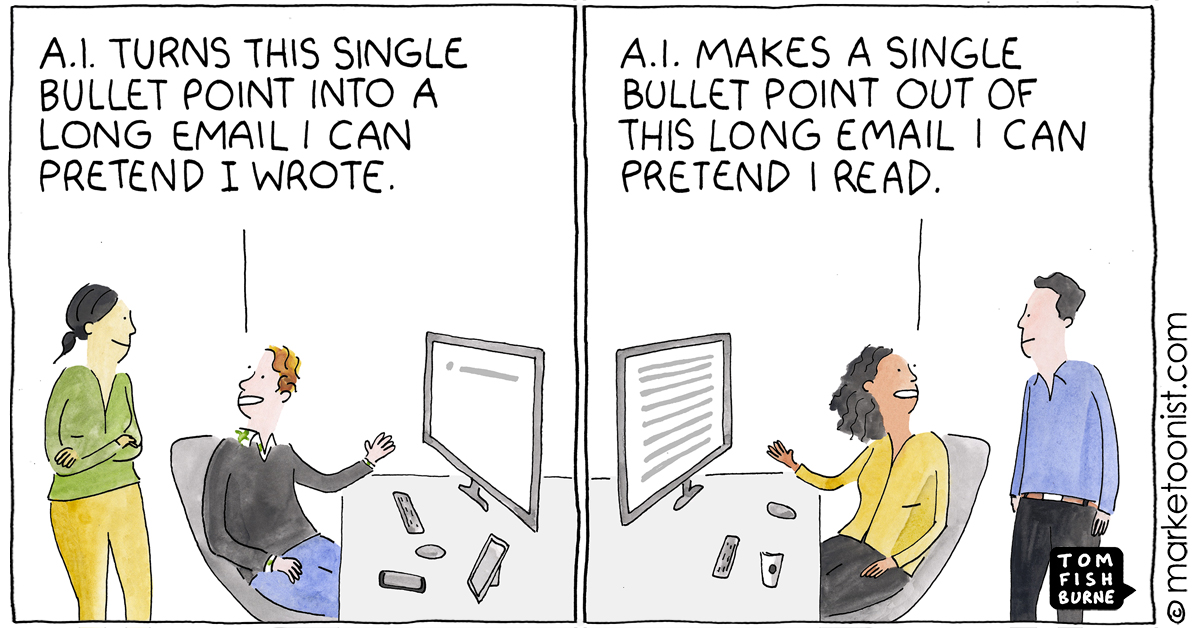
I've been pretty aggressively looking for a job for the past six months or so. I have 10+ years of professional software dev experience so I've mostly been looking at senior dev positions. I haven't used LLMs at all in my resume, cover letters, etc. I only apply to jobs that I believe I meet the requirements for and that I would likely accept if given an offer. How do I signal that 1) I am a real person 2) I really do have the job experience and skills listed on my resume, and 3) I really am interested in the specific job I'm applying for. Because doing this my hit rate has been abysmal. I've had maybe 10-12 initial phone screens (never an issue, I easily make it past these). Past that I've had maybe 3-4 interviews that get into the later rounds. From that I've had zero offers.
So why should I keep doing what I'm doing when it's getting me nowhere? Why shouldn't I switch to an automated "shotgun" approach that applies me to as many jobs as possible to which I vaguely fit the requirements? The only other way I've seen suggested to signal that I'm a real person with real experience is to know someone in the company who can vouch for me (which I almost never do).
I’m in a big semi-private Slack where people have been discussing CS application strategies for a long time (since before ChatGPT).
The desperate people usually go through an arc where they try automated applications and embracing LLMs. Their response rate is dismal, but they make up for it with shotgun volume.
The catch is that when they finally get a job, it’s usually at a company that sucks. Some place with incompetent hiring managers who can’t tell the difference between LLM slop and a genuine application. Interview processes that leave so much room for LLM cheating that all of your coworkers are going to be LLM jockeys too.
So you can try it. You might get something out of it, which is better than nothing. However, if you’re expecting a good job at a good company then it’s not going to deliver what you expect.
An arms race is afoot
Also after so many bad resumes I started being very forgiving for the ones that didn't fully match the job requirements if they had something in them that made it seem like a real person, e.g. a personal hobby section. I think a lot of people discourage writing that but I argue it makes you stand out in an ocean of fake and copy pasted junk.
At this point every remote internet checklist has to include checks for humanity, because the percentage of straight out fakes is too high. Even the questions to ask me at the end were GPT provided.
I was happy for that info to go to potential employers, but not to random company and its canine friend.
Then MS bought LI and I was so glad I'd left years ago already.
I've seen one of two places have mandatory URL fields for LinkedIn profiles.
One of the impressions I've been getting is that if you do not fit exactly into an recruitment agencies process, you're DoA, and I have begun to suspect the only work they do is look at LinkedIn.
I suppose I am supposed to actually fill out my LinkedIn too?
wait shouldn't that already have been the case? lol
During my last job hunt I applied to nearly 300 jobs. Then I recruiter I met at a tiny JavaScript meetup messaged me about a position, and boom. New job.
It’s just one anecdote, but it changed my perspective, that’s for sure. When I’m getting serious about my next hunt I’m just gonna attend tons of meetups and get real active in open source
I don't want to retype my recent experiences, but I have a thread from about 6 weeks ago that goes into my specific details here https://news.ycombinator.com/item?id=42137229
I was in a good position so I could take my time, but I honestly don't know what I would have done if I had needed a position quickly.
The best defense against AI would be a license number that identifies a person uniquely, provides their relevant job history from a database, proves some minimal common competency baseline, and confirms conformance to some ethical norm against known liabilities.
All of the rest including Faang companies I went in without any interviews by knowing people and pulling strings. You shouldn't have to "apply" for anything.
I'd go the other way, towards more schlepping and less automation[0].
Are you reaching out to anyone in your network and asking if they know anyone who needs your skills?
Are you joining communities (online or offline) that match up to your skills and interests?
Doing either of these, so that you can be warm intro-ed to hiring managers by someone who knows you (or maybe knows someone who knows you) will typically get you to the front of the line.
That's the approach I would take if I were looking today. Too much noise otherwise.
0: Works for startups: https://paulgraham.com/ds.html
Now, if on interview you pass rate is low, it's hard to say what you are doing wrong.
The current hiring market mirrors online dating.
Swiping right as much as you can (as a man) will get you more matches for sure, but is unlikely to result in a long term relationship.
There isn't much you can do. It comes down to two things: luck and timing.
I do think there are actions you can take to improve your odds, but you gotta figure out what will work best for you. If those actions were somewhat obvious, I'd imagine thousands of others are doing the same thing.
> know someone in the company who can vouch for me
It didn't take long to establish myself as a relatively skilled engineer in a discord community specific to a mobile development framework. I was able to help many junior engineers solve issues. If I was looking for a job, that community may have provided me an opportunity to at least get my resume in front of a few hiring managers.
Me personally, with all these seemingly out of work programmers who are likely as skilled. or more, I'd look to network with a few of them and do something interesting. Start a programming community that lets engineers self organize and launch a projects. Keep the bar to join very selective much like those dating apps that target VIPs and elite people.
Ask them if it is possible to re-apply in a few months.
Show your resume to friends and colleagues you trust and ask for honest feedback.
The referral is not sufficient, but unless you have an MIT PhD in Machine Learning, or similarly rare and in-demand credential, it is necessary.
And I wish I had something encouraging to tell you, but I don’t. I’m extremely broke and getting ghosted on application after application, or turned down months later via robot email. Never any human contact any step of the process.
I’m looking at getting into another industry, tbf.
Since university I have never not been offered the first job I've applied for. For 10 years now I could ring any of the firms working in the niche I've been in and more or less set my rate. I still could, but I'm trying to get out of that niche into the wider world. I've put hundreds of tailored applications in and basically had nothing (literally a few interviews with Canonical, which is a complete car crash of a process and an HR screening call for a role on half my previous income where she said they were struggling with the number of applications, that I didn't hear back from).
It's an absolute bloodbath out there. I regret I don't have any answers, but good luck with your search.
You've gotten 10 phone screens, so you can probably double your activity and get to 20. If you're actually going for jobs you're qualified for, 20 screens should net you ~3 offers, if not more.
My suggestion: record yourself on your interviews and have friends review the recording and offer critique. You have blind spots you need to address to achieve the outcomes you want.
Is the job market just as bad for juniors, people looking to enter the field right now?
I had many of my peers pay people for signing off that they had an "internship" at some companies.
IMO job boards are almost entirely useless. Going to meetups and making friends in open source communities is the way to go.
You ask your friends/past colleagues if the company they currently work for has any openings. If you've worked hard, solved problems and are good to work with, it's a good way to get further employment.
some people think SWE is about "logic". it is, in part, but the "engineering" in software is much more of an art than it is in other branches, like construction
the current sota AI is great at logic and terrible in creativity and actual engineering. if the technical assessment is not designed for you to show your creative engineering side, do it yourself, do more than you were asked, think about what would be relevant to that company in terms of engineering creativity and offer that
that's the best way I know of showing you're a real engineer, not an LLM operator, it's worked well for me in the job search process
good luck!
The last company where I worked, employee referrals were the preferred mode of hiring. The referring employee would also benefit, on successful completion of the new hire’s first year.
You might want to revisit this aspect.
HN hates recruiters, especially the cold calling kind on LinkedIn, but it has worked great for me. Every other job of mine has been through a recruitment agency and they have been responsible for the highest pay increases and they have been better to talk to about available budget for the role than the employer
Are you doing anything that shows and differentiates your interest isn’t the same as all the automated “interest”?
Ex: understand deeply some parts of the industry the company is in and how it can be improved w/tech? Or is it just “rust is cool”?
Meet people and form connections.
Also, not using LLMs might be a red flag. I wouldn't want a dev that is not open to this technology...
The person you're replying to is a senior, not junior candidate.
For junior devs who are still learning, LLMs are a great force multiplier that help them understand code faster and integrate new things.
For senior devs, LLMs are a maybe-optional tool that might save a couple hours per week, on a good week. I would consider extremely heavy LLM use a much larger red flag for a senior level position, than not using them at all.
My job isn't writing resumes and cover letters.
> Also, not using LLMs might be a red flag. I wouldn't want a dev that is not open to this technology...
lmao this is exactly the issue. There are hiring managers in here saying they're trying to filter out people using LLMs in applications and you're telling me to use LLMs.
Like completely fabricate what they need for a plausible answer from thin air.
As of now they do more harm than good.
I downvoted your post because this is a complete nonsequitur.
I did two rounds of hiring software engineers last year, one in spring that seemed normal, and one in the fall that was was brutal. The fall hiring had a flood of applicants, and in retrospect, most seemed like AI was used in some way.
For the fall round, I suddenly had a higher percentage of applicants that qualified after resume screening and initial phone screen, but they all collapsed when I did a technical round. And failure rate on the technical was much much worse than usual.
We have a full-time recruiter working with us, and I'm not 100% sure what tools he used, but I switched to manually reviewing each resume, and given that it was 100s, it took a long time, but I still had my problem of great initial screen, terrible technical interview.
Then, I decided to throw out anyone who heavily mentioned AI, LLM, or data science. After all, with almost a thousand applicants, I needed to sort some how. (To be fair, our use case is more esoteric, we're not writing Javascript or parsers, so it's not as much of a time-saver.) Large chunks of applicants dropped and the process felt more normal.
I also switched to only on-site interviews. My initial technical screenings are still done remotely. Before COVID we were 100% on-site interviews, but did hybrid after COVID. Now, I'm back to enforcing on-site for my group.
Pro tip for anyone hiring engineers for remote positions:
Tell the applicant that there “might be” an in person technical assessment, even if you know the process will be 100% remote.
The amount of fake candidates at the moment is insane. The only thing that makes fake candidates self-select out is knowing there’s the possibility that they will be required to be somewhere in person.
Another trick I’ve used is saying “Oh, you live in Flint Michigan?? We happen to have an employee 20 minutes away, would you be open to meeting them?” And then suddenly they drop out of the interview process.
There are a lot of foreign scammers exploiting the WFH trend in the US to the point where it drowns out real candidates. It’s really bad.
In this field, unless you're hiring a junior engineer, you can have a reasonable expectation that a potential candidate will fly out for an interview even if it's a 100% remote job.
If they refuse, well, there's a chance it's just because they can't afford to. The chance is far greater, though, that you dodged a bullet.
i haven't done an interview in a while, it's kinda crazy all the things people are pulling now for interviews on both sides. the process feels really broken.
I see plenty of people with poor technical skills claiming to be senior. They seem to be real enough though.
Right now my approach has been focused less on proving my skills, and more on proving I'm a real person. Hah.
I am likely the number one expert, in my field, globally. I apply for roles which specifically ask for an SME in my field. There is no question here of skills, and it is as certain as it can be without actually knowing that I am a light year ahead of all other applicants (because there is practically no one else actually qualified in my field). I'm not flapping my ego, this is how things look to actually be.
I find now I never get even contacted by agencies.
I think they are not reading my CV/application, and I think this is happening because they are flooded - hundreds of applications in the first hour. They take the first person who looks good enough (and they're not good - there are practically no people in this field who actually have skills and experience, as opposed to just "I've worked with") and run with that, and then turn to filling the next contract.
The upshot of this is that it doesn't matter how good you are, because your CV isn't going to be seen, not unless you apply in the first ten minutes or so.
You have to play that game, and automate your applications, to be seen.
So the question is, if you don't want to play that game, how now do you find companies who need skills?
I got made redundant back in March, applied for a bunch of stuff I matched profile for and maybe got 5-6 interviews off the back of it.
The worst was the agency that lined me up for a contract role, got me to fill out all the paperwork only for the job to fall through because the client apparently never got budget signed off for the position.
One of the things I'm thinking about doing in the future is sharing the screen with diagrams and adding irrelevant annotations to it (while clearly indicating to the candidates that those are irrelevant) as a primitive adversarial AI technique. Perhaps on-site interviews is part of the solution.
You're being penalized for doing right by candidates but it's likely that a lot of those candidates were penalized previously when they tried to interact the 'right' way with other folks hiring and adapted workarounds as a result.
It's a quintessential arms race. For what it's worth, I appreciate that you're trying hard to keep your hiring process broad and to mitigate your potential blind spots. That's refreshing to hear from a hiring manager.
However, I do believe onsite interviews is best solution but finance obviously screams about cost.
He doesn’t use LLM detection tools, but he says it’s easy to identify papers with warning signs of LLM use. For some reason, using ChatGPT for his specific niche topic overuses a few obscure, rarely-used words that most people wouldn’t even recognize. The ChatGPT abusers some times have these words appearing multiple times through their essays.
He’s also caught people who cited a lot of different works and books in their reports that were outside of the assigned reading, or in some cases books that don’t exist at all. Catching them is as simple as asking them about their sources or where they acquired a copy of the text.
I see a lot of parallels in hiring and talking to junior software engineers right now. We had a take-home problem that was well liked that we used for many years, but now it’s obvious that a majority of young applicants are just using LLMs to get an answer. When we want to talk about their solution in the interview, they “can’t remember” how it works or why they picked their method.
It’s really sad to me as a long time remote worker because I see far more blatant abuse from remote candidates. Like you, bringing people on site for interviews seems to instantly scare away the LLM cheaters, but it’s expensive and time consuming for everyone involved.
> When we want to talk about their solution in the interview, they “can’t remember” how it works or why they picked their method.
Technology enables scale and reach, which solves some problems but also creates its own set of issues. I think you're right on with the solution: do things that are anti-scale. If you make things a bit more inconvenient, a bit more costly, and a bit more local, you create an environment where there's space for trust and humanity---values that don't scale.
Regardless, if ChatGPT is tailored enough, or a custom model is created, I can't think of any way to detect if an LLM has authored something generic. The lazy college student will probably get caught, but the cunning one not so much.
Every time I answered their bait and they "just wanted a quick phone call", it was clear that they only were interested in filling their database.
Then I get spammed by them with irrelevant automated offers forever, unless I block them completely.
We solved this for email by aggregating spam/not spam ratings from tons of recipients. It’d be great if we could do that here.
I think it's very scary when even manual review is still yielding you results with horrible technical screenings. I wonder at that point if your technical review is very hard or specific (specific makes sense, yo did you you are looking for esoteric), or if it's just truly that polarized a market. Many are laid off and I imagine those qualified with such specialized knowledge and anchoring themselves instead of searching.
>I also switched to only on-site interviews
Kind of crazy. Not that I mind on-sites, but I haven't even heard a mention of on-site in the interview process since COVID. And I'm basically applying to any relevant position, locally or remotely. Just another curiosity.
It was bad. It was starting to affect my life outside of work.
> I wonder at that point if your technical review is very hard
My technical review is very hard, but it is directly applicable to the work I'm doing. And I've seen some candidates just do outstanding based entirely on their natural curiosity to look a bit deeper. I've been using a form of it for five years, so it's well reviewed.
As someone who graduated in the field of AI (so it's on my resume), and is now working in the Data Science field, often with LLMs, this hurts. Although I'm not sure what role you're hiring for, so perhaps I wouldn't be in the list of candidates anyway.
The problem is that with so much noise, good candidates may get ignored or rejected by mistake. And the cycle continues.
I get that the market is bad right now and there are lot of people looking for jobs but auto submissions and flooding job sites wont work. Not for the ones that matter anyway.
If it takes a qualified candidate 100's of applications to land a single interview, then can you blame someone for automating it? I'd say that having the initiative and ability to automate it well would make this guy a great hire, if he hadn't already found a job!
We did some spot checks on resumes that were passed on to make sure we were filtering ok and the quality was awful - a significant amount of people were applying for jobs asking for 5 years experience in a Java-like language with no experience, no degree and a half assed cover letter about being a good learner. A decent number were data scientists who had 2 years of python experience, and a surprising number were wildly over-qualified people who I realised after speaking to one or two they were actually trying to sell us their consulting services. That’s before you even get to “are they lying?”
Yes, a candidate is responsible for their own actions. This logic only sounds good until you’re on the hiring side and you see the stark difference between the LLM abuser applications and the people who are genuinely applying.
Those people who have to apply to 100s of jobs are probably in that situation because they’re spraying low-effort LLM resumes around and most hiring managers can see right through this game by now.
> I'd say that having the initiative and ability to automate it well would make this guy a great hire, if he hadn't already found a job!
Doesn’t work that way, in my experience. The people who game their way through the application process don’t suddenly switch to honest and high performing employees after they start. They continue the process of trying to min-max their effort given to the company, riding the line of finding how little or how low quality work they can get away with.
The mythical lazy applicant who suddenly becomes a brilliant and loyal employee isn’t realistic.
We know from the irrelevant offers that many professionals have automated the processes for casting a net. How it is a problem if individuals do that in reverse?
You're missing the point. The primary people who suffer for this environment isn't hiring companies—they'll eventually work through all the resumes and find someone who will be qualified to fill their open roles, it's just much more expensive—the primary people who suffer for this is qualified employees who now have to work that much harder to stand out from a sea of garbage.
Your odds and my odds of having our resumes thrown out summarily are 100x what they were a few years ago, because time-per-resume has dropped dramatically. That's the fallout from this trend to be concerned about, and we're the real victims of it, not the hiring companies.
Now it’s ATS’s turn to fix its own mess or someone else will. Start creating private benchmarks. Select from problems that LLMs can’t easily answer and use those for screening. Complaining that the genie won’t go back into the bottle isn’t a productive use of time.
If they can bullshit job description to reach more applications why candidates cannot do the same with CV?
The result we are going to is almost every CV now will be a 99% matching to the job description thanks to LLM tools.
And cover letter is even more useless now.
The saddest part to me is watching the AI and social media malaise infect young mentees. I’ve been doing volunteer mentoring for years. Recent cohorts have been infected with a sense that the job market is nothing more than a game that they need to min-max. It’s sad to see smart, motivated young people get their opinions on the job market from cesspools like Reddit and TikTok, which teach them that trying is lame and the only way to retain your dignity is to withhold your effort from a job, lie your way through interviews, and “quiet quit” by testing the limits of how little you can. Reddit and TikTok swoop in to rationalize this behavior as the fault of companies and CEOs, not their own decisions.
The recent tech recession was a huge wake up call for a lot of these people. The vibe in some of our cohorts went from smug malaise to being very humbled when they got laid off due to their own low performance. It’s depressing for me and other mentors who have been trying to warn that workplace behavior has consequences for years, but the weird tech market of 2021 and 2022 led a lot of young people to think the worst thing that could happen to them was that they’d get fired and get a new job next week with a 20% raise.
The new version of this malaise is believing that AI will take their jobs anyway so the game is to use LLMs to bluff your way through applications, through interviews, and then use LLMs to coast as long as possible at their jobs until the next one.
The problem is so bad that one company withdrew from partnering in our internal job board, citing rampant LLM-generated applications and obvious LLM cheating in interviews. The other side of this is that anyone who makes any effort to be genuine and learn (rather than rely on LLMs for communication and coding) is automatically in the top 25% or so.
I don’t know how this ends. My sense is that the job market is continuing to bifurcate into jobs that people take seriously on one end and jobs where everyone just does performative LLM ping-pong as long as they can get away with it.
Can you blame them? Other comments mention that automating applications is just the response to automating rejections, so why wouldn't an employee min-max their job when companies are min-maxing their employees?
I was given Tech Lead duties after being hired as a Senior SWE, but when it came time for the promotion and pay bump at the end of this year, I kept my current title and only got a 3% pay increase. All of the feedback was good. If there was criticism or bad opinions, it was withheld. I have to wait until next year to see if I can get that now while still carrying those duties, which is ample time to look for new positions.
I was also shown a chart where I was under the 50th percentile (roughly 33%) of pay of other Senior SWEs at the company. That was a nice disclosure, but they don't want to do anything about it. That is patently saying they believe I am below average even though I am doing regular senior SWE work plus tech lead duties without the title and pay. But they don't have any feedback for that. It's possible I just accepted a lower salary and they want to keep it as low as possible.
There could be other reasons why I didn't get it, but I have to guess at those reasons. I'm not going to do more than the minimum if they don't give me actionable feedback and don't reward taking on additional duties. Their move is to not give rewards for working harder, my move is job hopping for that increase.
You can't have many of these experiences before you become jaded. I am definitely not spending a minute outside of work when I take up additional duties on the job and still don't get rewarded for it.
I'm going to act like a business of one and just take as much as I can for as little as possible throughout the career. If that means spamming LLM applications for the next position, then so be it I guess.
Playing the blame game about whether workers or businesses caused this is pretty pointless, but the simple truth is that many people get far more money for far less effort than a Senior SWE (and certainly more than manual labor at all levels below where I'm at).
All of these stories we hear paints a picture of how the world really works, so can you really blame people for getting ahead that way and not taking the path of hard work when it doesn't reward you? I don't want to be taken advantage of and be a sucker - do you?
I saw people doing great get laid off all the same. Not really how things should work, should it?
I see sovietization everywhere in the country now.
What is happening is the same mechanism that RNA interference plays in cellular networks. Equilibrium means no one gets jobs, and its far more cost effective to ramp up the spam (and indirectly the lagging, but adaptive noise floor) than to correct the underlying issue. Nothing else works.
Also, there is a big problem with wages when you can't support yourself a wife, and multiple children and because of cooperation among companies in various little things they have integrated, this has gotten worse (like a sieve) over decades.
The recent tech recession is manufactured and AI driven. You have execs looking to use AI to replace wholesale any workers further driving wages down while vigorously replacing any workers that would dare to pace their wages independently of inflation (just keeping them static in terms of purchasing power, not even increasing).
The malaise is because jobs aren't available, and people are working for slave wages, they are no better than wage slaves in many respects. Companies care far more for short term profits than they do for sustainability, despite there being clear documented evidence that slaves are the worst most costly type of labor because of that lack of agency (malaise as you call it).
Slaves do subtle sabotage, and front-of-line block with minimal output, they also don't have children. If you read a bit of history this goes all the way back to where Spain during the inquisition had to outlaw slavery by decree in the Americas because threatened their colonies there (from the destruction of the natives, i.e. killing themselves in granary, or killing their children so they wouldn't have to suffer). How bad did it have to get for the government responsible for the inquisition to at the same time say, no we can't have this. (The Wealth and Poverty of Nations, Landis)
Business chooses what they do, Candidates don't choose for them. When business has adopted bad assumptions and frameworks, you need to re-examine your premises.
Qualified labor didn't just disappear, you filtered it out, and the fact that people don't see this shows just how blind people are today.
Also, when you black tarp out a landscape for long periods of time, of course everything dies underneath it, and its barren even if you change and remove that requirement, for a good amount of time.
Intelligent candidates have options in that they are flexible (and go to other sectors for business when no jobs are available). This is a sticky psychological decision, and they rarely as a general rule return to previous bad investments.
When you and most other businesses scorch the earth in pursuit of profit, why is there any surprise that talent can't be found? You selected and filtered against talent in the first place by the actions taken.
You can see this perfectly in the fact that for most companies, any gap in employment (not continuously employed, larger than 6mo), puts you at the bottom of a pile or straight to the waste-bin, regardless. False association says its because there is something wrong with the candidate, when in a downturn there may be nothing wrong. Its completely irrational when these people then say they can't find talent. The brain drain is real.
Incidentally, experience at companies outside your given sector is also considered another redflag as well, with a discard or waste-bin non-response. Perfectly competent candidates which your HR department, or 3rd-party pre-screener (AI), ignored, and that isn't even touching on all the protected class violations silently occurring in unenforceable ways, thanks to AI's black box characteristics (where age, gender, and other things are being used to decide).
The kicker? These are 100% remote jobs - the interviews are being performed at shared workspaces. That's the world we live in now.
Nah, if I was running a 100% remote job company ten years ago before all of this, I would still absolutely want to meet each of my hires in person before inking a deal. Maybe I'm old-school but I've been very successful and lucky with hiring.
I mean, I don't disagree emotionally, but this is a lot closer in spirit to what the OG hackers did than most of the stuff you see on the front page.
For god-sakes, the chess world is freaking out over an ANAL BEADS cheating scandal! https://kotaku.com/chess-champion-anal-bead-magnus-carlsen-h...
https://github.com/RonSijm/ButtFish
A candidate who wants that job will figure out some way to have ChatGPT help them in a way you can't detect, even if it also has an impact on their ass health.
This is just a natural response to the automatic screening methods that have been used by the hiring side for years. Finally the sides have more equal power again in this arms race started by the hiring side.
Of course the consequence is that everyone loses and is worse off than if this arms race never started, but you (not you personally, hiring managers in general) should have thought about that before screening automatically. This is on you.
It's absurd, and only getting worse.
win-win-win situation for every party, they got me my last two jobs in Vienna
Idea 2: Bid to have yourself reviewed for the job. Money goes in escrow pool.
Apply like a bot, work like a bot.
There's noise all around happening.
Maybe the problem is that spamming people is free.
We don't even have the job posted publicly anywhere and we get >100 submissions per day. Many are duplicates. I've found some that with some minor research turn out to be foreign organized crime. A large number of them had the exact same cover letter with changes in the names and past jobs.
Not only is it difficult to find candidates that actually fit the job role, it's hard to go through any that are even real people.
I've told many friends of mine to use connections and not online job postings because it's basically impossible right now with the automated resume submission companies.
And then the candidate management tools such as lever told me that no, every one of those candidates that applied were real people -- even when I provided proof that at least 40 of them were linked to a single organized crime group out of China.
During interviews, candidates use tools like HDMI dual-screen setups, ChatGPT, Otter AI, or Fathom AI to cheat and secure jobs. These consulting firms even fabricate green card verifications and other documents, enabling them to crack most interviews unless the candidate is exceptionally unskilled.
Once hired, these companies often delegate the actual work to individuals in India, paying them as little as $500 while profiting $4,000–$5,000 per month from the arrangement.
We uncovered this issue when we began conducting on-site interviews. While these candidates can handle medium-level LeetCode problems during virtual evaluations, they struggle with basic tasks, like implementing a LinkedList or solving simple LeetCode problems, in person.
Alarmingly, these consulting companies are becoming more sophisticated over time. This raises a critical question: how can genuinely experienced candidates compete in such a landscape?
I mean when I write a cover letter I take the cover letter I took the last time and change a couple of names and that's it.
Why do I want the job? I want the job because I do work for money, I don't have some idea that your SaaS is really giving me anything that any of the others I've worked at in the past didn't give me - no company means anything to me aside from having reasonably interesting problems to work on and hopefully not onerous working environment.
But per downthread comment, applicants don't care if their actions make things worse for the market as a whole. And it's not clear if they should as a one-turn game. (As someone else remarked, Prisoner's Dilemma and all that.)
But, yeah, if you don't have a network you're in a more difficult position.
Either the market needs to come up with a good solution that encourages good behavior from both sides or the governments can step in and start regulating.
How could regulations help?
Both sides already have good incentives to match positions to candidates; yet we are collectively failing.
There have been posts here on HN about people applying to 500 jobs in 8 months and not even getting so much as a human reply, let alone a job. There are other posts proving that companies are posting false job openings to give the impression of growth to Wall Street or also just to argue that more immigration is needed.
You may complain about it, but just be happy you haven’t been replaced by AI application reviewers, because that is coming. I suggest you start thinking about pairing down expenses and increasing savings. No, seriously. Worst case, you have more savings.
...
"Click here to submit to having your resume processed by a bot that will do all the filtering for us"
This might not be you and your company, but it seems to be most of them.
I look forward to the day the average person has the same level of access to agents to counter all this. Oh, Wall Street Journal you want to make it difficult to unsubscribe? You want me to call, waste time on the phone, etc. OK, I'll just have my AI agent call and take up your calling agents time, increasing your costs.
... my AI agent goes through phone tree... finally connected to agent... WSJ Support Person:'Hello, Wall Street Journal support' My AI Agent: 'please hold as I connect with my human' hold music plays... My AI Agent: 'sorry, we are taking longer to connect than normal, please hold while you are connected' hold music plays...
Would you hire a statistician that didn't have 'n' years of MS Excel experience, or had never used Pandas?
If I were a statistician with 20 years experience, would I even apply to positions listing those as requirements?
It's an interesting problem, as giving information on the position requirements clues applicants into the game they need to play and also runs the risk of turning some otherwise qualified people away.
Job seekers do not care and should not care what you want. They want the job, you are paid to find the best candidate. Just arriving at a situation where you get flooded with hundreds of resumes, means that you or your organisation has failed with what you were trying to do. You should have had hand picked candidates ready in the pipeline when it came time to hire. You are a hiring manager after all.
I saw this as a marketing kind of problem, your conversion is based both on number and quality of your leads.
The solution is likely some kind of highly curated list you have to pay to be on, for both sides to increase signal and get rid of scammers. Many friends of mine have gone down the line of replying to recruiters only to be met with “contract to hire <20% of market rate and you must move to Nowhere, MN” when clearly your profile says what metro you are attached to.
Things are gonna be worse longer I think. Leaning hard on my network.
hate the game playa ;)
I blame all the ASTs and companies that fail to give any feedback whatsoever other than a generic "We went another way". If you can't give people the 5 minutes of effort of looking over their resume, why do you expect them to respect your time instead?
Spoiler alert, it doesn't work. The result is a mountain of overfitted garbage, with keyword spamming like there was no tomorrow. And they all find the same unqualified candidates.
If you're a recruiter, you're supposed to find the qualified, non-trivial to surface candidates. And yes, unfortunately that means it's a lot of hard work. (The top-notch agency recruiters value their personally built candidate networks for a good reason.)
Maybe spray and pray works if you’re more junior, but later in your career you’ll want to be very picky about where you spend your time interviewing because the roles are long term and have a huge impact on your life.
The core problem is not that the systems suck but that so many people in IT lost their jobs in the last 2-3 years so that they don't have a choice other than to spray-and-pray (in the end of the day you need to put the food on the table).
Things won't improve until hiring recovers (increase in labor demand), and some IT professionals probably will pivot to other industries (decrease in labor supply), as it happened in 2000 and again in 2008.
I spend a week or so deeply researching where I want to work and figure out how to get there role-wise.
Figuring out how to get there means figuring out how not to get ghosted, not just blasting off a quick application and crossing fingers. I imagine that probably means reaching out to people in their network at the company, learning about their hiring practices and how people get hired there, etc.
I'd like to know more about a manual approach.
I think both approaches are valid. I took the automated approach to online dating, married now. So that worked out.
Taking the automated approach for companies will probably work in a similar fashion as online dating. However, unlike online dating, I feel very strong targeted approaches have a chance of working better as long as you get to the interview stage.
Targeted approaches don't work with online dating as the biggest issue is figuring out with whom you have chemistry. For work, there's no such thing to figure out - not to the extent as it is required like romantic intimacy.
The whole process took me previously half an hour to 45 minutes. Afterwards it took me less then 2 minutes. I didn’t apply for more, but could write an application in a fraction of time. And then focus on researching the company and the job.
Chatgpt made the whole process super smooth. We live in wonderful times.
1. Manual instructions. On the application submission page mention something like: All resumes or cover letters must copy and apply the following statement or will be dropped from consideration. This tests that candidates actually read and follow the instructions and rejections can be automated with a simple string search.
2. For that 1% of candidates that do follow instructions that during the technical filter phase of interviewing they will be required to do something unpopular as a demonstration of prior coding experience. In my case as a JavaScript developer it was walking the DOM from one node location to another. I was able to filter 22 candidates down to two and that doesn’t include the larger number that dropped out.
Is this open book? I can walk a DOM in many ways. With my eyes closed, I could hack something using `childNodes` and `nextSibling`, but the best way would be the the TreeWalker class, which I have previously used, though I couldn't write a working implementation on a whiteboard without briefly consulting MDN for a refresher. If you're just filtering candidates based on if they've memorized the ever-growing web standard, you're going to lose a lot of good candidates.
I know a lot has changed since I had to look for a job (a little over 4 years ago), but I disagree. The cover letter is the only opportunity to show some of your personality, not that you read the posting and tweaked your template to include details about the specific job you're applying for.
I have found that a good cover letter can be a game-changer. I landed my first dev job because the hiring manager/senior devs loved my cover letter. It's a great filtering mechanism for whether you'd be a good fit. I always throw a little humor in there, because I am not a very serious person and don't want to work at a place that expects me to be. When I had to do some hiring earlier this year, I would spend a few extra minutes reading cover letters to see if I could spot one that included something unconventional, but no dice. Every single one just followed the boring template from a cursory Google search of "how to write a cover letter".
Your resume isn't going to convey anything about whether you're the type of person that I want to work with. I had 200 resumes from people that were all capable of doing the job we were hiring for. If you're competing with 199 other equally skilled people based on resumes, a good cover letter could be a competitive advantage.
That being said, I know it's a very different hiring landscape these days, so my perspective could be completely wrong. But I imagine there are probably still hiring managers out there that take the time to read cover letters. If I decide to start looking for a new job at some point, I'll be spending a few extra minutes on my cover letter.
Anyhow, problems with the spray and pray aside, applicants should match the effort the hiring managers puts in. Which is automating the first few passes, and last mile is human read. As in, proofread your own generated cover letters.
It also feels like it's optimizing for the wrong thing (getting past the screening for as many job as possible, regardless of fit). I personally felt like the most successful experience I had with job search (and retention) is if I knew someone at the company and just bypassed the initial resume screening altogether and hand-crafted a nuanced resume and cover letter with a strong backing from people that knew me.
I realize not everyone has that luxury but I made diligent effort to network in and out of work and it has mostly helped me filter out bad jobs/fit and save time for both parties.
Well, that's how.
A great way to test this is to wait for the email inviting you to an interview.
The emotional rollercoaster of selling yourself on a company only for it not to work out hurts too much. It's also a cost borne only by the applicant. It's easy to want to kick that can down the road until you're sure that you have a shot where some part, at least, is within your own control.
It will never be entirely down to your own performance and actions. Lots of job descriptions out there are for roles without a budget, or at companies with hiring moratoria, or where there's already a successful applicant waiting for a formal job offer.
The effort you put into researching an application, IMO, should be a function of the effort required by the applicant to proceed and the respect given to applicants by employers. The effort for a phone interview is very low. The respect is near zero.
https://www.reddit.com/r/slavelabour/search/?q=job+applicati...
My advice for both sides: don’t use job boards. Use your own website.
I can't remember the details, but I stopped taking it seriously.
Isn't there right now a shortage of skilled tech workers? I feel like right now the hiring criteria in many places is "whoever comes through the door". I know we'd probably hire anybody who knows how to code, is reliable, and can work in a team.
Imagine you are a good tech worker. You applied to a company, along with 200 other people. Your resume gets swept into the trash because they had to automatically delete several applicants and your resume somehow didn't make the cut based on a simple heuristic, or maybe you got unlucky and they just delete the bottom half without looking at them
What do you do now? Do you spend a lot of other time and repeat this process next week, or do you just lower your standards and apply to 200 other companies?
Oh, and better have those recommendation letters free of any negative stuff disguised as positive feedback.
Everyone laughed and said it was too much work. I predicted it would be a YC company before long.
Only a matter of time before AIs will be talking to AIs to have a technical interview and negotiate salary.
This article unintentionally perfectly rebuts the idea of licensing: https://mcpmag.com/articles/2005/05/11/the-death-of-paper-mc...
Our industry is one where actual skills should and do matter, and much gatekeeping has been reduced.
Professional rote learning is great for mandarin jobs where you are working within a static prescribed framework (legal, accounting, building codes). It is terrible for jobs that require professional taste.
Tell me how you would create a license for a graphic designer or UX specialist.
I actually fail to understand idealists that believe that licensing might even work. Who are y'all?
Certification doesn't prevent accidents - the only thing it provides is scapegoats for faulty systems.
Saying things like this reflects poorly on our community and demonstrates a poor understanding on how much creativity and thought goes into legal and accounting. There's a reason there is a large pay band for lawyers and accountants.
I would be in favor of licensing knowing it would probably exclude me unless of course it does not require a university degree. I was not born into a family of means and being autodidactic allowed me to excel beyond my upbringing.
The best path would be to have journeyman type of pathway.
Basically you find a grad right now and make them do a coding test. Something is broken there.
A degree could include the vocational qualification as a 1 year study, but having the vocation qualification alone would save youngsters a lot of money and reduce the burden on hiring. You could even still interview coding questions but the application process can remove the spam/ai bullshit to some extent. "Can they code?" is answered.
Interested to hear if you have a different thought here
https://ncees.org/ncees-discontinuing-pe-software-engineerin...
But this is one of the most entitled industries in the universe. Even the mere notion of suggesting academic degrees, PE Exams and other forms of "gatekeeping" is tantamount to shouting Voldemort's name through a megaphone.
A couple of years ago it was so bad that I stopped applying as soon as I saw that WorkDay crap pop up, regardless of the company.
There's usually an option to upload another file near the end of the form. After it has filled in the fields using your plain resume, delete it and upload the nicer one.
You'll be shocked to find out which performed better!
There could also be a case for some kind of ante that applicants have to contribute to when they apply. Pass the different levels of interview and you get a portion of the pot. Make it to the job acceptance and win the pot and if you accept the offer you get what the employer staked.
Maybe something like that could help solve this issue. Either way we definitely need more structure and better defined processes for both sides of the job hiring process (looking for a job as a prospective employee, and hiring to fill a position). It would be great if we could automate this in a way that is mutually beneficial to everyone involved and had more transparency in the process. Right now there is zero accountability on either side, and as TFA demonstrates, the balance of power has shifted towards the applicants recently.
Employers can earn revenue from automated applications that aren't qualified. Applicants can earn income from fake jobs until the fake jobs can't afford to post anymore.
Would it not be better to ask the LLM to generate the status key last, since it cannot know ahead of generation whether the generation will actually be successful?
You get provably better performance if you let the thing analyze the situation / think through the problem / whatever before letting it commit to choosing a status like that.
I wonder if the application process will switch up in the near future to people posting their profiles for then company recruiters/AI to reach out and contact since if they post a job they just get 10k automated applications.
- scrape linkedin and apply to jobs based on the result
- take the responses with "positive sentiment" and then contact the linkedin person
Service is now connecting people with companies that already thought their generated CV was close enough to what they want. Call this a "recruitment agency".
That was my first thought when looking for jobs, but maybe I am naive, wouldn't this break their ToS?
So hurray for the tragedy of the commons, I guess. It was nice knowing everyone.
On a personal level, I consider the practice espoused by this article of flooding the world with automated messages without care for how it impacts anyone else to be narcissistic and morally reprehensible, not admirable, but whatever floats a person's boat.
This all makes me glad I am not actively looking for a new position. I always keep an eye on the job market though - I've noticed anecdotally the amount of applicants on any LinkedIn position have really amplified the last couple years. I knew the LLM driven application process was coming, but it doesn't make it suck any less.
It doesn’t matter though. The way to get actual good jobs is to be poached. And to get poached, you need to build real projects of your own that get peoples’ attention. Resume spamming is for the plebs.
You could maybe even use the fair as a screening to give applicants a boost in future online applications - if they seem like a good applicant after talking in person but perhaps not the exact fit needed for current open positions, just flag their career account internally as a verified high quality applicant.
Short of career fairs, verifying identity and employment history might be valuable and it seems like LinkedIn or some competitor should be able to do this. If a company can verify itself through a reliable process and then publicly mark accounts of employees who have been employed there for whatever duration, that seems like a low hanging fruit. In fact it sounds so obvious that maybe there's a reason they haven't done this yet? Any reason someone could think of for why this isn't already happening?
This is just the beginning and it shouldn't really be a shock to anyone who's been watching this unfold over the last five years.
That said, we really don't need to rip each other up over this. This latest golden era of good old fashioned programming is winding down. Look ahead to what's coming next! What are the challenges we will face now?
Get creative and stay open minded about what you're capable of and willing to do. Be proactive and use your imagination with all this new stuff. Don't take real relationships for granted, cultivate them. Don't isolate yourself!
One developer job on LinkedIn - 1100 applicants, 1000+ don’t even live in the right region, so clearly it’s automated and they’re not reading even basic requirements.
Next time - video interviews all the way through. Any hint of AI in the interview process, they’re done. If a different person shows up for the first day of the job, they’re done.
Does anybody here actually read _cover letters_? I almost never submit them, unless required. I feel it's a remnant of pre-digital age where you would apply _in-person_ and the cover letter makes it _feel_ personal.
We get a lot of low effort applications so I look for something why the candidate wants to work at our place. Did they research the position at least a bit before applying? Do they have an idea about the work, and does it mention how they can contribute?
If it looks like copy-paste or completely AI generated, there is a big chance that it goes to the round storage bin.
Nothing succeeds like success. If you are on n attempt, and you are geared up for what you will do for n+2, usually the problem surrenders its self on n.
Using all the top sites as well that are supposed to make the hiring process easier.
Any slight hint of AI prose could mean a direct No from me, let me explain why.
Our process is fair IMO:
1. one CV (if you apply to jobs you should have that one already)
2. a cover letter that shows that you know how to map your CV to our org and the free position. That cover letter could be text in the email you sent the CV in
3. (if invited) an 30 to 45 minute interview with a roughly 1:10 chance of getting in.
If you think you need to game that fair of a process you are the wrong hire anyways. That means the approx ten people who get invited are invited based on their (vetted!) CV and on their cover letter. That means your cover letter is read by a human who will judge your text.
I am not a fan of artificially driving up the effort canidates need to make when applying. I just want to know they informed themselves about my org and gave a few thoughts about the position they applied for (what job it is, why they like it, why they would do a good job etc.) - thst should not be a high bar to clear, but over 80% of candidates struggle even with answering that.
I always assumed it's because that's where most job seekers would drop off.
It's how I got a job as an HVAC tech without any trade school exp and how I got a software dev job without any college, bootcamp, or professional exp.
Just some advice for any job seekers out there. The more annoying the job application process, the more likely you are to get hired.
That is such a obvious imminent plague upon society, in so many ways, and the only thing I can do is nip the few buds that are within my reach.
Fine tune a small LLM to your past emails, cover letters, resumes and etc. then go ham.
Am I too cynical? Yes, because I do not like people who play games with desperate people.
(Now please all HR/HM downvote me because I told your truth).
On the contrary, I think these automated application games are most likely to land interviews with the companies doing LLM-based hiring and interviewing.
From what I’ve seen, the automated job application results are generally pretty bad. The few companies that get interviews are just bad at screening and interviewing, so even if you get in you’re going to be working with a lot of other people who self-selected into a company with a bad hiring process.
> HMs want to minimize their effort to 1% by happily renting LLM services which work 10% of the times and put up weird garbage(please record a 10min video to tell us why we should hire you,
I’m in a big Slack where people ask advice on hiring and interviewing. I can think of only one time someone asked about applying to a company asking for videos, and the advice was universally to skip that company.
I think these things happen very rarely, but angry internet culture never forgets and before long people act like these weird practices are happening everywhere when they’re definitely not.
I can’t even imagine what hiring manager would want to have to sit through 10 minute videos of each candidate. The whole thing doesn’t make sense and it’s definitely not common.
My advice is to invest heavily in your professional network and when you have one, treat it like the special garden that it is. This takes years to cultivate. I also see people try to come at it from a very transactional unauthentic angle which will always fail. The right way to approach it is honestly quite simple: make friends. Be nice. Help people. Mentor. Etc. Don’t expect anything from it. People remember that stuff. Opportunities find you.
Will be curious to see how many people succeed with this approach. Maybe if everyone does this the sheer volume of shit will at least help realise how broken the current process is on both sides.
I would say the signal-to-noise ratio is so low now, that entry level positions at any firm are impossible for domestic applicants.
* Contract rules in institutions that show your faculty interviewed at minimum 3 external applicants before tabling your preferences
* Corporate youth-employment tax credits that incentivize purging anyone over 32 to save money
* Immigration scams that need to show at least 5 domestic workers don't qualify for the company needs (usually list proprietary internal software and languages the public never hears about...)
* Staffing agencies posting nonexistent positions to run a lead-generation scheme, and legally exclude applicants from their product pool via a contract catch-22
* 10% of your towns population arrived in the past 3 years, and understandably will say/do anything to get their Visa secured
* Cons illegally farming data for their AI/LLM project, and various other scams
We need more investment bankers and CEOs that work for regular wages.
Fun Times =3
If you must nag for subscriptions, you might want to try and find a way that does it without interfering with page interactivity.
I'm trying to eke out enough money to put in my 401K and hope that when it's time for me to retire in a few decades, I'll have enough to scrape by on and the economy hasn't exploded by then and render my investments worthless.
And yes, I understand that this automation is but a reaction to the way companies handle applications
Using LLMs to write your applications is a sound idea. But why not have a platform do this for everyone in the equation? I would much rather - as a hiring manager - put my qualifications into a service and have it automatically and intelligently find great candidates, than dig through 1,000 ChatGPT-customized cover letters with yet another LLM cover letter bot…
Seems stupid to not put something in the middle that the employers pay for that automates both sides of the market to everyone’s benefit.
My other consideration is that I'm running on CPU and don't love depending on cloud services, so I've also been mostly getting stuff out of a DOM where I can... but it's occurred to me that there are scoped reasons to consider this, like deeper parsing from job descriptions, and I occasionally toy with it on stuff like HN posts. The prompt format here is a lot more thorough than what I've tried, and I might have to go back and experiment with this some more. I haven't gotten great consistency with this yet myself, and I'm not sure how much that's my prompting and how much it's that I'm using smaller (mostly ~7B) models. Which LLMs are you using for this -- ChatGPT throughout, or are there others?
I've been trying to avoid too much prior art while working on mine, but I'm definitely interested in hearing more about what you've been building around this.
[0] bhmt.dev/blog/scraping (warning: this is 10000 words + code samples, as it goes from browser console to browser automation and covers a few different side projects)
[1] github.com/chaosharmonic/escape-rope
[2] github.com/chaosharmonic/escape-rope-ui
Dear Hiring Manager,
I hope this message finds you well. My name is David Dodda, and I am writing to express my interest in the Software Engineer position at WIA Software Systems Inc. I am a Senior Software Developer with extensive experience in full-stack development, and I believe my skills align well with the requirements outlined in your job posting.
With a Bachelor’s degree in Electronics and Communication and over 5 years of professional experience, I have honed my capabilities in various programming languages and technologies, particularly in React, Node.js, AWS, and SQL. At Black Beard Development Group, I led the development of a privacy-focused AI platform and played a pivotal role in establishing CI/CD pipelines that improved efficiencies across our team.
Your job description emphasizes the importance of developing software solutions by studying systems flow, data usage, and work processes. In my previous roles, I have consistently evaluated user feedback to improve system designs and have successfully executed the full lifecycle of software development. Additionally, my involvement in agile methodologies and my proficiency in AWS aligns perfectly with your requirement for cloud and DevOps experience.
Furthermore, I have experience collaborating with teams to coordinate the development and integration of computer-based systems, ensuring optimal functionality and performance. My recent project involving a fantasy sports DApp required me to coordinate with various stakeholders, manage expectations, and lead technical efforts, making me well-equipped for the responsibilities at WIA Software Systems Inc.
I am particularly excited about the hybrid work arrangement offered for this role, as I believe it allows for both collaborative in-person engagement and the flexibility of remote work, which enhances productivity.
Thank you for considering my application. I have attached my resume for your review and would welcome the opportunity to discuss how my background, skills, and enthusiasms align with the goals of WIA Software Systems Inc.
Best regards, David Dodda https://daviddodda.com
- If the cover letter is a rehash of your resume, it's a waste of your time and mine. It certainly isn't helpful to your application, and if I have too many well-qualified applicants then it might be harmful.
- Poorly written cover letters suggest that the applicant doesn't care much about this specific opportunity, it's some sort of AI/oversees/... scam, or the applicant can't write well. They're very helpful for me when there are already other data points suggesting identity theft or similar automation (nail-in-the-coffin material). Otherwise, they're not necessarily a negative, but it's rarely advantageous to advertise a lack of some skill, and it does disqualify applicants from some roles.
- Some cover letters are especially compelling. Suppose your resume just has you as a pizza delivery driver, but your cover letter goes over the app you wrote and the data science behind it to optimize your hourly earnings. Suppose your work history is in web tech, but you're actually better at low-level optimizations and are applying here because you think that skill set is a good fit. I prefer varied backgrounds anyway, so you'll probably get some form of screening interview unless there's enough other evidence that you aren't qualified (e.g., junior experience for a senior role) -- I try to bias toward giving everyone a chance while not wasting too much of anyone's time, and I'm fine having a busier calendar to make that happen.
None of that helps you get the job though; it helps you get an interview. If your experience is that you're well qualified and usually land the job once you get into an interview, and if your cover letter has some information your resume lacks, you should definitely add one. If you normally struggle through the interview process, it'd be surprising for you to have an honest cover letter which would help you land the job in the first place, so I probably wouldn't bother.
Might be worth putting a little summary / objective in the resume file itself because of that.
The process outlined in the post also isn't a path to writing a good cover letter. You don't want to just go over your resume again you want to either talk about things that wouldn't be there (e.x. why you want this job specifically, because your 100% applying because this is the unicorn job for you, not because you need money to feed yourself) or expanding on how something on your resume uniquely qualifies you (I worked on this project that's very similar to what your doing)
If it's lining up your resume to the job description (you want someone who can write Scala, I have used Scala in my past 3 jobs) a resume is a better format for that. But that's all the LLM has context to do.
Oh yeah, ideally you'd also tune your resume to the job too.
In 99.9% of jobs in the world, there are zero applicants for who this truly holds. You might be working at a company hiring for a job that's part of the 0.1%, not sure. Otherwise, you're just selecting for those who are willing to lie as blatantly as required.
I made a Chrome extension for LinkedIn that would filter out listings to exclude certain keywords, e.g. "Rust" or "Java" and find only listings that applied to me. From there I could manually apply and track my job application status. This saved much more time. I had a few macros to paste information which sped up the process.
There's a big reason why OP was fighting with providers to set up something to what amounts to marketing email without an unsubscribe link...because it's not something you're supposed to do.
I don't think you should automate talking to a recruiter, anyway. At most this system should just generate email body and allow OP to review and send it out manually.
So it isn't automated at all
1. I got laughed at for wearing a suit by t-shirt devs
2. Around 40% of the places did not allow people to walk in the door at all.
I would be pleased with this kind of "analog" solution to this noise though, even as someone who missed the previous in-person paradigm entirely.
---
Just wanted to share that I've been working on a schema for job descriptions.
https://jsonresume.org/job-description-schema
I released about 6 months ago, hopefully some of the models use it in their training data. So you can just say "make an example JD, return it in the jsonresume job schema"
---
Just realized I should call it jsonjob or something
I have been using reactive resume for sometime now, but never know it was built on this standard.
you actually saved a lot of research time from my next project!
This timeline fucking blows.
The most recent place where I applied and my earlier workplace both asked for a video recording early during the recruitment process. I guess employers will ask for in person interviews next.
So you end up using technology to de-evolve society back to tribes.
Still, at least we are other people who are creating this AI technology and all of its application ... so we see the pain up close and we can start to steer it in a better direction that's more healthy for society.
But you know we have to find our integrity first.
As far as I can recall I’ve never not had an interview from an application.
I do generally use recruitment agencies so maybe that’s a factor.
Of cause this assumes you are a good fit in the first place regarding your skills. But the latter is usually much easier to filter out
I was looking for work in 2021-2022, and an approach like yours got me a job after interviewing with circa 10 companies. Unfortunately ended up on the wrong side of office politics and had to leave in early 2024.
At the start of my 2024 job search I again tried targeted search, targeting was good enough that I had a circa 1:10 application to interview ratio. It took over 50 companies before I found my current role. The market is much tougher now than it was a few years ago.
I hear there was a time when companies were eager/desperate to hire. Those were good years for job seekers.
Also, one can get falsely accused of using ChatGPT in online interviews, so just don't start if the role doesn't have at least one on-site round. If you get ghosted or falsely accused anyway, report it on Glassdoor at once. Always also report the questions you were asked.
Easier said than done, innit? I'm privileged enough to have a relatively highly trafficked blog, as well as some social media following, so this could possibly for me, but plenty of candidates who are arguably more qualified than me don't have either.
And why is glassdoor trustworthy?
I worked for a company that laid off 75% of their long term staff with zero severance right as glassdoor was getting popular. They off course got a bunch of deserving negative reviews. Within one year the company had buried all the bad reviews in a sea of obvious fake reviews.
Can't imagine what llm's are going to do for the entire fake review industry.
1. Why are there so many fake resumes/applications? Who's "applying"? Is it a foreign actor trying to gum up the works?
2. What are people's salary expecations? Are people still asking for salaries of $250k+?
I couldn't imagine being a manager having to sift through so much garbage just to find a candidate that's worth their salt.
It was a Fortune 10 company so plenty of roles and I eventually got in.
First point: you won't like what they say. You won't like it at all. You'll probably absolutely hate it, and even start to hate him a little in the process.
Second point: you'll have a job in under 6 months.
"Ask HN: How are those of you over 50 years of age getting jobs?"
That is changing every day, and if you are a life long learner, you will master it. I get that domain specific experience matters.
For example I passed the CCIE 10 years ago but today using Aider and LLMs to boost up Network DevOps related developments. I think using LLMs for code generation is a powerfull use case , is not really cheating, but a new way of working. Why would an employer not value this, and hiring managers, why are you not testing candidates in open book format on real world issues, giving candidates access to the latest State of the art LLMs, instead of using good old puzzles?
Today in development and Infra engineering space it might make more sense to ask candidates to build something real instead asking for a motivation letter and if they used Sonnet 3.5 v2 that is just a proof for trying to be effective.
I think the hard part is everyone knows that it's bad but no one has any ideas to combat the problem.
Don't blame us for wanting to pay our bills.
As a recent graduate from a developing country, I am truly grateful for the valuable insights gained.
Talking to a company is mainly to determine if you want to work there so I really don't get why you would want to automate it
And, just to confirm, you got a job?
While I'm partially glad someone put this together and did this, having seen firsthand what an utter shit show that job hunting has been for the past two years with no offers, dismal conversion ratios (x100 -> x10000), and this with a decade of directly applied professional experience in highly regulated sectors, as well as having all my colleagues amazed at the competency of the work and solutions I put out (which has just been going to waste these past two years).
I'm still only partial on this; however, because I don't think this does anything but make the problem anything but much worse in the long run for everyone.
Individuals using this are simply just treading water with assistance while drowning others like them (without), and businesses will adapt to the flood of applications (by not even manually reviewing them) and bad actors will simply increase the noise.
The people left out (those not using AI), will not find any work. No work, no prospects, despite education, investment, and direct experience; this is unacceptable and leads to unrest, and eventually something akin to 1776. Similar jobless conditions were present leading up through the 1760s prior to the American Revolution.
I think it should come as no surprise that this is a hellscape when you depend on work to get food and other life necessities, and businesses that adapt sign themselves up for deflationary spirals of doom (not being able to find qualified applicants). People won't put up with it. You see people turning to crime in California over retail thefts, and then laws being passed making it more draconian, then violence becomes commonplace. Its a vicious cycle and its preventable if one is rational enough to see it.
The process people have been using is not good at qualifying people, and really most of what people are looking in specific jobs is magical thinking that doesn't correspond to their actual requirements. Time is limited; on both sides.
Now what is the underlying problem? It is that the same mechanism used by RNA interference in a cellular network, is being created by AI in a communications network from both sides of the participants creating interference so labor relations is sabotaged and fails from interference. I would not be surprised if many of those ghost jobs out there are actually digitally fabricated by China. They have the most to benefit from destroying the underpinnings of western society and driving people crazy in a pre-war footing setting.
If people are unable to regulate themselves, and this first goes to the producers in an economy, then laws need to be made so that those unintelligent people don't destroy society for everyone else.
maybe I'm wrong but turning HTML into structured data example by using an LLM is bug prone and lazy.
the real challenge parts are pretty basic as well..
don't get me wrong I am not judging automation, but using LLMs for these trivial tasks is IMO a waste of time as a software engineer.
We use Recruitee, and ironically it doesn't have good automatic ways of filtering out the kind of spam generated by the author. On busy weeks, I spend about an hour per day screening and responding to applications. About half that is wasted on low-effort applications and automated spam generated by people like the author, and a significant part of that are repeat offenders. Nowadays I send one warning, and then I ask Recruitee support to ban the person, which due to implementation reasons on Recruitee's end prevents the person from applying at any company using Recruitee. It's harsh and I often feel bad about it, but after having to deal with this nonsense for multiple years now, I'm so sick of it, and I just ran out of patience.
SW/Hacker types have this on easy-mode compared to other industries because of how many professional / enthusiast groups we have floating around in every city. We do our jobs outside of work for fun. That's doesn't work for an accountant. Companies seem to vastly prefer recruiting from these events and they get you past the screens. I've never once not gotten the interview emailing or name dropping the event / company rep I talked to.
and runs this script for ten years, even while employed.
- CLI run for every job you want to apply for (this is important)
- JavaScript (Deno) with Puppeteer to run the JS for the page
- Create a directory for all the artefacts <yyyy-mm-dd-ms-pagetitle>
- Save the webpage link (artefact)
- Take a screenshot of the page (artefact)
- Extract the HTML (artefact)
- Convert HTML to Markdown with a CLI (artefact)
- Send Markdown to the Grok API to extract just the Job Description as Markdown (artefact)
- Send Job Description and Autobiography to Grok API to generate a Resume (artefact)
- Send Job Description and Autobiography to Grok API to generate a Cover Letter (artefact)
- Use pandoc to convert the Markdown Resume and Cover Letter into Open Document Format (LibreOffice) (artefacts)
The important differences here are:
- You need to find the job you are interested in. Why automate this?
- Run the CLI `job-hunter https://job.site/jobid` (50sec runtime)
- Open the ODF documents, review, edit, save (human involved is important)
- Use a bash script running LibreOffice CLI to convert ODF documents to PDF
- Review the PDFs
- Manually click the apply button on the site and upload the documents
I also keep a spreadsheet with the details for each job I apply for so I can track interactions, think CRM for job applications and recruiters. This could be automated, however, I got a job so have lost interest.
Points of interest:
- Markdown is a fantastic format in general, but for LLMs as prompts and documents, it's awesome.
- If you just curl the page html, you don't get the recruiters email addresses in most cases, hence the use of Puppeteer.
- Having all the artefacts saved on disk is important for review before and after the application, including adding notes.
- By using an Autobiography that is extreme in detail, the LLM can add anything and everything about you to the documents.
- Use Grok and support Elon. OpenAI can stick their "Open" where it fits.
- I don't end up having to format the documents that are generated as ODF files, they look great.
I can apply for around 10 to 20 jobs in a day if I try hard. Most of the time it is around 5 because I am doing other things. They are only jobs I'm interested in though, and I can customise the documents. Also, If I am applying for a job that includes AI, I add a note at the bottom stating it has been generated by an LLM and customised.
There's probably more interesting points, but you get the idea.
My TODO list includes a CLI switch to only open the page in a Firefox profile so I can authenticate to the page. This removes the stupid "automate auth on ever job site" issue. Simply authenticate and keep the cookie in the hunter profile.
The repo is private for the time being, but I could make it public.
Edit: formatting.
did you ever notice how your google-fu got worse over time, as google adapted their technology for the mass market? I predict your LLM-fu will also deteriorate.
I'm not saying "good for Google, what they did there", I'm talking about how you will experience the world.