I also learned many false assumptions. For example even though logically as an athiest i knew morals don't come from a deity the number of assumptions and thought paths I had ... Uh.. Thought or read about that clearly came from a christian influenced society really stuck out.
Cultural differences as well like maybe there's some positive aspects to a more collectivits society vs an individualist society like America.
It's hard to articulate how much impact living abroad had.
Another is just how much "yay us!!!" there is. I watched a Ken Burns documentary where it seemed that every other line was "Only in America". We've heard that so much we take it for granted without actually checking if it's true. Every country has this issue. It's only living outside that will make it stick out IMO
In not saying America sucks. Each country and culture has trade offs but until you truly spend time experiencing those differences you'll likely be unaware such differences even exist.
Unfortunately I don't expect enough people will ever live abroad
People don't need to live abroad to come to these conclusions. I suspect that you're probably mistaken that living abroad did this to you, and that it would have happened anyway. It's what happens to (most) intelligent people as they age and mature.
EDIT: Re vending machines on the street, I visited Connecticut once and where I stayed, there were boxes on the street that you can put money in and take a paper out of. I'm from the UK and if you had that here, it would be fine in a lot of places, but in some places, people would set fire to them for fun. Re car crime, on the same visit I noticed that people were leaving their car windows open in a car park (it was very hot). Like hell would I risk that in this country, but I'm sure there are plenty of places where it would be fine. Every country has their share of good and bad areas. Anecdotes are fairly useless here.
Yes, yes they do. Actually you're right, it's not a panacea, and to most intelligent people they gain this wisdom with age and maturity. However, we have a serious media problem in the US that doesn't always tell the truth. So, it's extremely difficult to learn about the world outside the American bubble.
Also, I did notice you are from the UK. It's much more culturally accepted to learn about the World outside of the UK. America, not so much.
...and how did I come to this conclusion? Because I'm American and live in your country! This isn't some sweeping generalization I heard on the news, I concluded it after having lived here. You'd be shocked how little Americans know and understand about the World.
Granted there are definitely some countries with lower crime rates, but for most property theft the US is actually ranked pretty well. For auto theft, which is the closest comparable crime I can find to stereo theft with available data, the US ranks below Sweden, Switzerland, New Zealand, Australia, and Ireland. And for residential burglaries we rank below England, Scotland, Canada, the Netherlands, and Australia.
Also, as long as we are using anecdotal evidence, out of everyone I know (well enough to know this), there are maybe half a dozen who have been robbed 4 of those have been while on vacation in Europe.
I now live in Ankara, a city with an official population larger than Chicago, but I can walk 15 min from my home and be in the middle of a field with no signs of civilization for miles. I think nowhere else in the world has urban sprawl that comes anywhere close to what you find in America. So, if you want an accurate comparison, I think you'd have to isolate and remove the statistics from suburbs, as they essentially don't exist outside the US.
This is when I learned that the U.S. is fundamentally unsafe.
P.S. Personal anecdote. Not to compare to nor diminish the very real physical threats that others face.
America is #1 in quite a few things, such as software, just try naming non-US software companies that matter, it's an interesting exercise. Also the US highway system is excellent, the US's culture of entrepreneurship is also awesome. The best US colleges are the best in the world. US computer games, TV shows (Breaking Bad/Mad Men/Louie/The Sopranos etc) and other things are great from the US.
But in many things the rest of the rest world laughs at the US. US High School education, for instance, is not well regarded. The US health care system is regarded as scary and pretty poor.
There are even other countries that are really good at seeing things overseas and copying. Australia, for instance, got a points based immigration system from Canada, Universal Saving for retirement from Singapore and looked around the world for ways to reform the Australian Reserve Bank.
I think this is a bit disingenuous. I would say that the US high school system is not equitable. It works just fine for the upper middle class on up. It's the lower class that gets screwed over by the way things are set up.
The text asserts the right of men [mankind] to pursue happiness, not the goal of government to provide it!
The role of government should be at least as good as the Hippocratic Oath: First, do no harm.
And while it's not the government's role to provide happiness, the structure and practice of government should at least not hinder the pursuit of happiness, and better should promote it. And if a government action does not promote the pursuit of happiness (in the large) ... why are we doing it?
This kind of voting system has been mathematically proven to create a two-party system (Duverger's Law). In many other countries they use runoff voting, so if no one gets 50%, they hold another round of voting with the top two candidates. This way you can vote for whoever you want without worrying about letting the wrong guy win. And it works - check out these numbers from France's 2012 election:
- 29% Hollande - 27% Sarkozy - 18% Le Pen - 11% Melenchon - 9% Bayrou
That could never happen in America. Our voting system is rigged to favor the Republicans and the Democrats. It's like choosing between DSL and cable - one may be better than the other but they both suck. How much brighter would our future be if we had more choices?
Has anyone actually stopped to figure out how multi-party systems really scale? India is the largest in the world, but also A) has Euro-style population density and B) is maybe not such a great example of a functioning representative government. France and Germany are better examples of governments that mostly work, but are dealing with a fraction of the US population and order-of-magnitude differences in density and geographic area compared to the US.
And, tellingly, what I know of French and German politics is basically that, while in theory there are a bunch of parties and there are places where they can pick up a seat or two... they're still two-party in the sense that they tend to develop stable, long-lived pairs of large dominant parties, who in turn are the only ones with a shot at forming a government. Every once in a while a third party gets just big enough to play kingmaker, but that's about it. And that doesn't sound like enough of a sweeping change to justify rebooting the entire system.
Meanwhile, in the last 159 years, the US has only had Democrats and Republicans.
Also, even if minor parties do not get elected, they offer healthy competition and keep the main parties on their toes. Candidates in the US hate to present concrete plans or answer specific questions. They only have one opponent, so they take the least controversial stance that will differentiate them against the other guy. Offering more information than this minimum required is bad strategy.
If other parties were in the running, candidates would be forced to take positions and offer plans, because they have to differentiate themselves from several opponents.
I don't think changing how we elect people counts as "rebooting the entire system". We would have to eliminate the electoral college, but who would be against that? It is a relic left over from the days when local election results had to travel on horseback with a trusted messenger.
I'm not saying any of the systems is best or worst in each case, but multi-party system has as many, if not more, problems than two-party system.
Voting isn't really about lofty ideals and finding the best person for the job. The presidents of France aren't significantly or consistently better or worse than the presidents of the US. The fact is that across all the voting systems in the free democratic world, the people elected are rarely brilliant and visionary leaders - they are just good enough and there is a solid mechanism for firing them if they screw up badly enough.
The runoff system sometimes provides different results in the second round, true. (And you know that it only applies if none of the candidates has more than 50% of valid votes, right?)
- lots of people still believing strongly in the American Dream, thinking 'one day I'll be rich'. Resulting in hardly any complaints when the taxes are lowered for the rich poeple. Resulting in an even bigger gap between poor and rich, and a middle class that is evaporating
- it's a miracle there hasn't been a revolution. Occupy Wall Street came close, but now they went underground
- people living in their cars
- 'Reaganomics': low taxes, low influence of the government, maximum freedom for private initiative. Which basically resulted in the crisis. Another example: New Orleans during Katrina. Since Reagan the government didn't watch the dikes anymore nor built new ones, seems there were also holes in them, in the spirit that everyone would took ther own initiative when things went bad. Resulting in a disaster.
- the media only report loudly on being pro or contra something. Not about the fact that there are always more poor people for instance [this is definitely differen in Europe]
- universities like Harvard will remain good because the elite puts money in them, but the rest of the education system is a mess, resulting in students that can hardly read and write [really?]
- a lot of Americans will either not believe claims like these, or be shocked
- Obama is actually doing very well, but gets the wind ahead from all areas, esp Tea Party, which is a shame
OWS was completely insignificant movement without goals, purpose, ideology, leadership, ability or understanding of anything that happens in the society. It was overhyped, mostly by sensation-seeking reporters that want clicks/eyeballs to run ads and by leftist press outlets because they wanted their own Tea Party (which of course no revolution either, but at least had some successes to boast).
Couple of thoughts.
1. Family was discussing where to live. US didn't really come up as an option because of healthcare and education. Things are generally cheaper in the US, but standard of living for our kids was considered more important. Canada in particular is very close, nearly as cheap and has better education and healthcare. Win-Win.
2. People in the US generally don't realize A. how cheap things are and B. how bad things like education and healthcare are.
3. We are taking a significant tax hit in either AU or CAN...and that is OK because of what we are getting in return. I'm actually more mad at thinking of the things we DON'T get in the US for our taxes.
4. lastly (unrelated to the article), the difference between AU and CAN consumerism culture is amazing. The change is rather drastic and, I feel strongly about this, better for overall health to not be so wrapped in the consumeristic US culture.
The single main reason is location. AU is FAAAAAR from things. I fly for work to the US and Europe several times a year. This gets very old very quickly in AU. To get to Singapore, which is the main hub to Europe, is 8hrs. That is already longer than the longest US flight. To get from Singapore to Europe is between 12 and 14 hrs. To get from Sydney/Melbourne to LAX is 15hrs. Do this with two kids and you'll just hate life.
Also, for the kids, the cousins, grandparents and aunts and uncles all live in the US, which is a quick direct flight away. This is the single biggest factor.
This is more a huge pet peeve of mine and I wouldn't move because of this, but I hate the nanny state that is AU. The government here is very restrictive and tends to take away rights "for the kids". There is constant talk about an internet firewall and quite a few other little things that add up to "nanny state". I told my wife that if we stayed in AU it might cause me to get into politics b/c of how messed up it is. It is that bad.
And, lastly, we've had an adventure. We are looking to settle in to a place for 10-15 years or so while the kids grow up and go to school. If it wasn't for the above, AU might have been that place, but the second item makes it hard for us to be this far away.
I say about AU that if you can leave your former life and live in AU (meaning, you live, work and pretty much embrace the AU life), AU is AWESOME. They really do have quite a bit going for it, even with the nanny state item. They don't call it 'the lucky country' for nothing!
Which America this guy is from? In the United States of America in which I am residing, lots of politicians talk all day long about pretty much every developed country in the world having better medical system than US (even though those systems are radically different and the politicians don't even bother to prove they are actually better) and they get regularly reelected. What is this thing with publishing articles in prominent magazines saying "Nobody in US dares to talk about it but I will! Yes, I'll do it and nobody can stop me!". Nobody wants a magazine opinion writer to be a hero - just a competent writer that does not insult the intelligence of their readers.
As somebody who lived in 3 very different countries, I understand learning from different cultures and countries is very useful. But in order to explain that, there's no need to exaggerate the faults of the US and present it as if most Americans are wildly opposed to any foreign ideas or experiences.
Really? Can you give a little more evidence to support your claim?
I'd love to see a clip of Romney or Obama saying "We're looking to copy the french healthcare system". They would get murdered for being "Un-American".
States having equal representation in the Senate is one of the few protections for States' Rights today. Population isn't the only reason for representation.
Direct election of the President by popular vote per state would probably be functionally the same as the electoral college, modulo faithless electors, but most proposals are for nationwide popular vote, which also hinders States' Rights -- and would allow a President to be elected by appealing just to voters in major cities (a plurality of the population).
America's #1 problem is that solutions that work are often fairly labelled socialist, because they are, and thus they immediately lose all popular support, because for some reason, you are all mentally still fighting the cold war?! (So are the Russians, but that's beside the point.)
"Socialism" needs to stop being pejorative. You're trapped by political language as much as insularity and self-regard.
Weak.
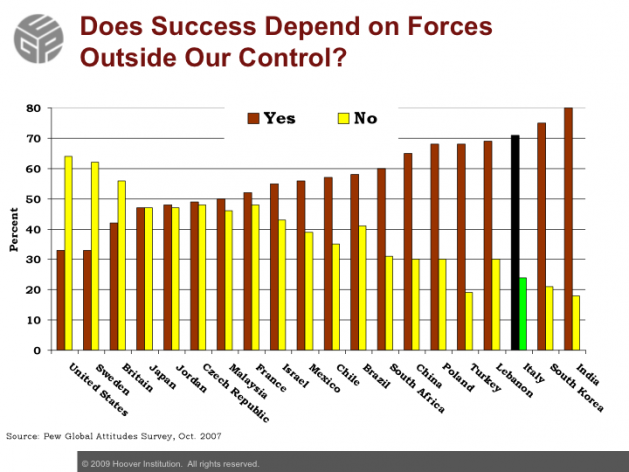
Antonio Cangiano wrote a post a while back about why Italy doesn't do enough startups (http://programmingzen.com/2011/11/10/the-real-reason-italy-s...). In that post, he has a chart (http://programmingzen.com/wp-content/uploads/2011/11/does-su...) that shows that Americans, more that the citizens of any other country, believe that their success or failure is a direct result of their own actions. This is a blessing and a curse, as it means that Americans are willing to work harder to get what they want, but they are also willing to believe when a politician says that there's no need for universal health care or help getting people jobs because "anyone who wants it enough can work harder and get it for themselves".
Regardless, I would argue that this is America's defining cultural strength.
I recently moved to Turkey. Turkey has "hospitality" as its defining cultural strength. If you go to a little shop and look around for more than 10-15 min, you can expect to be offered a drink (free of charge, of course). When I go to the bakery, the woman who works there frequently slips me a cookie or pastry after I've already paid. Most of the malls in Turkey have systems in place that tell you exactly where there is an open parking spot so you don't have to spend 15 min driving back-and-forth.
In America, people celebrate blog posts about pricing tricks that will convince customers to part with a few extra cents. In Turkey, cab drivers regularly round fares down to the nearest lira (well, assuming you aren't a tourist in Istanbul, which is a whole different issue). Now, you could do extensive studies to show that hospitality leads to customer loyalty over the long term, and greater profits blah blah blah...but Turks don't need that. Hospitality is second nature, and my anecdotal experience is that it makes for a generally happier populace, even when all the objective metrics indicate that Turks should feel worse-off than Americans.
What really strikes me, though, is that I have experienced Turkish-like hospitality from one company in the US: Apple. So, now you have every MBA student in America racking their heads trying to figure out what Apple has done to become the most valuable company in the world, where if they had only spent a couple of years living in Turkey they might already have their answer...
Could you explain this? Because I haven't ever gotten a free iPhone for browsing in the Apple Store for ten minutes.
[1] for example, did the mass immigration of millions of unskilled immigrants without high school educations contribute to income inequality? And is bankrupt France really a country to emulate, or should we cast our eyes to the Pacific Rim?
Yes, it really is. Its people are happier, healthier, and better educated; they work less, eat better and have better relationships with their families. And are substantially less indebted than those of the US.
http://en.wikipedia.org/wiki/List_of_countries_by_public_deb...
France's debt to GDP ratio is ~86-89%. The United States is 102%. Now the US is surely going to crash, and crash hard, but emulating France is not going to get us out of a debt crash. Quite the contrary.
  1) "France's debt crisis could doom the European Union"
  http://www.csmonitor.com/Business/The-Daily-Reckoning/2012/0724/France-s-debt-crisis-could-doom-the-European-Union

  2) "France to tackle crushing debt, says French PM Ayrault"
  http://www.bbc.co.uk/news/world-europe-18693089

  3) "Investors Won't Like The News Out Of Greece And France"
  http://seekingalpha.com/article/571001-investors-won-t-like-the-news-out-of-greece-and-france
DISCLAIMER: I'm writing this based in a view of "average" America. HN readers are most likely far from the average. It's a view shared by many younger (<35) people I talk to.
TL;DR: European views US as being backwards, socially underdeveloped. Geared for the rich. But with great TV, films and software companies. And the "average" American is 55, Obese, and thinks that Paris is a short stroll from the center of London (that might tainted be because I lived near Stratford-upon-Avon, which is a honey pot for dumb but wealthy Boomers on their first trip outside of the US).
I'm British, moved to The Netherlands at 26 (I'm now 32). I've travelled all over the world, US (see below), Scandinavia, most of Europe, Africa and Asia.
My perception of the US is that it's like a big company: they've been the boss for so long that they have forgotten to improve. Sure, in the 1960s they were the best at everything. Only the world has moved on, and in reality they're quickly turning into a dinosaur.
From what I've seen of Americans, their ideas are stuck very much in the 1900s. They're hierarchical, the system is tailored to the factory owners.
The lower class have been conditioned to think that faux sweat-shop working conditions (40+ hour working weeks) are a good thing. They don't have vacations. They can be sacked pretty much at will. Healthcare is fubar. There's a complete lack of empathy and realism. Which is strange from a land which claims to be "Christian".
The Americans I speak to seem to fall into two groups: those brainwashed into believing that if they work themselves to death they'll "get rich", or those who're just plain religious lunatics who've thus been conditioned to "suffer" for their "faith".
The only two areas where I see the US leading are in Computing and Entertainment; and this is more a function of the US speaking one language than it is anything inherent in the attitude or politics.
Now for something completely anecdotal:
I live in the Netherlands. I have a nice house. It's smaller than the American norm, but our land is smaller. It's better built (brick instead of wood).
I have a good job, earn a good salary (3x norm). In the US I'd earn three to five times as much - but that's more a function of the market than society (higher demand in US). I work a 38 hour week, and have 25 days holiday (+ 6-8 public holidays).
My health insurance costs $150/month, and isn't connected to my employer.
My employer can't just sack me. If I were to become unemployed, I'd get enough in welfare to live comfortably. If I'm injured, and unable to work, then I receive 70% of my salary plus the state benefits (which include the healthcare).
I pay lots of tax: 40% of my salary, 21% on anything I buy (except for cars, they have a 40% tax-rate, and food which is 6%), 70% of the cost of my fuel, and $100/month car tax. $100/month in local government fees. I can claw back $300 of tax a month on mortgage interest - it'd be much more if I'd have bought a bigger place (didn't seem wise at the time, we bought in 2007, at the peak).
I had a decent education in the UK, but I'm an outlier: because I got severally bullied (my parents were religious, evangelical Christians, and the UK's main religion is a Atheism) I missed my last year of Highschool (still score in the top 10% of the exams, top 5% in the STEM) and have educated myself to University-level via the Open University (and it helps having a decent IQ ~146 in the Mensa test, for what it's worth). I speak fluent Dutch (one of the harder languages to learn. Oh, and I still have an inferiority complex because I can't help but compare myself to the brilliant people here, and I aspire to top my field :)
My wife had a fantastic education in the Netherlands, and - together with all other people in her field - is better qualified than any American (she's a Pharmacist, in the Netherlands they're as well educated as medical doctors; pharmaceutical decisions are made by the specialists here, not just by the doctors).
I can go into town, to a coffee shop, and smoke a joint. I won't be arrested. I won't do it. But if I drive 50 miles to the East I would be (European insanity).
I have choice of cable/ASDL providers. Almost everyone here has >10mb/s internet. I have choice out of lots of mobile providers. Only if I travel 50 miles to the East, 100 miles to the South or 200 miles to the West it gets expensive (because the idea of the United States of Europe has failed in the face of capitalism).
I can cycle to work. Or to town. Without going on the roads, because there are cycle tracks everywhere. Lots of people do. But I'm too out of shape to do it. I probably should, because I'm overweight.
* I've been to Florida & NYC; they were like two different countries.
* Florida (1995) was a shit hole full of rude and ignorant people with plastic smiles. The officials at the airport were assholes, they treated the black and Asian foreigners like dirt. The people who weren't being assholes were all astonished to hear my British accent, they loved how quaint and foreign it sounded, "just like Monty Python" and "just like the Beatles" apparently (I sound nothing like either).
* NYC (2008) is fantasic. The people were friendly, they didn't patronise you. The police were friendly and helpful. The people at the Airport were great - nicer than they are in London Heathrow. That was the biggest surprise of all, and says the most about New York.
I totally agree with your sentiment and let me play something out on the flip-side that I noticed about British life...
British people are brought up in a society that teaches them average is always OK and that life has dealt it's cards, so just deal with it. I know this is a sweeping generalization, and isn't how everyone in Great Britain operates, but this has been my general understanding of the motivation culture in this fine country. I've had this discussion with many people, either foreign or not, and they tend to believe this is a result of being in a class-system for hundreds of years.
You see, America was built and is comprised largely of the most motivated people on the planet. They (we) came to find the country because they wanted something better. Does the American Dream still exist? Of course it does, because it's an idea and will only die if we tell the idea to die. America is NOT for everyone. As you've outlined, not EVERYONE wants to live like that. I enjoy the same comforts as you, but I believe if I have the same superior means and the intelligence a you, I can earn vastly more money in the US and live vastly more comfortable. Does that mean I necessarily want that life? Not really, it's just that America provides and culturally accepts that plausibility of it, regardless of whether it's truly a reality.
This is probably going to be a radical statement - but I really wish the poor people of America had the ability to leave the country. They are really the only ones who complain about America not being suitable and backwards. If you're rich in America, there's little to complain about and life is good. What this would do is force the rich to provide better support to the poor, because without the poor the rich won't exist and we'd have a much bigger middle class (which is something that has made America so strong).
That's a good observation about the British. They're also really pessimistic (Americans are broadly positive). And, unfortunately, they're very small minded (polar opposite of Americans). That's the result of being a fallen Empire, I guess.
I like the Dutch: they're stubborn and everyone has an opinion on everything BUT they respect that. Heck, it's expected. That's something they have in common with Americans (very direct and opinionated). They have a similar background (America was colonized by various Christian sects, The Netherlands was the central hub of lots of sects because it was the only place they managed to live together without killing each other). Yet they're pragmatic, and largely class-less. Same as the Scandinavians. They also share the same 19th century ideas over work as the Yanks (>40h weeks, retire at 67), only they have holidays. Protestant work ethic at work.
BTW, I would recommend spending some time living in a foreign country - as a native (INTEGRATING, not moving to Spain to live with a load of rich British ex-pats) to anyone reading. It really opens your mind, and changes the way you think about yourself (and the world as a whole). Even better if you can combine it with learning another language.
Could you explain this statement? If you mean to imply that the rich somehow exploit the poor, the reality is exactly the other way around - the poor and middle class exploit the rich.
http://gregmankiw.blogspot.com/2012/07/progressivity-of-taxe...
To quote Paul Krugman on the topic (he was discussing the 1980's, but none of the facts he relies on have changed significantly since then).
"...growth in inequality is not a simple picture. Old-line leftists, if there are any left, would like to make it a single story--the rich becoming richer by exploiting the poor. But that's just not a reasonable picture of America in the 1980s. For one thing, most of our very poor don't work, which makes it hard to exploit them. For another, the poor had so little to start with that the dollar value of the gains of the rich dwarfs that of the losses of the poor..."
The Age of Diminished Expectations, 1990, p. 22.
Also, the US has more progressive taxation than the rest of the OECD.
http://taxfoundation.org/blog/no-country-leans-upper-income-...
What? The last census (2001, since 2011 results are pending) put Christianity at 72% and "no religion" at 15%. Surveys in 2011 by other groups put Christianity consistently above 60%. Considering the UK has an official state religion, a monarchy and unelected bishops in political office.. I can't see how anyone can claim the UK is "atheist".
BUT, I do think the number of religious extremists is lower. (I haven't lived in the UK though).
It's like when I hear people here (I live in the Netherlands) that they are not a religious country. The fact that they have several political parties with Christian root (and still being actively referring to them) among other things tell me otherwise ...
Probably it's all more related to the idea of America as a country of free and innovative thinkers. Compared to Germany, where the definition of progress is a carefully hedged illusion of marginal improvement based on immovable foundations, the US still seems like a country where big ideas can be generated and accepted into society. When I'm over there, I also generally get the feeling people tend to be a bit more friendly and cooperative in the Staates.
Nah, just pick the right location. The USA has 300M people. A good number of them are scientifically minded atheists.
If I could change one thing about the US, this would be high on the list. In order to have meaningful access to quality health care, you must have insurance, and for most people the only way to get good insurance is through your job. If you have a job.
Don't lose your job, because if you get sick society is quite happy for you to dry up and rot.
To 'make America great' would require a deep cultural understanding of Americans and how American culture both helps and hinders them. It would then require solutions tailored to American culture - or if no culturally-compatible solution could be found, a plan to alter the culture before implementing the solution, fully appreciating that by altering the culture we may weaken some of America's real strengths.
This isn't easy at all to do and get right - which is why our default stance should be 'unless there's a really, really compelling reason to change things, don't tinker with it.' The Constitution's checks and balances are in place to enforce this stance, so people like the author can't rashly tinker with things on the strength of a single election, and cause more problems than they fix.
I've spent most of my adult life outside of the US, after having spent my childhood and university in Florida. Now, when I travel in the States, I see a _lot_ of good everywhere I go, but it's undeniable that other countries are doing certain things better (I'd argue that nobody has it all together, though Singapore comes mighty close in my book).
This is actually a great thing for the US in many ways -- we've spent almost a century in the lead, having to figure out what works through trial and error. Now the entire world is participating in this trial and error, and we are (in theory, if we're willing to be a bit humble and admit we don't know it all) able to benefit from the discoveries made without paying for the trials.
There will probably never be a repeat of the 1950s, where the United States dominated the world in almost every category, but ... who cares? The 1950s sucked in a lot of ways for a lot of people, most Americans included. That doesn't mean we can't maintain parity, and exceed in certain areas in which we've made priorities.
The entire world has been "participating" for centuries, long before the US even existed.
You may have picked up on that in your life outside the US.
The US was indeed exceptional for most of this time. It's not anymore, but it's more because the rest of the world caught up, not so much because the US stopped (although resting on laurels has certainly slowed it down).
There will probably never be a repeat of the 1950s, where the rest of the developed world was mostly bombed to smithereens and working hard to rebuild themselves.
There are those that espouse the views of the author, where privileges are derived from a central government composed of only the most intelligent and gifted members of society. The means of production are centrally controlled and wealth is distributed by whatever means dictated by the core elite.
And then there are those that want to live free. Those that believe that rights come from nature and from god, and that government cannot create rights, only take them away.
These two ideas cannot coexist in one nation. America has survived with both so far because of our size. But soon the division will be too great and we will hopefully go our separate ways. We tried once before.
Not "exceptionalism is a myth" but "exceptionalism needs a new paint job". This is what passes for dissent in mainstream American discourse.
Or even desirable.
There are many more socio-political interest stories on HN than there used to and the rhetoric in the comments sections tends to be poor.
as for the level of rhetoric in this comment section, I think it is high, and contains many interesting points to consider.