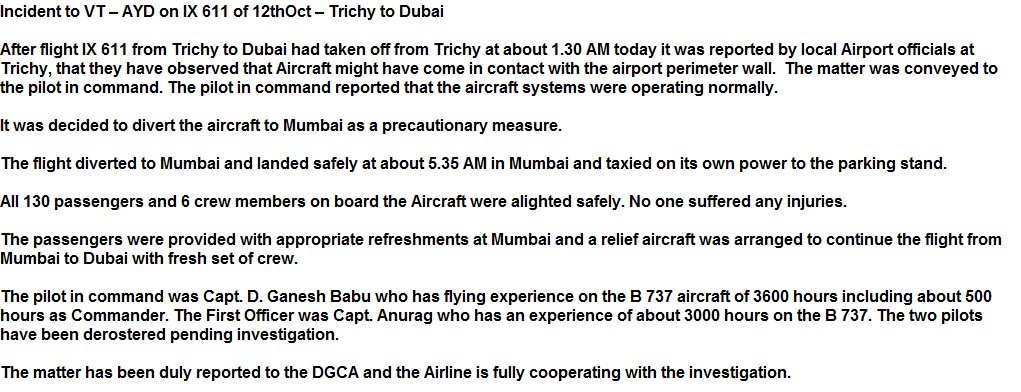
https://twitter.com/shukla_tarun/status/1050595274869993474
Looks quite severe.
I'm impressed the plane flew for 3 hours without getting destablized and crashing....
Air India has the worst safety reputation in India, and several accidents / incidents. I flew Spice Jet a few times over the last few weeks when I was there visiting. Spice Jet is like India's Virgin America. Service was excellent and I did not experience any issues while flying.
In 4hrs, they could have landed in Dubai itself easily
Being Indian, I agree with statement about AirIndia. I would never fly in AirIndia even if the ticket price is too low, laughably they usually cost way above than any other competitors.
Since I have flown with Air India, would you mind being more specific? Are the statistics? My flights were okay. Okay, zero status miles credited at Star Alliance and a bit stingy with alcohol on board. But food and service was good, plane looked well maintained.
Please tell me more.
What is the mysterious ILS that was hit?
Even after reading the Wikipedia article, I only have a vague idea - seems to be a radar system, both on ground and in the air. Did the plane hit a radar tower?
The ground portion of an ILS consists of two antenna arrays, one at the end of the runway called the localizer, and one just off to the side called the glideslope. These arrays produce two fan-shaped signals that vary left-to-right and up-and-down in such a way that an aircraft can determine its location relative to the runway with remarkable precision. The localizer signal provides lateral guidance to the runway centerline, while the glideslope provides vertical guidance down to the touchdown zone, usually on a 3° glidepath. One or both of these arrays is what this airplane ran into.
The system is passive, in that the signals are simply broadcast from the ground continuously, aren’t unique to a particular aircraft, and there is no return or response from aircraft. The ground antennas simply “shout into the void” as it were, and aircraft receivers determine their location based purely on the shape of the signals at the aircraft’s location in space.
For illustration here is a localizer antenna (though note that the airplane in this picture is “backwards,” i.e. the localizer for a given runway is at the far end of the runway, though it is possible to “fly the backcourse” and land with one at the near end): https://image.slidesharecdn.com/instrumentlandingsystemils-1...
And here is a glideslope antenna: https://i.pinimg.com/originals/8f/56/b3/8f56b3b52fb9b81c84f7...
Here's a good one: https://youtu.be/FeELh0kMSIA
How many articles posted here on HN tell you what a CPU is? Or a pointer? Or a container? And that's just to pick a few common terms. News about a certain topic will build on the assumption that the basic concepts related to it are already known to the reader.
The situation in the article can be very well explained in layman's terms. Most people know enough of the ground-world and air-world to understand how things hit and what's important about hits.
However, the article uses an overly specific term, and on top of that, it overloads it with a meaning which is not the one found in literature. Notice that Wikipedia's diagram of "ILS" shows it as an airport-sized system made of several components, none of which is called "ILS".
https://en.wikipedia.org/wiki/File:ILS_diagramsimplified.png
This doesn't make understanding possible, unless you know what "ILS" means in the lingo.
In IT terms, this is akin to saying "A sysadmin tripped over a CISC and fell". To someone familiar to the terms, this translates to "someone tripped over a silicon chip with a CPU, most likely an Intel".
Meanwhile, a layman would look up "CISC" on Wikipedia and be confused about whether someone trippped over a computer box, an instruction set, or a processor. All of this is confusing and irrelevant to the point, which can be understood by anyone: someone tripped over a few cm wide piece of silicon.
Back to the aviation article: "A plane hit a few meter high tower housing an ILS antenna." conveys all the information, but doesn't leave anyone in the cold.
I stand by my initial complaint: any speech that obscures the actual topic behind lingo available only to a small group of people should stay in that small group or improve.
It's all speculation at this point.
Usually there ought to be more than one locking mechanism involved, though..?
https://generalaviationnews.com/2018/03/16/failure-secure-se...
https://generalaviationnews.com/2016/10/18/seat-sliding-back...
Those passengers just won the lottery.
That said, I'm not sure I am on board with the explanation. It could just be that with everything going on in a cockpit it wasn't noticed.
The cargo area of most airliners is not pressurized, so the gash is not an immediate problem.
In a case like this, the pilots would want to climb to several thousand feet and evaluate the situation before landing.
Looks like the pilot did a great job once it was realized the airplane was damaged of remaining calm and flying the airplane.
I'm not a pilot, but I'm 100% sure V1 means you can't safely abort the takeoff, _not_ that you're committed to the remainder of the flight.
Also, the ILS is at the end of the runway, they were surely airborne by this point (i.e. past V2), so I'm not sure why you even brought up V1 in this discussion.
In fact, I can't imagine being so low at the end of the runway. At somewhere like Midway (MDW), you'd almost certainly hit a house, at the very very least the perimeter fence.
> In a case like this, the pilots would want to climb to several thousand feet and evaluate the situation before landing.
I'm fairly certain that in an emergency situation you don't "evaluate the situation". Short of actually being unable to fly, you have to take off after V1. If there is any issue whatsoever, you alert the tower and begin to come around to do an emergency landing using "normal" emergency procedures.
The accelerate stop distance is the distance it takes to accelerate to V1, reject the takeoff, and stop the aircraft. V1 is in KIAS (knots of indicated airspeed). ASD is in feet/meters.
You are correct that passing V1, the aircraft is committed to fly unless an emergency relating to controllability surfaces.
FO: Tower said we hit something, may have damage. Capt: Just close, we'll be okay. FA: We heard a thump, and so did the passengers. CA: Just a noise, we'll be okay. Dispatch on ACARS: You hit the localizer and wall past the far end, you morons. Descend, lower your cabin diff pressure, and GTF to Mumbai. CA: How do we explain this? FO: Ask the passengers for newspapes, we must find new jobs..
Given the apparent structural damage, that was a risky decision.
I don't see how this could happen without the pilots noticing; they would have been skimming the ground well past the end of the runway.
[0] https://www.google.com/maps/place/Tiruchirapalli+Internation...
[1] https://twitter.com/shukla_tarun/status/1050581391828836352
I'm even more surprised that the plane could land on its own wheels despite the huge gash in the fuselage. Do landing gears retract so quickly, or was the wall simply not wide enough?
Airliners have enough power to lose an engine at a decision speed (V1) while still on the runway and on the one remaining engine continue to accelerate on the runway to rotation and eventually liftoff speed and still clear obstacles. There is no mention of an engine loss causing this issue (and surely the airplane wouldn't launch for FL360 with one engine INOP), so this almost has to be a mis-set takeoff thrust accident as, with both engines set for proper takeoff thrust, it's rare to use more than 2/3 of the runway and the initial climb is brisk due to the large excess of power a turbojet engine has at sea level.
I also think the wall is lower than the ILS gear, so probably that is what made the gash in the belly of the plane. Amazed that nothing serious was cut.
I cannot believe the pilots were completely unaware, I mean just reaching the end of the runway without having pulled up must be a never-in-your-career kind of scary moment.
From my limited experience of pilots, this seems entirely unlike the kind of behaviour you'd expect - they're usually conservative when it comes to safety or is that just the projected image to reassure the public?!
Also, more automated, single-pilot/ground operated or pilotless aircraft can’t come soon enough.
including Hong Kong?
When using anecdotal data one just can't make sweeping judgements and conclusions data does not support, that takes discussion into the region of prejudice and bigotry.
This anecdotal one person usually 'an insider' finding one thing wrong or incident in some country and casually conflating it to the whole is seen too often and creates grossly inaccurate stereotypes, when the exact same issue or incident exists everywhere else.
This is not harmless and derails informed discussion. It creates prejudice and in this case stress among travelers when they travel to other countries thinking about 'training, hull loss, safety' based on uninformed discussion not supported by data on the ground. If you are going to travel in a Cessna the standards including pilot training is not comparable to jets whichever country you are in. But no stable functioning country in the world takes passenger and running jets casually as the accident and safety data shows.
1. https://www.independent.co.uk/news/world/america-russia-and-...
2. https://en.wikipedia.org/wiki/Pilot_error#Notable_examples
This does not seem like normal behavior from an airline pilot at all. I can see about 10% of private pilots doing something like this. It would probably be someone who has been flying a long time and gotten way too comfortable. Things always work out, so why not this time? The difference with an airline is its incredibly public flying. Even if the pilots disregard everyone’s safety (including their own) they know that they’ll be caught. You do something dumb and it’s going to be on the news, even if it all works out. How many of us can say that about or jobs?
The fact that the crew thought that this was a risk worth taking reflects really poorly on the safety culture of that airline. They thought that flying an airplane that was compromised some unknown amount was worth keeping the schedule going (or maybe people just wouldn’t find out?). That idea got informed somehow.
... by their desire to overwrite the CVR??
Obviously the plane had issues getting off the ground. Probably because it was too heavy. Typically, pilots calculate a speed beyond which they can no longer safely abort the takeoff. Beyond that speed, the plane is basically going to fly or shoot off the runway and crash. That point is decided based on weight, wind, runway length, etc. It's entirely possible mistakes were made with that or with loading the plane. Maybe there was some wind shear as well, which could explain a sudden drop or unexpected challenges getting off the ground.
Usually the co-pilot's job is to call these speeds out and if either of them calls to abort, there is supposed to be no discussion or debate on this and pilots are trained to act right away because every second counts. Obviously that did not happen
So, the pilots were not aware of issues before the abort speed (or they should have aborted) and committed to getting off the ground. I'm sure the in cockpit recordings will be part of the investigation. They sort of succeeded in the sense that they hit some objects but ultimately did not crash and got off the ground. Their climb rate must have been terrible. Usually the gear comes up as soon as you have a positive rate of climb (reduces drag). I imagine they called gear up seconds after leaving the ground before they hit anything even and the gear was likely transitioning.
Wind shear could have caused enough change in airspeed to cause the plane to not climb or even descend a bit. A heavy plane would have used up most of the runway in any case.
They then proceeded with what looks like normal procedure to get to altitude. Presumably they would have almost climbed out and changed frequencies from tower to local traffic controllers after 20-30 seconds or so. Recordings of that are going to be interesting. Presumably the damage to the ILS equipment would not have been noticed right away on the ground and people would have needed some time to figure out what the hell happened and what caused it and what plane hit it. Likewise the damage to the wall would not have been reported right away. By then the plane would have transitioned out of their area.
The question is whether the pilots noticed that they hit any objects and what the communication was with these controllers on this. The plane would have been pitched up (restricts visibility to the ground in front of you) and the damage occurred pretty far behind the pilots. So they may not have seen the obstacles immediately in front of them or heard/felt hitting them. These planes are big and heavy and there's lots of noise and vibrations when a plane takes off.
The damage looks dramatic but you wouldn't be able to see it until after the landing. Obviously the plane was flying and climbing and cruising normally. And they also landed safely. So flight operations seem to not have been directly affected. So, I can see them concluding that they had a stressful takeoff but had gotten in the air successfully. Then some time later they got the news that they hit some obstacles and that there is probably damage to the plane.
The big question is why that took 3 hours. I imagine it involved a lot of communication on the ground.
As some of the others have mentioned, the reason the plane survived is likely because that was not a pressurised area. If it had breached the pressure vessel they would've noticed it very quickly (lack of pressurisation).
https://www.bbc.com/news/world-us-canada-43818752
and one of the most famous incidents (in the U.S.)
https://en.wikipedia.org/wiki/Aloha_Airlines_Flight_243
Both were from fatigue, but fatigue doesn't have to be a gradual thing; it could come from a single hit that causes the pressure vessel to fail at altitude.
See the whole list here
https://en.wikipedia.org/wiki/Uncontrolled_decompression#Not...
Edit: clarify, typo
i could not find a reference but i remember an incident where an aircraft only scraped its backend on take off and repairs were made, but years later the aircraft was lost with everyone on board after cracks propagated up and around and the aircraft lost its whole tale section
There's no reason the aircraft can't be properly repaired, and be as strong as it was when it was delivered. The Boeing Structural Repair Manual is very precise. It was just ignored.
22 years later!
Worst single-aircraft disaster in history.
I thought that on airliners pilots input runway length, altitude and wind strength and direction, and the computer optimized the thrust accordingly?
https://www.flightglobal.com/news/articles/temperature-error...
The various flight trackers all use thousands of receivers around the world, and most of them probably use the same kind of SDR chip that was originally designed for USB TV and radio receivers.
I wonder if anyone says, “I won’t be there Gus if it isn’t an Airbus”.
Also, the airport wasn't good anymore. They had just destroyed the Instrument Landing System at the end of the runway. Nobody should land there.
Usually in times of partial emergencies, there is a threshold point where you full own the emergency and declare it.
https://ichef.bbci.co.uk/news/624/cpsprodpb/C99D/production/...
Airport perimeter damage: https://mobile.twitter.com/ANI/status/1050582092688629760
As far as I can tell this wasn't unusually close to the runway, the plane just stayed on the ground far past the end of the runway.